
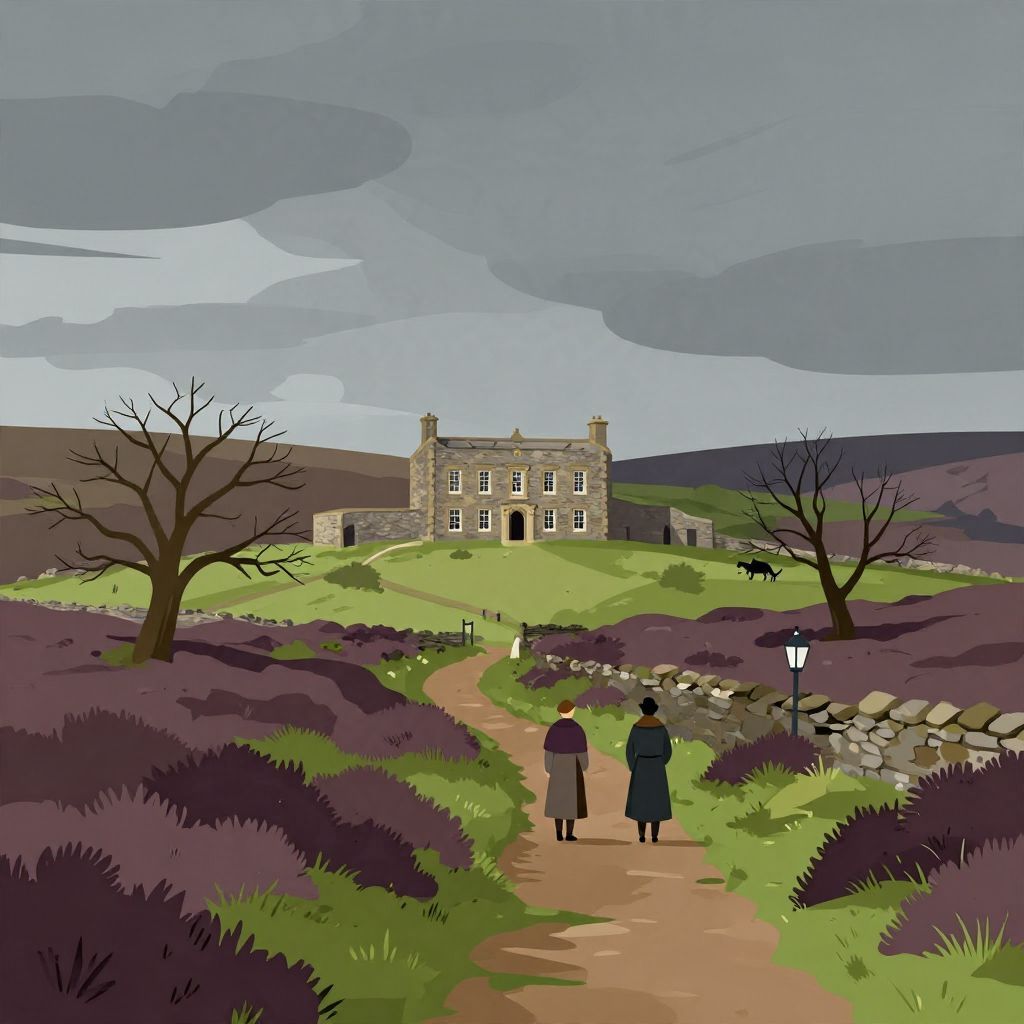
When does Wuthering Heights take place? Emily Brontë’s novel is set mainly in the late 18th and early 19th centuries, with the central action beginning around the 1770s and continuing into the 1800s. Because the book uses a framed, retrospective structure, the exact dates are not always stated outright, but the story clearly spans several decades.
That long time span matters: the novel is not just a Gothic love story, but also a portrait of changing English society, inheritance, class, and family life across generations. Understanding its historical setting helps explain the characters’ behavior, the property disputes, and the world in which the Earnshaws and Lintons live.
When does Wuthering Heights take place?
Wuthering Heights is set in late 18th-century and early 19th-century Yorkshire, roughly from the 1770s through the 1800s, with the outer frame of the novel extending into the 1800s and beyond. Emily Brontë never gives a single exact year for the whole story, but the social world, references to age, inheritance, and historical context point to that period.
The novel’s timeline: a story told across generations
The easiest way to place the novel historically is to separate its two layers: the frame narrative and the main family history. The outer story begins when Mr. Lockwood arrives at Thrushcross Grange in the 1800s, while the inner story reaches back to the childhood of Catherine Earnshaw and Heathcliff decades earlier. The result is a multi-generational narrative rather than a single-year setting.
The frame narrative
Lockwood’s visit to the Heights and the Grange belongs to the early 19th century, likely the 1800s or 1810s. He is a tenant at the Grange, and the adult Heathcliff is already in control of Wuthering Heights. By this point, the earlier conflicts have already played out, and the novel unfolds as a recollection of past events.
The main historical action
The central events begin in the 1770s, when Mr. Earnshaw brings Heathcliff home as a child. Catherine and Hindley are also children at this stage. The story then moves forward through Catherine’s adolescence, her marriage to Edgar Linton, Heathcliff’s return after an absence, and the next generation’s struggles. This means the novel covers roughly 30 to 40 years of history.
Why historians and readers place it in the late 1700s and early 1800s
The novel does not announce its dates in the way a historical chronicle would, but several clues place it securely in this period. The social structure, the emphasis on landed property, the legal importance of inheritance, and the rural Yorkshire setting all fit late Georgian and early Regency England. Brontë writes about a world before railways transformed travel and communication.
Clues from social and legal life
Inheritance is one of the strongest historical markers in the novel. Property passes through family lines, widows and children are vulnerable, and marriage is closely tied to land and status. These concerns reflect the legal and social realities of 18th- and early 19th-century England, when estates shaped power and family strategy.
The novel also assumes a society in which class boundaries are rigid. Catherine’s choice between Heathcliff and Edgar is not only emotional but social: Heathcliff’s uncertain origins make him unacceptable as a husband for a woman expected to preserve status and property. That tension is deeply rooted in the period’s class culture.
Clues from daily life and material culture
The homes, travel, and communication in the novel also point to an earlier era. Characters move by horse, visit by carriage, and depend on local roads and nearby estates. There are no references to industrial rail travel or the urban expansion that would dominate later Victorian fiction. The landscape feels pre-industrial, even though the novel was published in 1847.
How the setting shapes the novel’s meaning
The historical setting is not just background. It shapes the novel’s central conflicts. In an age when property and lineage mattered enormously, the struggle over Wuthering Heights and Thrushcross Grange becomes a struggle over identity, legitimacy, and belonging. The setting helps explain why private passions have such public consequences.
Property and inheritance
Much of the novel turns on who owns what and who can legally pass property to the next generation. Heathcliff’s rise is inseparable from land ownership, and his revenge depends on exploiting the inheritance system. In this sense, the novel reflects a world in which land is wealth, power, and social authority all at once.
Marriage as a social institution
Marriage in the novel is not simply romantic. It is a legal and economic arrangement that can preserve or destroy family fortunes. Catherine’s marriage to Edgar Linton is influenced by status and security, while Isabella’s marriage to Heathcliff shows the dangers of treating marriage as a social alliance without understanding the person involved. These concerns were common in the period Brontë depicts.
Isolation and the Yorkshire landscape
The remote moorland setting matters historically as well as symbolically. Rural Yorkshire in the late 18th century could be isolated, harsh, and shaped by local custom. The moors in the novel are not decorative scenery; they reflect the roughness of life, the limits of society, and the emotional intensity of the characters. The landscape helps create the Gothic atmosphere that defines the book.
Is Wuthering Heights a historical novel?
Not exactly. Wuthering Heights is usually classified as a Gothic novel, not a historical novel. Emily Brontë was writing in the mid-19th century about an earlier period, but she was not trying to reconstruct history in the detailed, documentary sense. Instead, she used an earlier setting to explore timeless themes of obsession, class, revenge, and family trauma.
Published in 1847, set earlier
The novel was published in 1847, during the Victorian era, but its main action takes place before that. This distance between publication date and setting is important. Brontë’s readers would have recognized the story as belonging to an earlier England, even if the novel does not pause to explain historical events in the wider world.
Why the date is intentionally vague
Brontë’s vagueness is part of the novel’s power. By avoiding exact dates, she creates a story that feels both historically grounded and strangely timeless. The absence of precise chronology allows the emotional and psychological drama to dominate. Still, the evidence strongly supports a setting in the late 1700s and early 1800s.
A simple chronology of the novel’s historical setting
For readers who want the timeline in order, the novel’s historical movement can be summarized like this:
- c. 1770s: Mr. Earnshaw brings Heathcliff to Wuthering Heights as a child.
- 1770s–1780s: Catherine, Hindley, and Heathcliff grow up together.
- Late 1780s–1790s: Catherine’s relationship with Heathcliff breaks down; she marries Edgar Linton.
- 1790s: Heathcliff disappears and later returns with wealth and status.
- Early 1800s: The next generation becomes central, including young Catherine, Hareton, and Linton Heathcliff.
- By the time Lockwood arrives: the main tragedy has already happened, and the novel is being remembered after the fact.
What the historical setting reveals about the characters
Knowing when Wuthering Heights takes place helps clarify the characters’ choices. Catherine’s conflict is not merely personal; it is shaped by the expectations of her time. Heathcliff’s outsider status matters because birth and legitimacy carry enormous social weight. Hindley’s decline, Edgar’s refinement, and Isabella’s vulnerability all make more sense in the context of this older, hierarchical society.
The novel’s historical placement also explains its emotional harshness. In a world with limited mobility, strong property rules, and few social protections, resentment can harden over years. People cannot simply start over. That sense of confinement is one reason the novel feels so intense and so bleak.
So, when exactly is it set?
If you want the shortest accurate answer, Wuthering Heights is set mainly in late 18th-century Yorkshire, beginning around the 1770s and extending into the early 19th century. The novel’s frame narrative comes later than the central events, but the heart of the story belongs to the Georgian-to-Regency transition rather than the Victorian age in which it was published.
That historical placement helps explain the novel’s obsession with inheritance, rank, marriage, and memory. If you are exploring more literary history, you may also want to read about Victorian novel history or the rise of Gothic literature.