
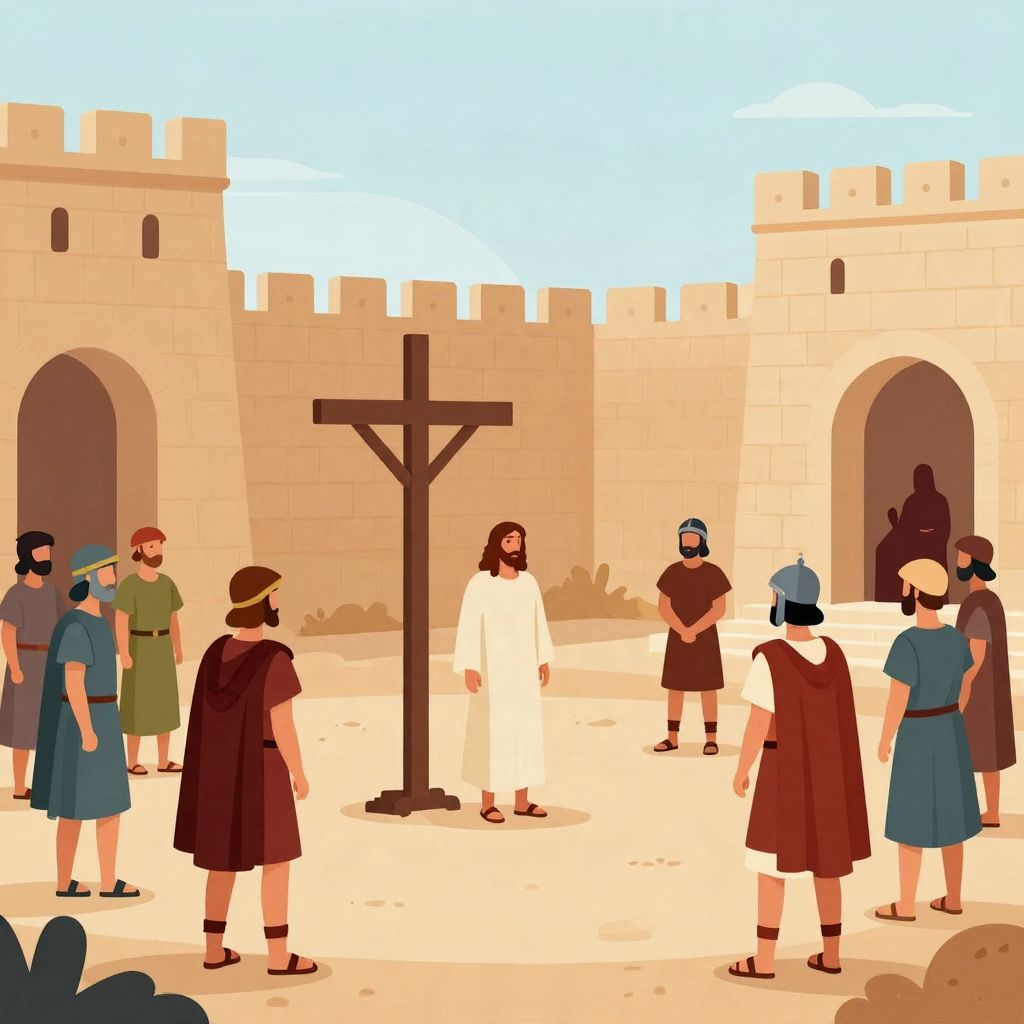
Why did the Romans kill Jesus? The short historical answer is that Roman authorities executed him by crucifixion because they viewed him as a political threat in a tense province, especially during Passover in Jerusalem. The execution was carried out under Roman power, most likely under the prefect Pontius Pilate, though the exact legal process is only partly recoverable from the surviving sources.
To understand the decision, it helps to separate the Roman role from the broader story. Jesus was a Jewish teacher in Roman-ruled Judea, and his arrest and death took place amid local religious tensions, crowd fears, and the empire’s harsh approach to public order.
Why did the Romans kill Jesus?
The Romans likely executed Jesus because they believed he could stir unrest in Jerusalem. Crucifixion was Rome’s punishment for rebels, slaves, and people seen as dangerous to public order. Jesus was not killed for teaching theology in a modern sense, but because Roman officials may have interpreted his movement as a potential challenge to imperial stability.
The Roman province of Judea and the risk of unrest
Judea was a small but volatile province in the eastern Roman Empire. Rome ruled through local elites and governors, but it expected taxes, loyalty, and peace. When unrest threatened order, Roman officials could act quickly and brutally. A public execution was meant to deter anyone else from causing trouble.
Why Jerusalem mattered
Jesus’ death probably occurred in Jerusalem during Passover, a festival that drew large crowds and carried strong memories of liberation from foreign rule. That made the city especially sensitive. Roman governors feared riots, messianic excitement, and any leader who might inspire hopes of Jewish independence.
Why crucifixion was used
Crucifixion was not a private punishment. It was slow, humiliating, and public. Rome used it to display power and warn others. It was commonly reserved for those judged dangerous to the state, especially rebels or people accused of sedition. If Jesus was crucified, the Romans were signaling that they saw him as more than a religious teacher.
What Jesus was accused of
The surviving sources suggest that the central Roman accusation was political: Jesus was presented as a claimant to kingship, or at least as someone whose popularity could be read that way. The title “King of the Jews,” placed above the cross in the Gospel accounts, reflects the charge that mattered to Rome: rivalry with Caesar’s authority.
Messiah, king, and Roman suspicion
In Jewish thought, “messiah” could mean an anointed deliverer or ruler. Roman officials did not need to understand the theology in detail. What mattered was whether a crowd might rally around a figure who seemed to offer an alternative authority. In an occupied province, that was enough to trigger a crackdown.
Was Jesus leading a rebellion?
Most historians do not think Jesus was a military rebel in the ordinary sense. He does not appear to have commanded an army or launched an armed uprising. But Rome did not require a full rebellion before acting. A movement that looked politically charged, especially one with public enthusiasm and apocalyptic expectation, could be treated as dangerous.
Pontius Pilate and Roman decision-making
The Roman governor most associated with Jesus’ execution is Pontius Pilate, who governed Judea roughly from AD 26 to 36. He represented Roman authority in the province and had the power to order executions. The Gospels place Pilate at the center of the trial, while other ancient references confirm that Jesus was executed under his administration.
What the sources say
The main narrative sources are the New Testament Gospels, which were written from Christian perspectives and are not neutral court records. Yet they agree on the key point that Jesus was crucified under Roman authority. The Roman writer Tacitus, writing later, also says Jesus suffered the extreme penalty under Pontius Pilate during the reign of Tiberius.
How much did Pilate personally decide?
Historians cannot reconstruct every step of the legal process. Pilate may have acted on his own judgment, or he may have responded to pressure from local leaders who feared disorder. Either way, the final authority for crucifixion belonged to Rome. The execution was a Roman act, even if local politics helped bring it about.
The role of local Jewish authorities
The question “Why did the Romans kill Jesus?” should not erase the role of some Jewish leaders in the Jerusalem establishment. According to the Gospel accounts, certain priests and council members saw Jesus as disruptive and feared the consequences of his popularity. That does not mean all Jews were responsible; it means a specific local conflict helped shape the arrest.
Why some leaders may have wanted Jesus removed
Jesus taught in ways that challenged established authority, criticized hypocrisy, and attracted crowds. He also acted symbolically in the Temple, which may have been interpreted as provocative. For leaders trying to preserve order under Roman occupation, a public disturbance during Passover could be disastrous.
A political handoff to Rome
Local authorities in Judea did not usually have the power to carry out Roman-style crucifixion. If they wanted Jesus executed, they likely needed Roman approval. That meant framing the issue in a way Rome would understand: not as an internal theological dispute, but as a matter of public security and political risk.
What happened during the arrest and trial?
The exact sequence is debated, but the broad outline is clear. Jesus was arrested, questioned, and then handed over for execution. The Gospel narratives describe hearings before Jewish authorities and then before Pilate. The historical core is that the arrest led to a Roman sentence of crucifixion, probably after a rapid process in a tense political atmosphere.
Why the process was so fast
Roman provincial justice could be swift, especially when officials wanted to prevent unrest. In a festival week with many pilgrims in the city, delay could be dangerous. If Pilate believed Jesus might provoke disturbance, a quick execution would have seemed like the safest option.
The charge on the cross
The inscription associated with Jesus’ cross, “King of the Jews,” is important historically because it points to the Roman understanding of the case. Rome was not merely punishing a preacher; it was punishing someone it associated with royal or political pretension. That is the clearest clue to why crucifixion was chosen.
What historians think today
Most historians agree on several points: Jesus existed, he was active in Roman Judea, he attracted followers, and he was crucified under Pontius Pilate. They also generally agree that the Roman state executed him because his movement could be interpreted as politically threatening. The exact balance between Roman initiative and local pressure remains debated.
Established evidence
- Jesus was crucified in Judea under Roman rule.
- Pontius Pilate was the Roman prefect during the likely time of the execution.
- Crucifixion was a Roman punishment associated with political danger and public deterrence.
- The Jerusalem setting and Passover season increased concern about unrest.
What remains uncertain
- The precise legal charges brought against Jesus.
- How much pressure local leaders exerted on Pilate.
- Whether Pilate acted reluctantly or decisively.
- The exact wording and sequence of the hearings.
Why the Romans cared about one man from Galilee
From a modern perspective, Jesus may seem too small a figure to worry an empire. But Roman governors did not need a large rebellion to act. In an occupied province, a popular teacher who spoke about God’s kingdom, gathered crowds, and entered Jerusalem at a volatile time could appear politically risky. Rome preferred prevention to response.
Public symbolism mattered
Jesus’ actions and message may have carried symbolic force beyond what he intended. References to a coming kingdom, the gathering of followers, and the Temple incident could all be read through a Roman lens as signs of potential disorder. In imperial politics, symbolism could be as dangerous as weapons.
The aftermath of Jesus’ execution
Jesus’ death did not end the movement associated with him. Instead, it became the central event in Christian belief. His followers came to interpret the crucifixion as part of a divine plan and later proclaimed the resurrection. Historically, the execution that Rome intended as a deterrent became the foundation of a new religious movement.
Why the execution mattered so much later
The crucifixion turned Jesus into a martyr-like figure for his followers, even though the term “martyr” developed in later Christian usage. The shameful Roman punishment was reinterpreted as victory. That reversal is one reason the question of why Rome killed Jesus has remained so important for history, theology, and culture.
Conclusion
The Romans killed Jesus because they saw him, or allowed him to be presented, as a threat to public order in a sensitive province. His execution was shaped by Roman imperial power, local fears, and the volatile politics of Jerusalem. Whatever Jesus meant to his followers, Rome treated him as a man whose movement had become dangerous enough to crush. For related context, see who was emperor when Jesus died and what happened to Judas after he betrayed Jesus.