
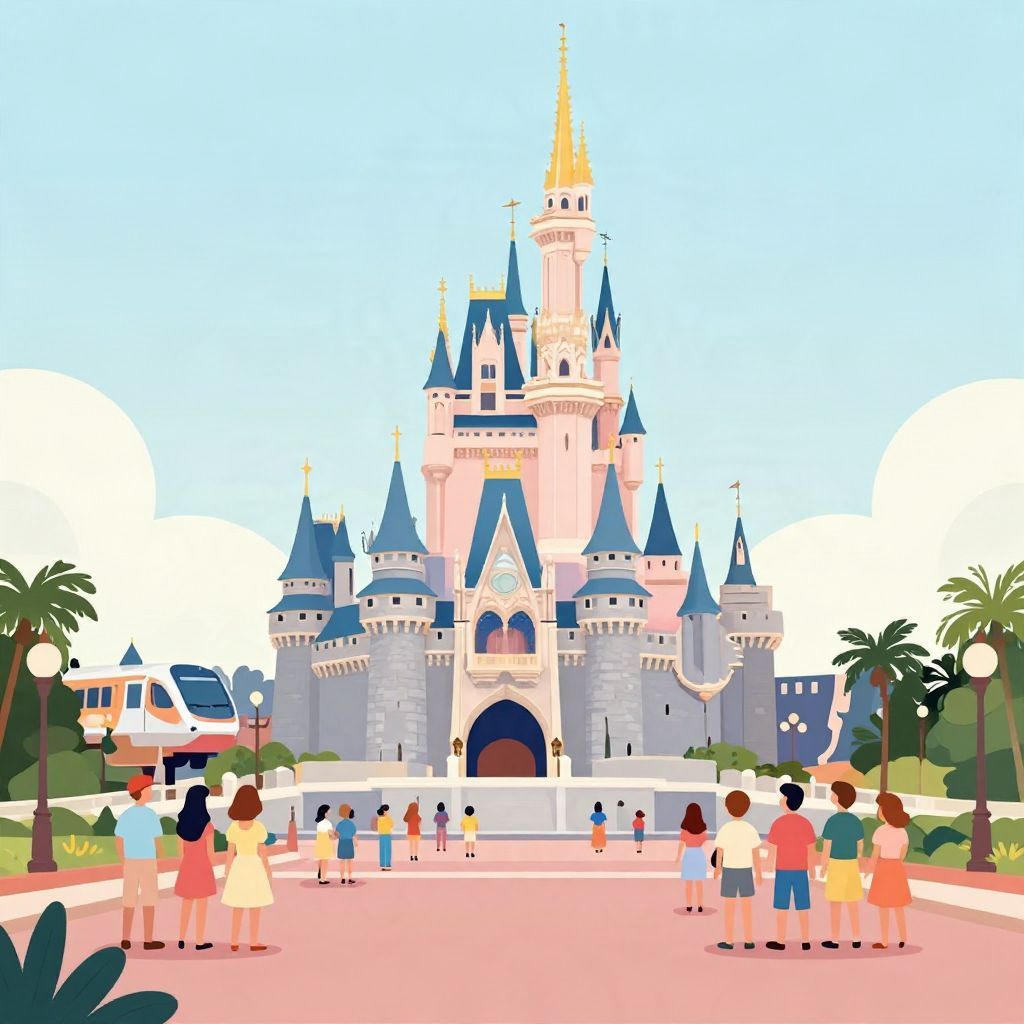
When was Disney World opened? The short answer is that Walt Disney World Resort officially opened on October 1, 1971, in central Florida. That date marked the debut of the first theme park there, Magic Kingdom, along with the resort’s first hotels and much of its early infrastructure.
The opening was the result of years of planning, land acquisition, and construction after Walt Disney’s company chose Florida for a much larger project than Disneyland in California. Disney World was designed not just as an amusement park, but as a vast resort and planned destination city.
When was Disney World opened?
Disney World opened on October 1, 1971. More precisely, that was the opening day of Walt Disney World Resort and its first park, Magic Kingdom, in Bay Lake and Lake Buena Vista, near Orlando, Florida. The resort’s opening introduced a new model for family tourism in the United States: a large-scale, integrated destination built around entertainment, lodging, and carefully managed development.
What opened on that day?
On October 1, 1971, visitors could enter Magic Kingdom, stay at the newly opened Contemporary Resort or Polynesian Village Resort, and experience the early version of the complex that would later expand into a multi-park resort. The opening was not the debut of every Disney World attraction that exists today, but it was the start of the property as a functioning resort.
The first phase of the resort
- Magic Kingdom opened as the first theme park.
- Disney’s Contemporary Resort and Disney’s Polynesian Village Resort welcomed guests.
- The resort’s transportation and infrastructure systems began operating.
- Additional parks and districts came later, over the following decades.
Why was Disney World built in Florida?
Disney chose central Florida for practical and strategic reasons. The region offered large amounts of relatively inexpensive land, a warm climate, and room for expansion far beyond what was possible at Disneyland in Anaheim, California. The company also wanted more control over the land around the resort so it could shape the visitor experience and future development.
Another important factor was scale. Walt Disney had long imagined a bigger, more immersive destination than Disneyland alone could provide. Florida gave the company space to create not just a park, but a resort complex with hotels, transportation links, and long-term development potential.
The role of Walt Disney’s vision
Walt Disney did not live to see the opening; he died in 1966. But the project reflected his late-career ambition to build something larger than a single amusement park. His plans included an experimental urban idea known as EPCOT—originally intended as a real, functioning planned community. After his death, the company redirected that concept into a theme park, but the broader dream of controlled, large-scale development remained central to the Florida project.
The road to the 1971 opening
The opening date was the culmination of a multi-year effort that began in the mid-1960s. Disney’s team quietly purchased land in central Florida through a network of shell companies so prices would not rise sharply before the acquisition was complete. Once the land was secured, the company created a special development structure that allowed it to manage roads, utilities, and zoning-like functions within the resort area.
This level of control was unusual and helped Disney build a self-contained destination. It also meant the resort could be designed with a level of coordination that was rare in American tourism and real estate at the time.
Key milestones before opening
- 1965: Disney’s Florida land purchases became public.
- 1966: Walt Disney died, leaving the project to the company.
- Late 1960s: Construction accelerated on the first park, hotels, and infrastructure.
- October 1, 1971: Walt Disney World officially opened.
How did the opening differ from Disneyland’s debut?
Disneyland opened in 1955 as a single theme park. Disney World, by contrast, opened as the first stage of a resort system. That difference mattered. In Florida, the company was not simply building rides and themed lands; it was creating an entire visitor environment, with hotels, transportation, and space for future parks.
This broader approach changed the economics of theme parks. Guests were encouraged to stay longer, spend more time on property, and experience Disney as a destination rather than a one-day outing. In that sense, the 1971 opening marked a major evolution in American leisure travel.
What was the public reaction?
The opening drew national attention. For many Americans, Disney World symbolized postwar optimism, consumer culture, and the growing popularity of family travel by car and air. The resort’s debut also reflected the rise of Florida as a major tourism region. Central Florida would eventually become one of the most visited destinations in the United States, in large part because of Disney’s presence.
At the same time, the opening was not without criticism. Some observers questioned the scale of the development, its influence on local land use, and the way a private company could shape a large geographic area. Those debates have continued in different forms as the resort expanded.
What happened after 1971?
The 1971 opening was only the beginning. Disney World expanded over time into a much larger complex with new parks, resorts, and entertainment districts. The opening of Epcot in 1982, Disney-MGM Studios in 1989—now Disney’s Hollywood Studios—and Animal Kingdom in 1998 transformed the resort from a single-park destination into one of the largest tourism complexes in the world.
That growth fulfilled the basic logic behind the original project: create a place where visitors would not just attend one attraction, but enter a fully managed vacation environment. The 1971 opening laid the foundation for everything that followed.
Lasting significance
Disney World’s opening mattered beyond entertainment history. It influenced resort planning, family tourism, and the development of large-scale themed environments. It also showed how a company could combine storytelling, architecture, transportation, and land management into a single commercial landscape. In that sense, October 1, 1971, was not just the opening of a park—it was the start of a new model of leisure in modern America.
So, if you are asking when Disney World was opened, the answer is October 1, 1971. That date marks the official beginning of Walt Disney World Resort in Florida, a project shaped by Walt Disney’s vision, completed after his death, and expanded into one of the most influential tourist destinations in the world.