
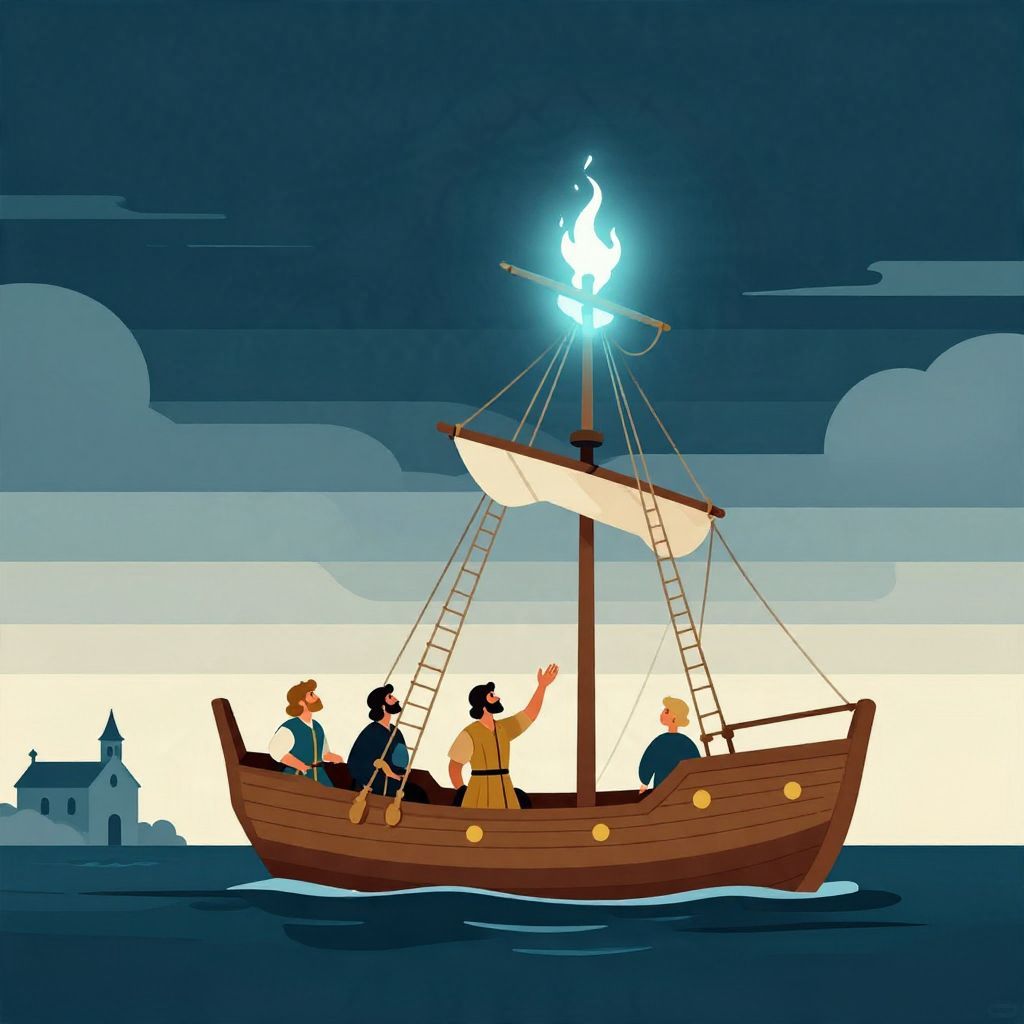
Why is it called St Elmo’s Fire? The short answer is that the name comes from St. Elmo, a Christian saint associated with sailors, and from a long seafaring tradition of interpreting the eerie glow as a sign of divine protection. The phenomenon itself is not supernatural; it is a form of electrical discharge that can appear on ship masts, church spires, and aircraft.
The name reflects how people in the past explained a striking natural event before modern science could explain electricity, weather, and atmospheric charge.
Why is it called St Elmo’s Fire?
It is called St Elmo’s Fire because sailors in the Mediterranean and Atlantic world linked a blue or violet glow on ship rigging to St. Erasmus of Formia, also known as St. Elmo, their patron saint. The name became common in early modern Europe as mariners treated the light as a hopeful omen, especially during storms.
The saint behind the name
“St. Elmo” is a sailors’ form of the name St. Erasmus, a Christian bishop and martyr whose cult spread in late antiquity and the Middle Ages. Over time, sailors in parts of southern Europe associated him with protection at sea, especially during violent weather. The glow seen on masts and spars was therefore interpreted as the saint’s presence rather than a physical process.
Why sailors connected the light to a saint
Life at sea was dangerous. Storms, lightning, and shipwrecks were constant threats, and sailors often relied on religious symbols to make sense of risk. A luminous flame-like glow appearing during a storm seemed extraordinary enough to demand a sacred explanation. In that world, naming the phenomenon after a protective saint made emotional and practical sense.
The historical context: seafaring, fear, and interpretation
Before electricity was understood, unusual lights in the sky or on objects were often read through religion, folklore, and maritime custom. A ship at sea was a place where observation and superstition blended. When a charged atmosphere caused a visible glow, sailors did not have the scientific vocabulary to describe it as plasma or electrical discharge. They had stories, saints, and experience of danger.
A sign of hope rather than a bad omen
In many maritime traditions, St. Elmo’s Fire was considered a good sign. It often appeared when thunderstorms were nearby, and sailors saw it as evidence that the saint was guarding them. Some accounts describe crews greeting it with relief, because the light suggested the storm’s electrical activity was concentrated elsewhere and that lightning might not strike directly.
That interpretation was not scientifically accurate, but it was culturally meaningful. The glow could indeed appear during intense atmospheric conditions, and in a world without meteorology it was natural to connect visible signs with divine intervention.
What the phenomenon actually is
St. Elmo’s Fire is a type of corona discharge. It happens when the electric field around a pointed or elevated object becomes strong enough to ionize the air nearby. The result is a steady glow, usually blue, violet, or pale white, rather than the sudden flash of lightning.
Where it appears
Historically, sailors noticed it most often on:
- ship masts and rigging
- church steeples and towers
- mountain peaks
- aircraft noses and wings in modern times
The effect is most visible on sharp, conductive points because electric charge concentrates there. That is why masts and spires, which rise above their surroundings, were common places for the glow to appear.
How the name spread through history
The phrase “St. Elmo’s Fire” entered European maritime language through long-standing seafaring culture, especially in the Mediterranean. By the late medieval and early modern periods, sailors from different regions shared stories, terms, and beliefs as trade and naval travel expanded. The name survived because it was vivid, memorable, and tied to a familiar religious figure.
From oral tradition to common usage
Unlike a formal scientific term, the name developed through repeated use among sailors and later writers. Travelers, chroniclers, and natural philosophers recorded the phenomenon, often describing it as a “fire” that burned without consuming anything. As knowledge of electricity grew in the 17th and 18th centuries, the old name remained in use even after the explanation changed.
Why the name mattered culturally
The history of St. Elmo’s Fire shows how people name natural phenomena before science provides a full explanation. The name is not just a label; it preserves a cultural memory of fear, faith, and maritime life. It also reveals how Christian devotion, especially among sailors, shaped the language used to describe the sea.
Religion and practical experience
Sailors did not simply invent the name out of ignorance. They were responding to a real phenomenon in the best framework they had. The saint’s name gave the light meaning in a dangerous environment. In that sense, the term represents a meeting point between observation and belief, not a simple mistake.
Legends, reality, and scientific correction
Many older explanations of St. Elmo’s Fire treated it as miraculous. Some stories implied that the light was a direct blessing or warning from heaven. Modern science, however, shows that the glow is a natural electrical event. The historical value of the name lies in how it captures the older worldview, not in the accuracy of the belief itself.
What historians can say with confidence
It is well established that the name comes from sailors’ devotion to St. Erasmus/St. Elmo and that the phenomenon was widely observed long before its physics were understood. What is less certain is the exact moment the term first became fixed in English or in any one European language. Like many folk terms, it likely developed gradually in maritime speech rather than being coined on a single date.
St. Elmo’s Fire in the age of science
As natural philosophers and physicists studied electricity, the glow was reclassified from omen to phenomenon. Experiments in the 18th century and later helped explain how charged air behaves around sharp objects. Yet the old name persisted because language often outlives the beliefs that created it.
Why the old name still survives
The term remains useful because it is specific, memorable, and historically rooted. It also distinguishes the glow from lightning, even though both are linked to atmospheric electricity. In modern usage, “St. Elmo’s Fire” is both a scientific description and a reminder of the seafaring culture that named it.
Why the answer matters
Understanding why it is called St. Elmo’s Fire helps explain how historical communities made sense of the natural world. The name preserves a story of sailors confronting danger with the tools they had: faith, observation, and tradition. It is a small but revealing example of how language carries history forward.
So, it is called St. Elmo’s Fire because sailors named the mysterious glow after a protective saint, and the name endured even after science explained the effect as electrical discharge. For more on how historical names reflect changing identities and meanings, see why places get their names and how cultures develop different ways of understanding the world.