
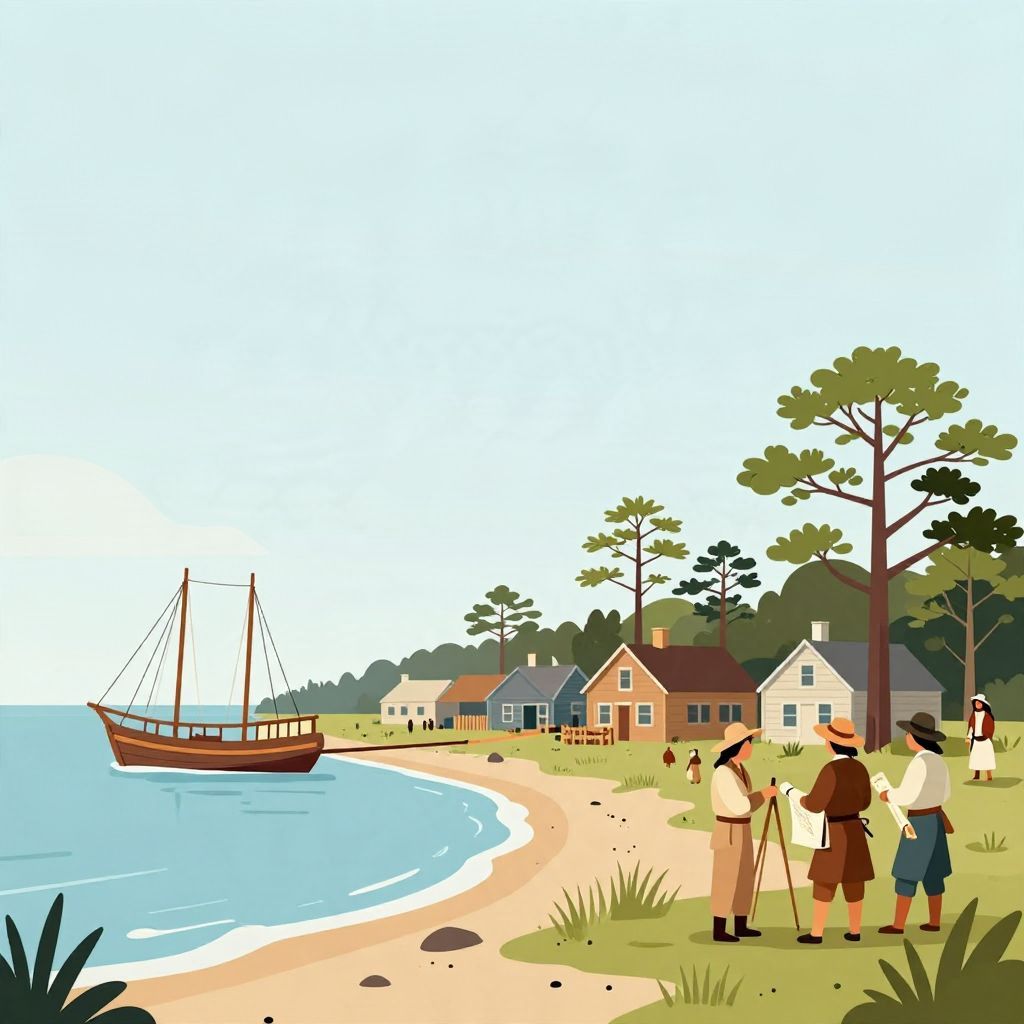
When was North Carolina founded? The short answer is that there is no single “founding” date in the modern sense. The area became part of English colonial claims in the mid-1500s, was first settled by English colonists in the late 1600s, and became a separate British colony in 1712.
Because North Carolina developed gradually, the right date depends on what “founded” means: first European claim, first permanent settlement, or official colony. Each stage matters, and together they explain how the state emerged from a contested borderland into one of the original thirteen colonies.
When Was North Carolina Founded?
North Carolina was not founded on one exact day. If you mean the creation of a distinct colony, the best answer is 1712, when Carolina was formally divided into North Carolina and South Carolina. If you mean the first English settlement, that dates to the 1660s. If you mean the first European claim, it goes back to the 1500s.
The Earliest European Claims to North Carolina
European involvement in the region began long before North Carolina existed as a colony or state. In the 1500s, the Spanish and English explored the Atlantic coast, and England later claimed the area through royal charters. These claims were broad and often more aspirational than effective, since Indigenous peoples already lived there and Europeans had not yet built lasting settlements.
Spanish exploration and failed settlement
Spanish expeditions reached the southeastern coast in the 16th century. The most famous early attempt to colonize the region was the Roanoke Colony, established by the English in the 1580s under Sir Walter Raleigh. It disappeared under mysterious circumstances and became known as the “Lost Colony.”
Roanoke is important to North Carolina history, but it was not a lasting foundation. It showed English interest in the area, yet it did not create a stable colony or permanent colonial government.
Indigenous homelands before colonization
Long before Europeans arrived, the region was home to many Native peoples, including the Cherokee, Tuscarora, Catawba, and numerous Algonquian-speaking communities along the coast. Any discussion of “founding” should recognize that European colonization did not begin on empty land. North Carolina’s later history was shaped by displacement, trade, warfare, and adaptation between Native peoples and newcomers.
The First Permanent English Settlement in the Region
The first lasting English settlement in what is now North Carolina emerged in the 1660s, when settlers from Virginia moved south into the Albemarle region. This was not yet a separate colony in a formal political sense, but it marked the beginning of permanent English colonization in the area that would become North Carolina.
Why settlers moved south
English settlers crossed into the Albemarle Sound region for several reasons: available land, access to waterways, and opportunities for trade. The area was attractive because it was less tightly controlled than older colonies like Virginia. Early settlement was scattered, and local communities often developed before strong colonial institutions did.
Why this matters historically
These early settlements are often treated as North Carolina’s practical beginning because they created a permanent colonial population. Still, they were not yet “North Carolina” in the modern sense. The region was part of a larger proprietary grant called Carolina, and its political identity remained unsettled for decades.
How Carolina Became North Carolina
The colony of Carolina was originally one large proprietary colony granted by the English crown in the 1660s. Over time, its northern and southern sections developed differently. By the early 1700s, distance, geography, weak communication, and local political differences made unified rule difficult. In 1712, Carolina was officially split into two colonies: North Carolina and South Carolina.
The 1663 Carolina charter
In 1663, King Charles II granted Carolina to eight Lords Proprietors. The charter created a huge colony stretching across much of the southern Atlantic coast. In theory, the proprietors would govern the region and encourage settlement. In practice, the colony was too large and diverse to manage easily as a single unit.
Why the split happened
Several factors pushed the division:
- Geography: travel between the northern and southern parts of Carolina was difficult.
- Different settlement patterns: the north developed smaller farms and local communities, while the south centered more on plantation agriculture and port commerce.
- Weak central control: the proprietors struggled to govern effectively from afar.
- Local political tensions: settlers in the northern and southern regions increasingly acted as separate communities.
The formal division in 1712 is the strongest answer to the question “When was North Carolina founded?” if the question is asking about the colony’s official creation.
North Carolina in the Colonial Era
After 1712, North Carolina developed as a distinct colony with its own government and identity. It remained under proprietary rule until 1729, when the crown took control of most of the colony. This shift did not “found” North Carolina, but it did reshape its political future.
From proprietary colony to royal colony
The Lords Proprietors originally held Carolina, but governing from England proved difficult. In 1729, seven of the eight proprietors sold their interests to the crown, and North Carolina became a royal colony. Royal control often meant tighter imperial oversight, though local conditions still gave North Carolina a somewhat independent character.
Economic and social development
Colonial North Carolina was less urbanized than some neighboring colonies. Many settlers lived on small farms, especially in the backcountry. Coastal plantations also grew, particularly in the production of tobacco, naval stores, and later rice in some areas. The colony’s geography encouraged regional differences that would remain important well into the state’s history.
North Carolina and the Road to Statehood
North Carolina became one of the original thirteen states in 1789, when it ratified the U.S. Constitution. That date marks statehood, not founding. By then, North Carolina had already existed for generations as a colony with its own political institutions, economy, and regional identity.
Why 1789 is not the founding date
Some people confuse statehood with founding, but they are not the same thing. North Carolina’s identity as a colony began earlier, especially in 1712. Statehood came later, after independence from Britain and the formation of the United States.
North Carolina in the American Revolution
During the Revolution, North Carolina played an active role in resistance to British rule. The colony declared its independence from Britain in 1776 through the Halifax Resolves, one of the earliest formal colonial declarations in favor of independence. That event was important to the state’s political identity, but it still was not the same as its founding.
So What Is the Best Date to Use?
If you need one simple answer, use 1712 for the founding of North Carolina as a separate colony. That is the date when North Carolina officially emerged from the larger Carolina colony. But a fuller historical answer should note that the region’s story began earlier, with 16th-century exploration and 17th-century settlement.
A simple timeline
- 1500s: Spanish and English exploration of the coastal region.
- 1580s: The Roanoke Colony is established and later disappears.
- 1663: The Carolina charter creates a large proprietary colony.
- 1660s: Permanent English settlement begins in the Albemarle region.
- 1712: Carolina is divided into North Carolina and South Carolina.
- 1729: North Carolina becomes a royal colony.
- 1789: North Carolina ratifies the U.S. Constitution and becomes a state.
Why North Carolina’s Founding Story Is Complicated
North Carolina’s history does not fit neatly into a single founding moment because it developed gradually from exploration, failed colonization, settlement, and political division. That complexity is common in colonial history. Modern states often began as shifting imperial claims long before they became clearly defined political units.
In North Carolina’s case, the most accurate answer depends on the question being asked. For a colony, 1712 is the key date. For settlement, the 1660s matter. For European claims, the 1500s matter. Each date tells part of the story, but none alone captures the whole process.
So, when was North Carolina founded? The most historically grounded answer is that it was officially founded as a separate colony in 1712, after decades of exploration and settlement. If you want to explore other founding stories and early colonial timelines, you may also find what is the oldest city in America and when was New Mexico founded useful for comparison.