
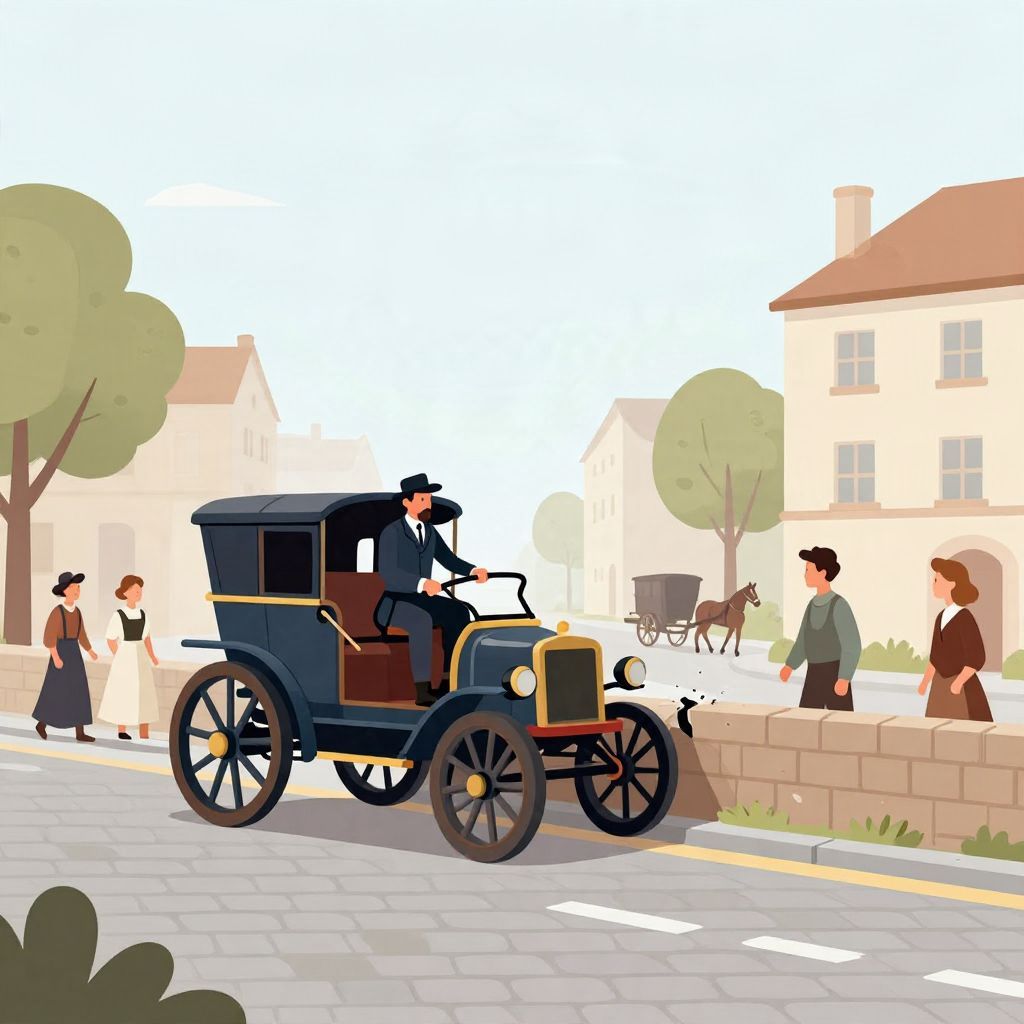
When was the first car accident? The short answer is that the earliest widely cited automobile crash happened in the late 19th century, soon after cars first appeared. But the exact “first” depends on what counts as a car, what counts as an accident, and whether you mean the first recorded crash in history or the first one involving a motor vehicle.
Most historians and car-history writers point to an 1891 crash in Ohio as the first documented automobile accident in the United States. It is not the first possible collision involving a self-propelled vehicle anywhere in the world, but it is the earliest well-known, clearly described car accident in the historical record.
When Was The First Car Accident?
The first widely recognized car accident is usually dated to 1891, when a motorized vehicle built by James and Frank Duryea crashed in Springfield, Ohio. Because early automobiles were experimental, records are incomplete, and some earlier mishaps may never have been documented. Still, 1891 is the safest answer for the first recorded American car accident.
Why the “First” Car Accident Is Hard to Pin Down
Answering this question requires a definition. If “car” means any self-propelled road vehicle, then accidents can be traced to the earliest experiments with steam and gasoline power in the 18th and 19th centuries. If “car” means a practical automobile, then the story begins in the 1880s and 1890s. If “first accident” means the first one preserved in newspapers or eyewitness accounts, the evidence points to the Duryea crash in 1891.
Different meanings of “car”
- Steam road vehicles appeared before gasoline cars and could also crash or overturn.
- Early automobiles were often hand-built prototypes, not mass-produced vehicles.
- Recorded accidents are easier to identify than actual first accidents, because many early incidents were never reported.
That is why historians usually avoid claiming a single universal “first car accident” for all time. Instead, they identify the earliest well-documented examples.
The 1891 Springfield, Ohio Crash
The most commonly cited first American car accident involved one of the Duryea brothers’ early gasoline-powered vehicles. In Springfield, Ohio, the car reportedly struck a tree after the driver lost control. The incident is remembered because it occurred at a moment when automobiles were still novelties and because it is one of the first crashes tied to a gasoline car in the United States.
Who were the Duryea brothers?
Charles and Frank Duryea were among the earliest American automobile pioneers. They built one of the first successful gasoline-powered cars in the United States in the early 1890s. Their work helped move the automobile from experimental machinery toward a practical road vehicle, even though the roads, traffic laws, and driving habits of the era were not yet ready for it.
That mismatch mattered. Early cars were noisy, unreliable, and unfamiliar. Drivers had little training, roads were rough, and pedestrians, horses, and bicycles all shared the same space. In that setting, an accident was almost inevitable.
What the Earliest Car Accidents Reveal About the Age of Automobiles
The first car accidents were not just strange mishaps; they revealed how quickly technology can outpace social rules. Before automobiles, most roads were designed for horses, wagons, and walking. When cars arrived, there were no traffic signals, no speed limits in the modern sense, and no standardized driving instruction. Early collisions exposed the need for new laws, better roads, and safer vehicle design.
Roads were not built for cars
Late 19th-century roads were often muddy, uneven, and poorly maintained. A vehicle that could move faster than a horse-drawn carriage also needed better steering, braking, and suspension. Many early crashes were caused by mechanical weakness, poor visibility, or simple inexperience.
People were still learning how to share the road
At first, many people saw automobiles as loud curiosities rather than serious transportation. Horses could spook, pedestrians could misjudge speed, and drivers themselves were learning how to handle a machine that behaved very differently from anything else on the road.
Were There Earlier Car Accidents Before 1891?
Yes, possibly—if you broaden the definition of “car.” Some steam-powered road vehicles in Britain and elsewhere were involved in mishaps before gasoline automobiles became common. However, these earlier incidents are harder to classify because the vehicles were experimental, the terminology was inconsistent, and surviving documentation is uneven. For that reason, the 1891 Duryea crash remains the best-known early answer.
Steam vehicles and early experiments
Inventors in the 18th and 19th centuries built steam carriages and road locomotives. These machines could fail, overturn, or collide just like later cars. But because they were not yet the familiar “automobile” of the 20th century, historians often treat them separately from the story of the first car accident.
Why historians prefer documented cases
When a question asks for the “first,” historians look for evidence that is both early and reliable. A claim may be popular without being provable. In the case of car accidents, the earliest clearly recorded examples come from the period when automobiles were entering public use and newspapers began describing them in detail.
How the First Car Accidents Changed History
Early crashes helped shape the future of transportation. They made clear that cars were not just mechanical inventions; they were public hazards unless society adapted to them. Over time, governments introduced licensing, traffic laws, road rules, and safety standards. Engineers improved brakes, steering, lights, and tires. In that sense, the first car accidents were part of the learning process that made modern driving possible.
From novelty to regulation
- Traffic laws emerged as cars became more common.
- Driver licensing developed to reduce reckless or untrained driving.
- Road engineering evolved to handle faster vehicles.
- Vehicle safety features improved as accident risks became better understood.
These changes did not happen overnight. The automobile spread faster than the legal and physical infrastructure around it, so early accidents played an important role in forcing adaptation.
The First Car Accident in Popular Memory
People often ask about the first car accident because it feels like a milestone in the history of modern life. Cars transformed travel, work, cities, and leisure. The earliest crash is therefore more than a curiosity: it marks the moment when a revolutionary invention met the practical limits of the real world.
That is also why the story has lasting appeal. It reminds us that every major technology brings unintended consequences. The first car accident was not just an embarrassing mishap; it was an early sign that the automobile would change society in ways its inventors could not fully control.
So, What Is the Best Answer?
If you want the most careful historical answer, the first car accident is best described as an early documented automobile crash in 1891, commonly associated with the Duryea brothers in Springfield, Ohio. If you mean the first accident involving any self-propelled road vehicle, the answer becomes less certain and may reach back to earlier steam-powered experiments.
In other words, the “first car accident” is not a single fixed event so much as the beginning of a new era of road risk. As soon as automobiles appeared, accidents followed—and so did the rules, roads, and safety measures that define driving today. For related context, you may also want to read about when the first car was made in America and the car President Kennedy was shot in.