
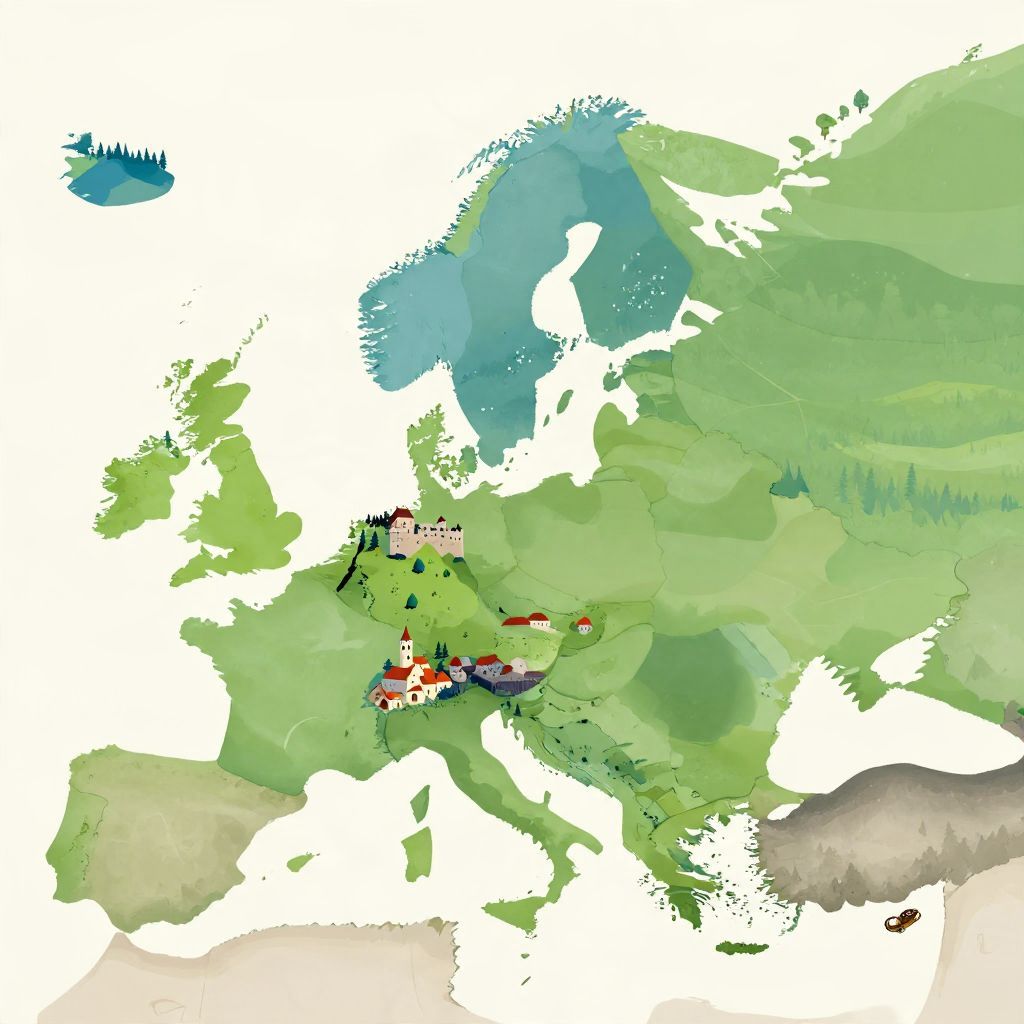
Is Transylvania a real place? Yes—Transylvania is a real historical and geographical region in central Romania, not just a setting from vampire fiction. It has a long documented past shaped by Dacians, Romans, medieval kingdoms, Habsburg rule, and modern Romanian statehood.
The confusion comes from the way literature and film turned Transylvania into a Gothic symbol. But behind the legends is a mountainous, multiethnic region with towns, fortresses, churches, and a complex political history that can be traced across many centuries.
Is Transylvania a real place?
Yes. Transylvania is a real region in central Romania, bordered by the Carpathian Mountains and historically known for its diverse population and shifting rulers. It is not a country, but a distinct historical region with a documented past stretching from antiquity to the present. Its fame in popular culture comes from Dracula stories, yet its real history is richer and older than the myth.
Where is Transylvania, and what makes it a historical region?
Transylvania lies inside the arc of the Carpathian Mountains in the heart of present-day Romania. The name is usually associated with the central plateau and surrounding mountain basins, though its historical boundaries changed over time. As with many European regions, its identity was shaped less by modern borders than by centuries of rule, migration, and local custom.
Geography and name
The word “Transylvania” comes from Latin roots often interpreted as “beyond the forest” or “beyond the woods,” reflecting how medieval outsiders described the area. In Hungarian, it is called Erdély; in German, Siebenbürgen. These different names already hint at the region’s multiethnic past and the many political worlds that claimed it.
What is the historical evidence for Transylvania?
There is abundant evidence for Transylvania in ancient, medieval, and modern records. Archaeology, written chronicles, royal charters, church documents, and administrative records all refer to the region under various names. Its existence is not a matter of legend; what changes over time is who governed it and how its population was described.
Ancient and early medieval roots
Before the medieval period, the area was inhabited by Dacian peoples. After the Roman conquest of Dacia under Emperor Trajan in the early 2nd century CE, Roman rule briefly extended into parts of the region. When Roman administration withdrew in the 3rd century, the area remained populated and later became part of the larger migration-era world of the Carpathian Basin.
Because the early medieval centuries are sparsely documented, historians debate details of population continuity and migration. What is clear is that by the 10th and 11th centuries, the region was increasingly integrated into the Kingdom of Hungary.
How did Transylvania develop in the Middle Ages?
In the medieval era, Transylvania became a frontier region of the Hungarian kingdom. It was not isolated: it was connected to trade routes, military defense systems, and settlement policies. Kings encouraged the arrival of different groups, including Hungarians, Székelys, Saxons, and others, which helped create the region’s distinctive cultural mix.
Medieval settlement and diversity
One of Transylvania’s defining features was its ethnic and social variety. Medieval Hungarian kings granted privileges to certain communities, especially the Saxons, who founded towns and helped fortify the region. The Székelys also held a special military role. Romanian-speaking populations lived in the area as well, though their political status varied and is still debated by historians.
This diversity did not mean equality. Medieval Transylvania was organized through estates and privileges, not modern ideas of citizenship. Political power was concentrated among recognized groups, while peasants, regardless of language or religion, had limited rights.
Fortresses, towns, and defense
Transylvania’s castles, fortified churches, and walled towns were built in response to both local rivalries and wider threats, especially Mongol and Ottoman pressure. The Mongol invasion of 1241–1242 devastated much of the region and led to stronger fortifications afterward. These structures are part of the real historical landscape that later inspired Gothic imagery.
Why is Transylvania associated with Dracula?
Transylvania became famous worldwide because of the Dracula legend, but the connection is literary rather than historical. Bram Stoker’s 1897 novel Dracula placed much of its atmosphere in Transylvania, helping create the modern image of a remote, haunted land. That image is powerful, but it should not be mistaken for the region’s actual history.
Vlad the Impaler and the Dracula myth
The historical figure most often linked to Dracula is Vlad III, also known as Vlad Țepeș or Vlad the Impaler, a 15th-century ruler of Wallachia, not Transylvania. He was a real prince known for brutal punishments and warfare against the Ottomans and rivals. However, he was not a vampire, and his life was later reshaped by folklore and fiction.
Stoker borrowed the name “Dracula” from historical and linguistic sources, but the novel’s vampire character is not a biography of Vlad III. The association between Vlad, Dracula, and Transylvania is therefore a blend of history, literary invention, and later popular culture.
What happened to Transylvania in the early modern period?
After the medieval kingdom weakened under Ottoman pressure, Transylvania became a semi-independent principality in the 16th century. It occupied a strategic position between the Habsburgs, the Ottomans, and local elites. This period gave the region a distinctive political identity while keeping it entangled in wider European power struggles.
The Principality of Transylvania
Following the Battle of Mohács in 1526 and the fragmentation of the Hungarian kingdom, Transylvania emerged as a principality under Ottoman suzerainty. It retained a degree of autonomy and became known for relative religious pluralism compared with many neighboring lands. Catholic, Lutheran, Calvinist, and Unitarian communities all had a place in its political order, though not on equal terms with everyone.
This era matters because it shows Transylvania as more than a borderland. It was a political entity with its own princes, estates, and diplomatic maneuvering, even while stronger empires influenced its fate.
Habsburg rule and imperial change
By the late 17th century, the Habsburgs gained control over Transylvania as Ottoman power receded in central Europe. Under Habsburg administration, the region was tied more closely to imperial structures. Local institutions persisted, but authority increasingly came from Vienna. These changes affected taxation, religion, military organization, and elite politics.
How did modern nationalism change Transylvania?
In the 19th and 20th centuries, Transylvania became central to competing national movements. Romanians, Hungarians, and other communities all claimed parts of its heritage. Modern nationalism transformed older regional identities into political arguments about language, history, and sovereignty.
From empire to nation-state
In the 1848 revolutions, and later during the Austro-Hungarian period after 1867, questions of rights and representation became sharper. Romanian leaders sought greater recognition, while Hungarian authorities often promoted centralization and Magyarization. These tensions were not simply about ethnicity; they were also about power, administration, and the meaning of belonging.
After World War I, Transylvania was united with Romania in 1918 and recognized internationally by the Treaty of Trianon in 1920. This was one of the most important turning points in the region’s modern history. The change redrew borders, altered political loyalties, and left lasting memories among both Romanians and Hungarians.
20th-century upheaval
Transylvania’s 20th-century history included border changes during World War II, shifting occupations, and postwar consolidation under communist Romania. After 1945, the region remained part of Romania, where it continues to be an important cultural and economic area. Its history is still visible in bilingual place names, churches, schools, and urban architecture.
Why do people sometimes think Transylvania is fictional?
People often assume Transylvania is imaginary because it has been heavily romanticized in novels, films, and tourism. The region’s forests, castles, and mountain setting fit Gothic storytelling so well that fiction has sometimes overshadowed geography. But a place can be mythologized without ceasing to exist.
Folklore versus history
Transylvania does have rich folklore, including stories of spirits, werewolves, and supernatural beings common across Eastern Europe. These traditions are part of cultural history, but they are not proof of vampires or haunted castles. The real historical value of folklore lies in what it reveals about fear, religion, landscape, and local imagination.
That distinction is important. Legends can shape identity and tourism, but historians separate them from evidence-based accounts. In Transylvania’s case, the legend of Dracula became famous precisely because the region already seemed mysterious to outsiders.
What is Transylvania like today?
Today, Transylvania is a real and vibrant region within Romania, known for its cities, universities, medieval centers, and rural landscapes. Cluj-Napoca, Sibiu, Brașov, and Târgu Mureș are among its best-known urban centers. The region remains culturally mixed, with Romanian, Hungarian, German, and Roma communities contributing to its life.
Historical significance in the present
Transylvania’s importance is not limited to tourism or legend. It is a place where medieval urbanism, early modern pluralism, imperial administration, and modern nation-building all left visible traces. Churches, citadels, and old town centers preserve layers of history that make the region a valuable example of how European identities developed over time.
Conclusion: the real Transylvania behind the myth
So, is Transylvania a real place? Absolutely. It is a real historical region with a long, documented past, even if popular culture has turned it into a symbol of mystery and horror. Its story includes ancient peoples, medieval kingdoms, Ottoman and Habsburg politics, and modern Romanian statehood. If you want to explore more about how regions develop distinct identities, see what cultural divergence means in history and how imperial power shapes regions and identities.