
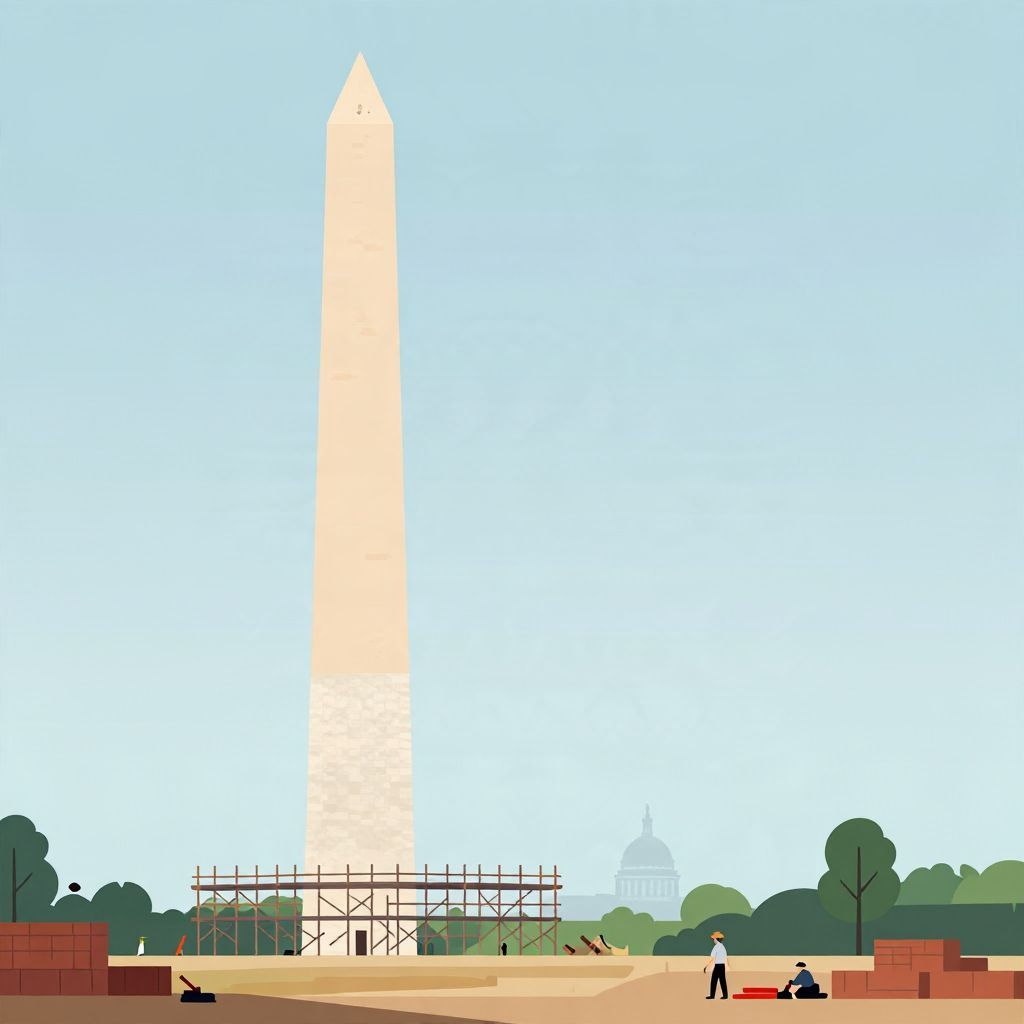
When was the Washington Monument built? The short answer is that construction began in 1848, but the monument was not fully completed until 1884 and officially dedicated in 1885. Its long construction history reflects changing politics, funding problems, and the Civil War, which interrupted the project for decades.
The Washington Monument is more than a tall stone shaft on the National Mall. Its story shows how a young nation tried, failed, and eventually succeeded in honoring George Washington with a national memorial worthy of the first president.
When Was the Washington Monument Built?
Construction of the Washington Monument began on July 4, 1848. Work stopped in 1854, resumed in 1879, and the monument was completed in December 1884. It opened to the public in 1885. Because of those interruptions, the answer depends on whether you mean the start of construction, the completion of the structure, or the formal dedication.
The Long Road from Idea to Monument
The idea for a monument to George Washington emerged soon after his death in 1799, but the United States took decades to turn that idea into a finished structure. Early plans were ambitious, expensive, and politically complicated. Americans agreed that Washington deserved a national memorial; they did not agree on how to pay for it, where to place it, or what form it should take.
Why Washington Needed a National Memorial
George Washington was seen as the central figure of the Revolution and the new republic. By the early 19th century, many Americans wanted a monument that would express national unity and gratitude. The project was meant to be more than a tribute to one man. It was also a statement that the United States had matured enough to create a grand public monument on a national scale.
Early Plans and Delays
In the 1830s and 1840s, supporters organized a private effort through the Washington National Monument Society. They hoped to raise money from the public rather than rely entirely on Congress. This approach reflected both patriotic enthusiasm and the limits of federal support at the time. Yet fundraising was slow, and the design process was uneven. Several proposals were considered before the society settled on the simple obelisk shape that would become familiar worldwide.
What Happened in 1848?
The first stone was laid on July 4, 1848, a date chosen for obvious symbolic reasons. The ceremony linked Washington’s memory with Independence Day and the ideals of the republic. At that moment, the monument was still only a plan becoming real. Builders began the shaft, but the project soon ran into financial and political trouble.
The Original Design
The monument’s final form is a clean, tapering obelisk, a design inspired by ancient Egyptian monuments and popular in 19th-century neoclassical architecture. The simplicity was intentional. Rather than crowd the memorial with sculpture or ornament, designers wanted a form that suggested permanence, dignity, and national seriousness. The result was a monument that stood apart from many more decorative memorials of the era.
Why Construction Stopped
By 1854, work had stalled. Money ran out, and the Washington National Monument Society struggled to keep the project moving. Political tensions also grew. In 1854, anti-Catholic and anti-immigrant activists associated with the Know-Nothing movement seized control of the society and contributed a block of stone that was later rejected by many supporters. The episode damaged the monument’s reputation and deepened the project’s problems.
After that, the shaft stood unfinished for years, visible on the skyline but incomplete in meaning and form. The Civil War then made a major public building project even less likely.
How the Civil War Changed the Project
The Civil War halted the monument’s progress for more than a decade. In a divided nation, a memorial to unity and national identity was not an easy priority. The unfinished shaft became a reminder of both patriotic ambition and national fracture. What had begun as a celebration of the republic was left standing as a silent, incomplete stone column.
Resumption After the War
Construction resumed in 1879 under the direction of the U.S. Army Corps of Engineers. By then, the federal government had become more directly involved. The renewed effort reflected a postwar desire to complete the monument and restore the project’s dignity. Engineers also had to address structural and material issues left by the earlier, uneven construction.
The completed monument is not made from a single uniform stone source. Its lower sections and upper sections differ slightly in color because of interruptions in building and changes in quarry sources. That visible shift is one of the physical reminders of the monument’s long and uneven history.
When Was the Washington Monument Completed?
The Washington Monument was structurally completed in 1884. The capstone was placed on December 6 of that year, marking the end of major construction. The monument was then dedicated in 1885, after final preparations and public arrangements were made. So if you ask when it was “built,” the most accurate answer is that it was built over a span of nearly four decades.
Key Dates in the Monument’s Construction
- 1799 – George Washington dies; calls for a memorial begin to grow.
- 1830s–1840s – The Washington National Monument Society organizes fundraising and planning.
- July 4, 1848 – Construction officially begins with the laying of the first stone.
- 1854 – Work stops amid funding shortages and political conflict.
- 1879 – Construction resumes under federal direction.
- December 6, 1884 – The monument is completed with the placement of the capstone.
- 1885 – The monument is officially dedicated.
Why the Monument Took So Long
The Washington Monument’s long construction timeline was caused by a combination of money problems, political conflict, and changing national circumstances. Unlike a modern government project with a fixed budget and schedule, this memorial depended on donations, public enthusiasm, and shifting leadership. When those forces weakened, the project stopped.
Funding Problems
The monument was originally a private fundraising effort. That meant progress depended on donations from individuals, organizations, and states. When enthusiasm faded, so did the money. The society’s inability to maintain stable funding was one of the main reasons the monument remained unfinished for so long.
Political Tensions
The 1850s were a period of intense sectional conflict in the United States. Debates over slavery, immigration, and national identity made it harder to sustain a unifying public project. The monument, intended to honor a national hero, became entangled in the politics of the time. Its unfinished state reflected the nation’s own instability.
Engineering and Structural Issues
When construction resumed, engineers had to work with a partially completed structure that had stood exposed for years. They needed to ensure the monument was stable and could be finished safely. The later work was more controlled and professionalized than the early phase, which helped bring the project to completion.
What the Washington Monument Means Today
Today the Washington Monument is one of the most recognizable landmarks in the United States. At 555 feet tall, it dominated the Washington skyline for generations and remains a central symbol of the capital. Its height and simplicity make it instantly identifiable, but its deeper meaning lies in its history: a national monument shaped by idealism, delay, and perseverance.
A Monument to an Idea as Much as a Man
The monument honors George Washington, but it also represents the struggle to define American identity in the 19th century. The long gap between the first stone and the finished structure tells a broader story about how the United States remembered its founders. The monument’s unfinished years were not a failure so much as a reflection of the country’s uneven development.
Why the Completion Date Matters
People often ask when the Washington Monument was built because the answer is not a single year. The project began in 1848, stopped, and then resumed decades later. That makes the monument a useful example of how historical landmarks can have layered timelines. The start date, completion date, and dedication date each tell part of the story.
The Best Historical Answer
If you want the clearest answer to when was the Washington Monument built, say this: construction began in 1848, was interrupted for decades, and the monument was completed in 1884 and dedicated in 1885. That timeline captures both the physical building of the monument and the historical forces that shaped it.
The Washington Monument stands today not just as a tribute to George Washington, but as a reminder that national symbols are often built slowly, through conflict, compromise, and persistence. If you want to explore more building histories, you may also enjoy reading about the oldest building in the United States or when the Sears Tower was built.