
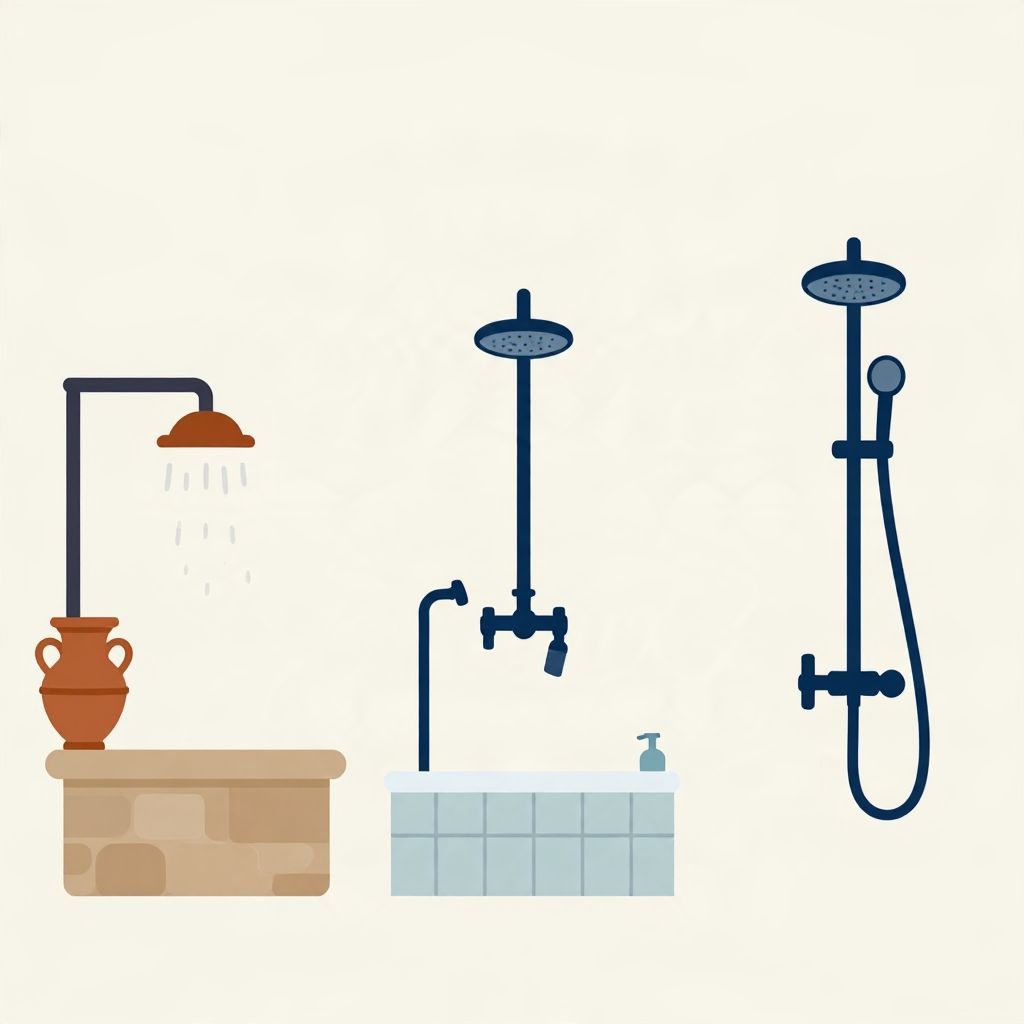
When were showers invented? The short answer is that the basic idea of washing the body with running water is ancient, but the modern shower as a household fixture was invented in the late 18th century and became practical and widely used much later. Its history runs from early communal bathing systems to industrial-era plumbing and modern bathrooms.
That means there is no single “first shower” in the way there is a first light bulb or airplane. Instead, showers developed over time as people found better ways to move, heat, and drain water. The story is really about technology, hygiene, and changing ideas about cleanliness.
When were showers invented?
The modern shower was invented in England in the late 1700s, with one of the earliest known patented designs appearing in 1767. But showers did not become common in ordinary homes until the 19th and early 20th centuries, when indoor plumbing, hot water systems, and modern bathrooms made them practical.
The long history of bathing before the modern shower
People have washed with flowing water for thousands of years. Ancient civilizations used baths, basins, and water poured over the body, but these were not showers in the modern sense. The shower emerged from older bathing traditions, especially communal bathhouses and mechanical devices that could send water downward over a person standing below.
Ancient and early bathing practices
In ancient Egypt, Greece, Rome, and elsewhere, bathing was a major part of daily life for many people. The Romans in particular built elaborate bath complexes with heated rooms, pools, and water systems. Some ancient bathers used water poured from above or washed under streams and waterfalls, but these were not yet the enclosed, plumbed shower stalls familiar today.
What mattered historically was the combination of two things: a reliable water supply and a way to direct water over the body. Ancient societies had the first in some places, but not the second in a modern mechanical form. The shower’s later invention depended on both engineering and changing domestic habits.
The first modern shower: 1767
The earliest widely recognized modern shower was invented in 1767 by William Feetham, an English stove maker. His device used a hand pump to lift water into a container above the bather, then let it fall through a nozzle. It was an early attempt to create a reusable, self-contained shower apparatus.
Feetham’s invention was important because it separated the shower from the bath. Instead of soaking in a tub, the user stood while water was poured from above. That basic concept is still the foundation of showers today, even though modern versions are much more advanced.
Why Feetham’s shower did not catch on immediately
Feetham’s shower was ingenious, but it had limits. It was awkward to use, relied on manual pumping, and did not offer hot and cold mixing in the way later showers would. It was also not part of a typical home bathroom, because most homes at the time did not have indoor plumbing or a dependable supply of heated water.
For that reason, the invention existed before the social conditions needed to make it widespread. Many inventions follow this pattern: they appear first as clever devices, then become common only after supporting infrastructure develops.
How showers evolved in the 19th century
During the 1800s, showers improved as plumbing and water heating advanced. The rise of urban water systems, cast-iron pipes, and better drainage made it easier to install bathing fixtures indoors. By the mid-19th century, showers were being used in some institutions, hospitals, military settings, and public bathhouses.
Public baths and hygiene reform
In the 19th century, many reformers linked bathing with health, discipline, and cleanliness. Cities built public baths for workers and poor residents who lacked private bathing facilities. Showers were often promoted in these settings because they used less water than a full tub bath and could serve many people quickly.
This was especially important in crowded industrial cities, where sanitation was a growing concern. The shower became associated not only with cleanliness but also with efficiency, order, and modern public health.
The prison and military shower
One of the earliest places showers became routine was in institutions such as prisons, barracks, and schools. These settings valued speed, supervision, and water economy. A shower could bathe many people in a short time, which made it useful long before it became a domestic convenience.
That institutional use helped normalize the shower as a practical hygiene tool. Over time, what began as a controlled and sometimes disciplinary device became part of everyday private life.
When did showers become common in homes?
Showers became common in middle-class homes mainly in the 20th century, especially after indoor plumbing, bathrooms, and reliable hot-water systems spread more widely. In many countries, this happened gradually between the 1920s and 1950s, though adoption varied by region, income, and housing quality.
Before that, many homes had no dedicated bathroom at all. People bathed in tubs, washstands, or public bathhouses. The shower became a normal household feature only when homes could support enclosed bathrooms, drainage, and pressurized water.
Why indoor plumbing changed everything
Indoor plumbing transformed bathing from a labor-intensive task into a routine part of daily life. Once water could be piped into the home and waste water carried away safely, showers became far more convenient. Hot water heaters and improved valves also made it possible to mix temperatures and control flow.
In other words, the shower was not just an invention; it was also the product of a larger plumbing revolution. Without that infrastructure, the modern shower could not have become a standard fixture.
Showers versus baths: changing ideas of cleanliness
For much of history, bathing meant soaking in a tub or washing with bowls and cloths. Showers gained popularity partly because modern societies increasingly valued quick, frequent washing. As medical and public health ideas changed, many people came to see showers as cleaner, more efficient, and more suitable for daily use.
That shift was cultural as well as technological. In earlier periods, bathing habits varied widely, and frequent full-body washing was not always common. By the 20th century, especially in urban industrial societies, daily showering became linked to modern personal hygiene.
Water use and practicality
Showers also appealed because they could use less water than filling a tub, depending on the design and length of use. They were easier to fit into smaller bathrooms and more efficient for households with busy schedules. These practical advantages helped showers overtake bathtubs in many settings.
Still, baths never disappeared. Even today, showers and tubs coexist, with showers favored for speed and convenience and baths often associated with relaxation.
What counts as the “invention” of the shower?
The answer depends on how you define a shower. If you mean the first device specifically designed to spray or pour water over a standing person, then the answer is the late 18th century, especially 1767. If you mean the shower as a common bathroom fixture, then the answer is the 20th century. If you mean the broader practice of washing under falling water, then the idea is ancient.
This is why historians usually avoid a single simplistic date. Technologies often have multiple “births”: the first prototype, the first practical version, and the first mass adoption. Showers fit that pattern very well.
A simple timeline
- Ancient era: People bathe with poured or flowing water in baths and communal washing spaces.
- 1767: William Feetham patents an early modern shower in England.
- 1800s: Showers spread in institutions and public bathhouses as plumbing improves.
- 1900s: Showers become common in private homes as indoor bathrooms and hot water systems expand.
Why the shower mattered historically
The shower may seem ordinary today, but its history reflects major changes in everyday life. It shows how industrialization reshaped homes, how public health reform influenced private habits, and how technologies spread from elite or institutional settings into mass use. The shower is a small invention with a large social story behind it.
It also reminds us that many familiar household objects are the result of long development rather than a single moment of genius. The modern shower emerged when engineering, plumbing, and changing ideas about hygiene finally came together.
So, when were showers invented? The best historical answer is 1767 for the first modern shower device, with widespread household use arriving much later. If you want to explore the next step in that story, see when showers became common and when indoor plumbing became common.