
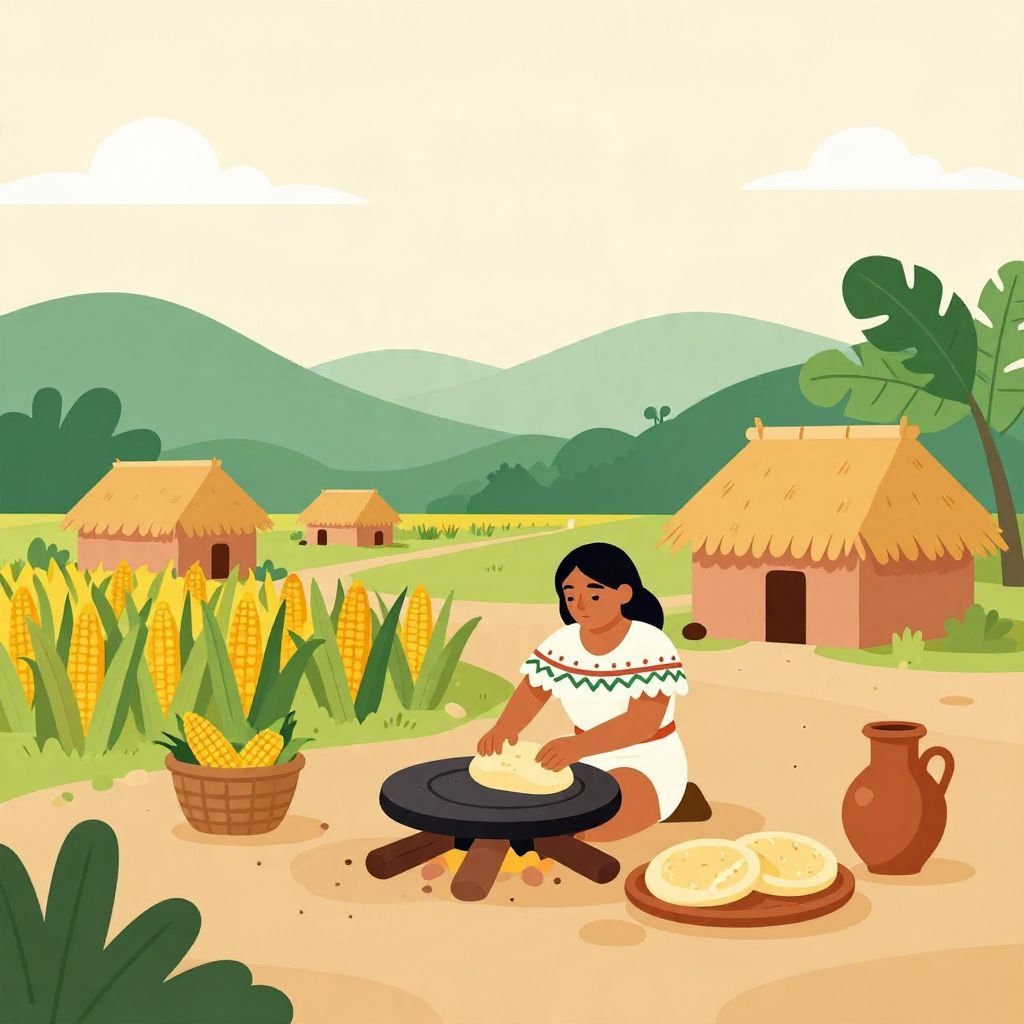
Arepas are one of the best-known foods of the northern Andes and Caribbean rim, but their origins go back much farther than any modern national border. The short answer is that arepas come from the Indigenous cultures of what is now Venezuela and Colombia, where people were making corn cakes long before the Spanish arrived.
Because arepas spread across regions and centuries, their history is shared rather than exclusive. Today they are strongly associated with Venezuelan and Colombian cuisine, yet their deeper story begins with pre-Columbian maize traditions that shaped everyday life across northern South America.
Where Are Arepas From?
Arepas originated in pre-Columbian northern South America, especially in the areas that are now Venezuela and Colombia. They developed from Indigenous maize cooking traditions and were already part of local diets before the Spanish conquest in the 16th century. Modern national versions differ, but the dish itself is much older than either nation.
The Indigenous Origins of Arepas
Long before arepas became a national symbol in Venezuela or Colombia, Indigenous peoples in the region cultivated maize and turned it into a wide range of foods. Corn was central because it could be grown in many environments and stored for later use. Ground maize dough, cooked on hot stones or clay surfaces, was a practical and nourishing staple.
Maize and daily life
In many Indigenous societies of northern South America, maize was more than an ingredient. It was part of agriculture, ritual, trade, and household labor. The arepa likely emerged as one of several ways to prepare maize into a portable, filling bread or cake. Its simplicity made it adaptable to different communities and tastes.
The meaning of the word “arepa”
The word arepa is usually linked to Indigenous language roots, often associated with the Cumanagoto or other local languages of the region. Scholars generally agree that the term is pre-Hispanic, though the exact linguistic path is not fully settled. What is clear is that the name itself reflects Indigenous origins rather than a Spanish invention.
How the Arepa Evolved Over Time
Arepas did not remain frozen in one ancient form. Over centuries, they changed with new tools, ingredients, and regional habits. The arrival of Europeans brought wheat, livestock, and new cooking methods, but maize remained central in many rural communities. The arepa survived because it was inexpensive, flexible, and deeply rooted in local food culture.
From hand-ground maize to modern flour
For much of history, making arepas meant soaking, grinding, and kneading maize by hand. This was labor-intensive, so arepas were part of a household rhythm that depended on time and skill. In the 20th century, industrial precooked corn flour transformed the process, making arepas faster and easier to prepare at home and in restaurants.
This change did not create the arepa, but it did help spread it more widely. Commercial flour made the dish more convenient for urban families and migrants, helping it become even more visible as a modern national food.
Arepas in Venezuela and Colombia
Both Venezuela and Colombia claim the arepa as their own, and both claims are historically understandable. The dish belongs to a shared regional heritage that predates modern borders. Over time, however, each country developed distinct styles, fillings, and eating habits that gave the arepa different cultural meanings.
Venezuelan arepas
In Venezuela, arepas are often split open and stuffed with fillings such as cheese, beans, shredded meat, avocado, or eggs. They are commonly eaten at breakfast, lunch, or dinner. Venezuelan arepas became especially prominent in urban food culture and later in diaspora communities abroad, where they served as a marker of identity and memory.
Colombian arepas
In Colombia, arepas are often flatter and may be served plain, with butter, cheese, or other simple toppings. Regional variety is especially strong there: different areas have their own versions, from the thin arepas of the Caribbean coast to thicker, stuffed, or sweet forms elsewhere. In Colombia, the arepa is both everyday food and regional emblem.
Why the Origin Is Shared Rather Than Single
It is tempting to ask whether arepas came from one exact place, city, or date. History rarely works that neatly. The most accurate answer is that arepas emerged in a broad cultural zone where Indigenous peoples shared maize-based food traditions. Modern national identities later claimed and reshaped that older heritage.
Border changes do not change older food history
Venezuela and Colombia did not exist as independent nations in pre-Columbian times. Their current border divides a region that once held connected Indigenous societies, colonial provinces, and trade routes. For that reason, trying to assign arepas to only one modern country can distort the historical record. The dish is best understood as a regional tradition with multiple heirs.
What Sources Support This History?
Historians, linguists, and food scholars rely on several kinds of evidence when tracing arepa history: Indigenous language traces, colonial-era descriptions of maize foods, and the long continuity of corn-based cooking in the region. There is no single “first arepa” document, but the combined evidence strongly supports a pre-Columbian origin.
What is well established
- Maize was a major staple in pre-Columbian northern South America.
- Indigenous peoples in the region made corn cakes and similar foods before Spanish contact.
- The word arepa is of Indigenous origin.
- Modern Venezuelan and Colombian arepas developed from that older tradition.
What is less certain
- The exact community that first made something we would now call an arepa.
- The precise date when the word entered written records.
- Whether the earliest versions were identical to today’s arepas in shape or texture.
These uncertainties are normal in food history. Everyday foods often leave fewer records than wars or rulers, so historians reconstruct them from language, agriculture, and long patterns of use.
How Colonialism Changed the Arepa
The Spanish conquest altered Indigenous societies dramatically, but it did not erase maize culture. Instead, many local foods continued under colonial rule, sometimes adapted to new ingredients or social conditions. Arepas endured because they were inexpensive, filling, and easy to prepare with local crops.
Colonial society also intensified regional differences. In some places, arepas remained associated with Indigenous and rural households; in others, they spread across social classes. Over time, what had been a practical staple became a food that could signal home, region, and eventually national belonging.
Arepas in the Modern Era
In the 20th and 21st centuries, arepas moved from local staple to international symbol. Migration from Venezuela and Colombia carried the dish across the Americas and beyond. Restaurants, bakeries, and home cooks introduced arepas to new audiences, often adapting fillings and techniques to local ingredients and tastes.
A food of identity and migration
For many people, arepas are more than breakfast bread. They are a connection to family, language, and place. In diaspora communities, making arepas can preserve memory and continuity, especially when people live far from the region where the dish originated. That emotional meaning helps explain why the arepa has become so visible today.
Arepas vs. Other Corn Cakes
It is useful to distinguish arepas from other maize foods in the Americas. Corn cakes appear in many Indigenous and later colonial cuisines, from tortillas to pupusas to gorditas. These dishes may resemble one another, but they are not the same historical product. Arepas belong to a distinct northern South American tradition, even if they share a broader Mesoamerican and Andean maize heritage.
What makes an arepa an arepa?
At its core, an arepa is a corn cake made from ground maize dough, shaped into a round form, and cooked on a griddle, skillet, or similar hot surface. Beyond that basic definition, there is wide regional variation. Some are thick, some thin, some stuffed, some plain, and some enriched with cheese or other ingredients. The diversity is part of the dish’s history.
So, Where Are Arepas From?
Arepas are from Indigenous northern South America, especially the lands that are now Venezuela and Colombia. They began as pre-Columbian maize cakes and survived colonization, border changes, and modernization. Their history is not the story of one inventor or one nation, but of a shared food tradition that endured for centuries.
That is why the best historical answer is both simple and nuanced: arepas are Indigenous in origin, regional in development, and Venezuelan and Colombian in modern national identity. If you are interested in the wider history of everyday origins, you may also enjoy reading about where coffee originally came from and how the term soccer came about.