
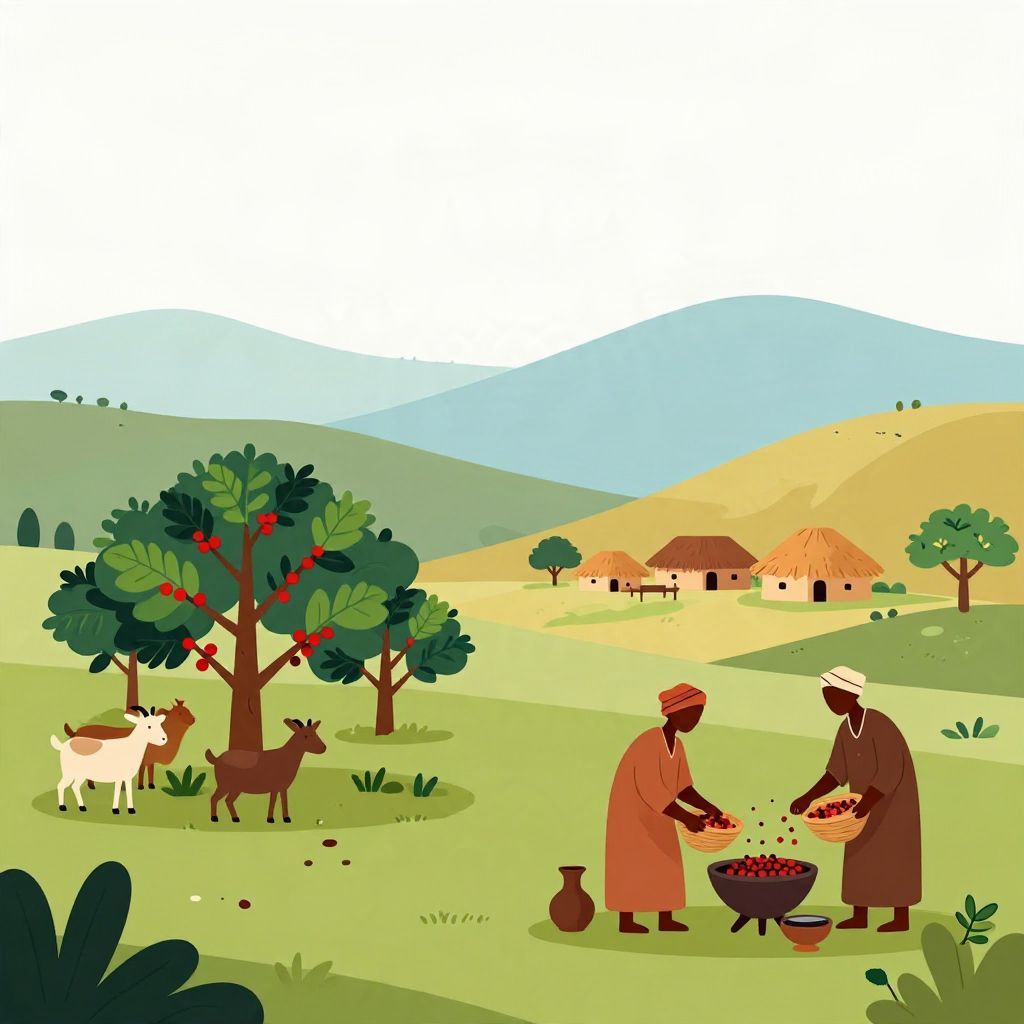
Where is coffee originally from? The short historical answer is that coffee is native to the highlands of Ethiopia, especially the region of Kaffa, though its earliest documented cultivation and trade developed across the Red Sea in Yemen. The drink’s story begins with a plant in East Africa and becomes a global history through Arab, Ottoman, European, and colonial networks.
Because coffee spread so widely, its “origin” can mean different things: the plant’s natural homeland, the first place people likely used it, or the region where coffee drinking became a major social practice. Those are related but not identical histories.
Where Is Coffee Originally From?
Coffee is originally from southwestern Ethiopia, where wild coffee plants grew long before humans cultivated them. The best-known species, Coffea arabica, is native to the Ethiopian highlands. From there, coffee moved to Yemen, where it was first widely cultivated and turned into the beverage that later spread across the Islamic world and beyond.
The Ethiopian Origins of Coffee
Botanically and historically, coffee’s roots lie in Ethiopia. Wild coffee plants grew in forested highland areas, and local communities likely knew the plant long before written records describe it. The association with the Ethiopian region of Kaffa helped shape the modern word “coffee,” though the exact linguistic path is debated.
The legend of Kaldi
The famous story of the goatherd Kaldi, who supposedly noticed his goats becoming lively after eating coffee berries, is a popular legend rather than established history. It may reflect later attempts to explain coffee’s discovery in memorable form. Historians treat it as folklore, not as reliable evidence.
What historians can say with confidence
What is well supported is that coffee plants were native to Ethiopia and that people in the Horn of Africa were the first to encounter them in their natural environment. Early use may have included chewing the berries, mixing them with fat, or preparing simple infusions, but the exact earliest method is not securely documented.
How Coffee Reached Yemen
Coffee’s next major historical chapter began across the Red Sea in Yemen, probably by the 15th century. This is where coffee became more clearly visible in written history as a cultivated crop and a brewed drink. Yemeni Sufi communities are often linked to its early popular use, especially for staying alert during night prayers.
Why Yemen mattered
Yemen was crucial because it transformed coffee from a regional plant into a commercial and cultural product. The port of Mocha became especially important in the coffee trade, and the beverage took on a new identity as part of urban and religious life. In this sense, Yemen was coffee’s first major center of cultivation and export.
From local use to organized trade
By the late medieval and early modern periods, coffee was being grown, processed, and traded more systematically in Yemen. Authorities and merchants recognized its value, and its movement through ports connected coffee to the wider Indian Ocean world. This trade helped standardize coffee drinking and made the beverage easier to export.
When Did Coffee Become a Drink?
Coffee as a recognizable beverage emerged gradually, not in a single moment. The transition from wild plant to brewed drink likely happened over centuries, but the clearest historical evidence appears in the 15th century in Yemen. By then, coffeehouses and communal drinking practices were beginning to shape new social habits.
From medicine and ritual to everyday life
Early coffee use was not only recreational. In some settings it was associated with medicine, religious devotion, and practical alertness. Over time, it became an everyday beverage. That shift matters because coffee’s history is not just about geography; it is about how people learned to use the plant in social and cultural life.
How Coffee Spread Across the Islamic World
From Yemen, coffee spread to Mecca, Cairo, and Istanbul, where it became part of urban life by the 16th and 17th centuries. Coffeehouses emerged as places for conversation, music, games, news, and debate. These spaces made coffee more than a drink; they made it a social institution.
Religious debate and public concern
Coffee was not universally welcomed. Some religious and political authorities worried that coffeehouses encouraged gossip, dissent, or unruly behavior. At different times, coffee faced criticism or temporary restrictions. Yet these controversies also show how influential the drink had become in everyday society.
The Ottoman role
The Ottoman Empire helped carry coffee across a vast territory linking Arabia, North Africa, the eastern Mediterranean, and southeastern Europe. Ottoman cities became major centers of coffee culture, and the beverage gained prestige through elite and popular consumption alike. This was a turning point in coffee’s global history.
How Coffee Reached Europe and the Wider World
Coffee entered Europe in the 17th century, first through Mediterranean trade routes and then through cities such as Venice, London, and Paris. At first, some Europeans viewed it as an exotic or even suspicious drink. Soon, however, coffeehouses became important urban spaces for commerce, politics, and intellectual exchange.
Europe’s coffeehouse culture
European coffeehouses differed from place to place, but they often served as meeting points for merchants, writers, officials, and travelers. Coffee’s bitter taste, stimulating effect, and association with conversation helped it fit the rhythms of early modern city life. Its popularity grew rapidly despite early skepticism.
Plantation expansion and global production
As demand increased, coffee cultivation expanded beyond Ethiopia and Yemen. European colonial powers transplanted coffee to Asia, the Caribbean, and Latin America. This expansion changed coffee from a regional crop into a global commodity, but it also tied coffee production to colonial labor systems, including slavery and coercive plantation economies in many places.
Why Coffee’s Origin Story Is More Than One Place
People sometimes ask where coffee is originally from and expect one simple answer. Historically, the answer has two layers: the plant is native to Ethiopia, while the beverage tradition developed most clearly in Yemen. Both are essential to coffee’s origin story, and neither should be ignored.
Botanical origin versus cultural origin
The botanical origin refers to where the coffee plant grew naturally. The cultural origin refers to where people first cultivated, brewed, and traded coffee in ways that made it a lasting social practice. Ethiopia and Yemen each belong to different parts of that story.
Why the distinction matters
This distinction helps avoid oversimplification. A plant can be native to one region and become culturally important in another. Coffee is a perfect example: its roots are Ethiopian, but its rise as a beverage was shaped by Yemeni cultivation and the broader networks of the Islamic world.
Key Milestones in Early Coffee History
Here is a simple chronology of coffee’s early history:
- Ancient and early medieval periods: Wild coffee grows in the Ethiopian highlands.
- Before the 15th century: Local communities in East Africa likely know and use the plant in limited ways.
- 15th century: Coffee cultivation and beverage use become clearly visible in Yemen.
- 16th century: Coffee spreads through the Ottoman world, including Mecca, Cairo, and Istanbul.
- 17th century: Coffee reaches Europe and becomes part of global trade.
- 18th century and after: Plantation cultivation expands coffee production across colonial empires.
What Coffee’s Origins Tell Us About History
Coffee’s history shows how a local plant can become a global commodity through migration, trade, religion, and empire. It also shows how origin stories can be layered: one place may be the natural homeland, while another becomes the center of cultivation, consumption, and cultural meaning.
So, where is coffee originally from? Its plant is originally from Ethiopia, especially the highlands of the southwest, but coffee as a brewed and traded drink first took shape in Yemen. That dual origin is the most accurate historical answer. If you enjoy origin stories like this, you may also like reading about where gin came from and where pineapples originated.