
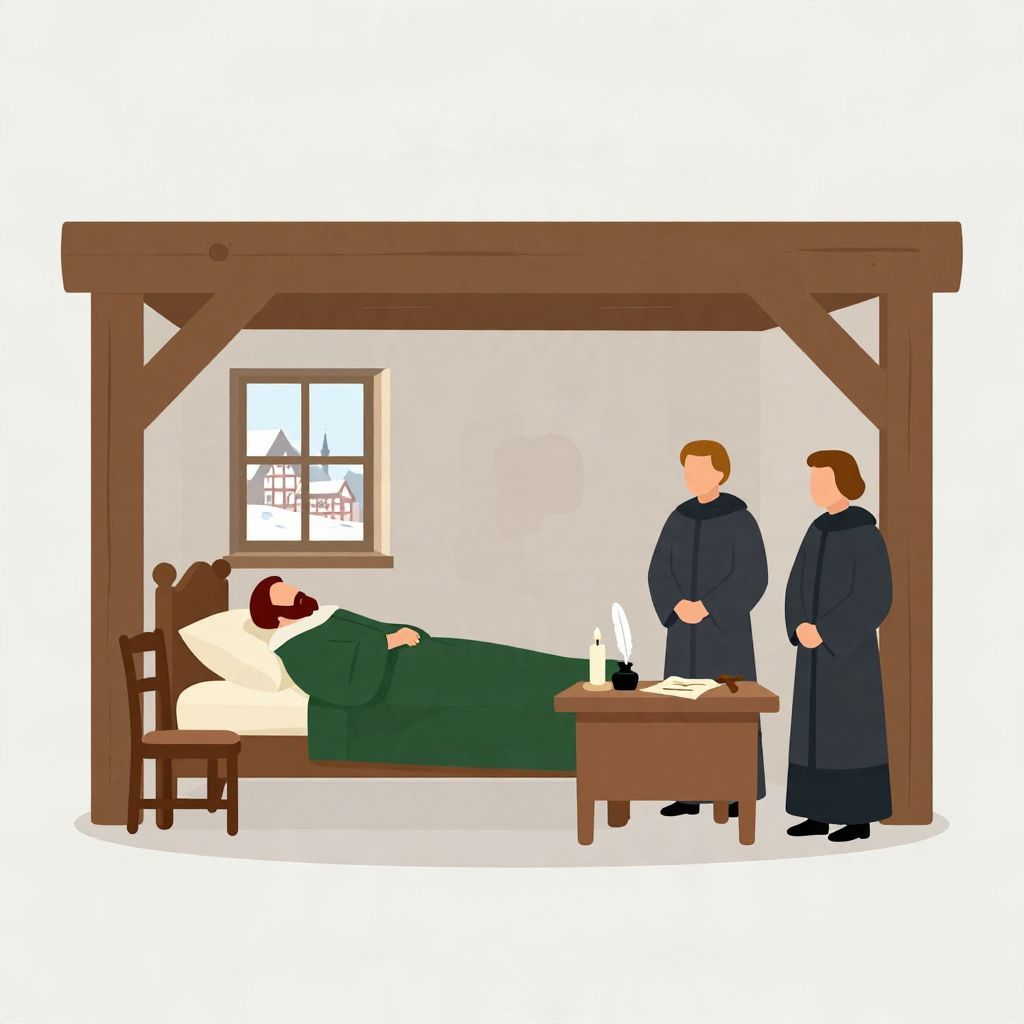
Where did Martin Luther die? The answer is precise: he died in Eisleben, in the County of Mansfeld, on 18 February 1546. Eisleben is now in modern-day Germany, in the state of Saxony-Anhalt. Luther had been born there as well, so his death in the same town gave his life a striking geographic symmetry.
His final days were tied to the region where he was born, educated, and often returned to settle family and church disputes. Understanding the place of his death also helps explain the last phase of the Protestant Reformation and Luther’s continuing role as a religious and political figure in 16th-century Europe.
Where did Martin Luther die?
Martin Luther died in Eisleben, a town in central Germany, on 18 February 1546. He was staying there on church business connected to a dispute in the Mansfeld region when he suffered a fatal illness. Historical accounts agree on the location, though the exact medical cause of death is described in different ways by contemporaries.
The place of death: Eisleben in the Mansfeld region
Eisleben was part of the County of Mansfeld in the Holy Roman Empire, the loose political framework that covered much of central Europe in Luther’s time. Today the town lies in Saxony-Anhalt, Germany. Luther’s death there was not accidental in the broad sense: he had traveled back to his native region to help mediate a local conflict among the counts of Mansfeld.
This matters because Luther was not simply a theologian working from a pulpit or university chair. In his later years, he often acted as a counselor, negotiator, and public authority figure. His final journey to Eisleben shows how deeply his religious influence had become intertwined with regional politics and family affairs.
Why was Luther in Eisleben?
Luther had been asked to help resolve tensions involving the Mansfeld counts, whose disputes affected mining interests and local governance. The area was important economically, especially for copper mining, and Luther’s family had roots there. He was traveling in the winter of 1546 despite fragile health, which suggests both his sense of duty and the seriousness of the conflict.
What happened in Luther’s final days?
Luther arrived in Eisleben in January 1546 and stayed at the home associated with the Counts of Mansfeld. By mid-February, his health had declined sharply. He died during that visit, reportedly after a period of weakness and chest pain. His companions and later chroniclers preserved the broad outline of these final hours, but not every medical detail can be known with certainty.
One reason the story is so well remembered is that Luther’s death was quickly treated as a major event. He was already one of the most famous men in Europe, and his passing raised immediate questions about the future of the Reformation movement he had helped launch three decades earlier.
How did contemporaries describe his death?
Different early accounts describe Luther as suffering from illness that may have been related to heart trouble, exhaustion, or a stroke-like event. Modern historians are cautious about diagnosing him precisely from these reports. The safest conclusion is that he died suddenly after a period of worsening health, rather than from a single clearly documented cause.
What is certain is that he did not die in battle, in prison, or in exile. He died in a room in his home region, surrounded by associates, after a long public career that had transformed European Christianity.
Why Eisleben was important in Luther’s life
Eisleben was important because it was both Luther’s birthplace and his place of death. He was born there on 10 November 1483. That unusual full-circle ending has made the town central to Luther memory and commemoration. For later generations, the fact that he began and ended his life in the same place gave the town symbolic importance far beyond its size.
However, Eisleben was not the center of Luther’s career. His major work was associated with Wittenberg, where he taught theology, preached, and challenged church practice. Still, his return to Eisleben in 1546 shows how closely his personal origins remained connected to his public identity.
Eisleben and the Reformation memory
Because Luther died there, Eisleben became one of the key memorial sites of the Reformation. Visitors often associate the town with his last days, while nearby Wittenberg is linked to the start of his public protest and reforming work. Together, the two places help frame the story of Luther’s life from beginning to end.
How Luther’s death affected the Reformation
Luther’s death did not end the Reformation, but it did mark the close of its founding generation. By 1546, Protestant ideas had spread widely across parts of Germany and beyond. Luther’s death removed the movement’s most influential original voice, even though his writings, sermons, and allies continued to shape Protestant churches.
The timing was significant. The Holy Roman Empire was still deeply divided over religion, and conflict between Catholic and Protestant rulers was intensifying. Luther’s death came just before the Schmalkaldic War, a major conflict between the emperor and Protestant princes. He did not live to see the war’s outcome, but his ideas had helped create the political landscape in which it occurred.
What happened after his death?
- His body was taken back to Wittenberg, where he was buried in the Castle Church.
- His followers continued to systematize Lutheran teaching, turning reform into lasting church structures.
- His death became part of Reformation memory, especially in German-speaking lands.
The burial in Wittenberg is also important. Although he died in Eisleben, his resting place became Wittenberg, the city most closely associated with his reforming work. This means that the geography of Luther’s death and burial are different, and both locations matter historically.
Martin Luther’s last journey: from Wittenberg to Eisleben
Luther’s final trip reflects the practical and political world of 16th-century Germany. Travel was slow and difficult, especially in winter. Yet he still made the journey because he believed the dispute in Mansfeld required his intervention. That willingness to travel despite illness helps explain why his death occurred away from Wittenberg, even though he spent much of his adult life there.
The journey also reveals how Luther’s role had expanded beyond theology. He was consulted by rulers and local elites because his moral authority carried real weight. By the 1540s, he was not just a reformer but a public figure whose opinion mattered in secular as well as religious matters.
Key dates in the final chapter
- 10 November 1483 — Luther is born in Eisleben.
- January 1546 — He returns to the Mansfeld region to mediate a dispute.
- 18 February 1546 — Luther dies in Eisleben.
- Late February 1546 — His body is brought to Wittenberg for burial.
How historians know where he died
The location of Luther’s death is one of the best-established facts in Reformation history. It is supported by contemporary remembrance, later records, and the strong tradition surrounding his final journey. There is no serious historical dispute about the town itself: he died in Eisleben. The main uncertainty concerns the exact medical cause, not the place.
Historians are careful, however, not to overstate the certainty of every detail surrounding the event. Accounts written by friends, followers, and later biographers may differ in emphasis. Some details were shaped by the desire to present Luther’s death as fitting and meaningful. Even so, the central fact remains stable across sources.
Why the question still matters
Asking where Martin Luther died is not just a matter of geography. It opens a window onto the final stage of the Reformation, the political culture of the Holy Roman Empire, and the way historical memory is built around places. Eisleben is remembered not only because Luther died there, but because his death connected his personal story to the wider transformation of European Christianity.
In that sense, the answer is simple but historically rich: Martin Luther died in Eisleben, in 1546, while carrying out one last act of mediation in the region where his life had begun. For readers interested in the broader setting of his life, see also where Martin Luther lived and the wider historical background of what Germany is known for.
Martin Luther’s death in Eisleben closed a remarkable life that had reshaped religion, politics, and culture across Europe. The town is the correct and historically secure answer, but the deeper story is how that place became part of the enduring memory of the Reformation.