
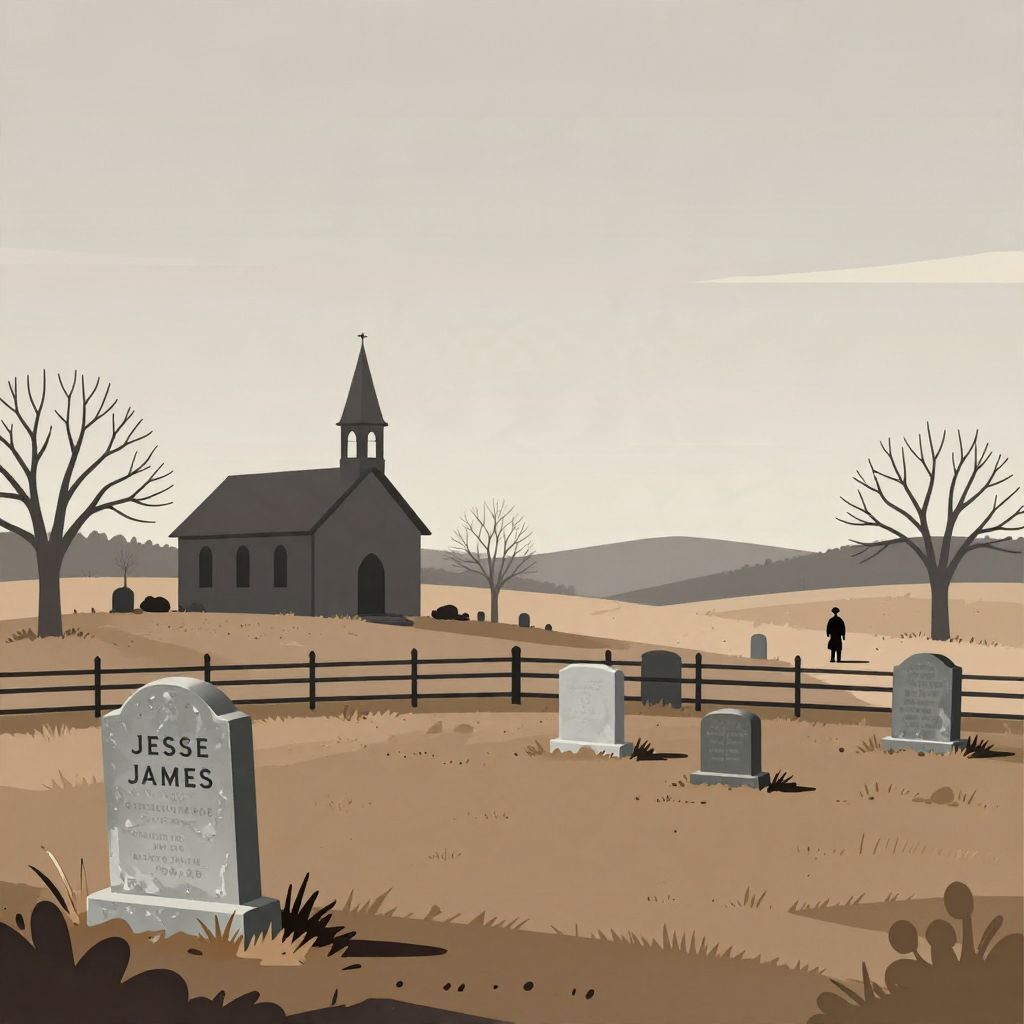
Where is Jesse James buried? The outlaw is buried in Mount Olivet Cemetery in Kearney, Missouri, where his grave remains one of the best-known historical sites connected to the American West. He was killed in 1882, and his burial place has drawn attention ever since because of the legend surrounding his life, death, and the long afterlife of his reputation.
Jesse James’s grave matters not only because he was famous, but because it sits at the intersection of history and folklore. The burial site has become part of the larger story of how Americans remember outlaws, Civil War guerrillas, and the violent world of the postwar border states.
Where Is Jesse James Buried?
Jesse James is buried in Mount Olivet Cemetery in Kearney, Missouri. He was interred there after being shot and killed on April 3, 1882, in St. Joseph, Missouri. His grave is marked and widely visited, making it the accepted burial location for the outlaw whose name became synonymous with the American frontier myth.
Why Jesse James Was Buried in Missouri
Jesse James was a Missourian by birth and identity, and Missouri remained central to his life, crimes, family ties, and public memory. After his death, burial in his home state fit both family preference and local custom. Missouri also became the main stage for his posthumous reputation, especially as stories about his Confederate sympathies and outlaw career spread through newspapers and popular culture.
From Civil War guerrilla to outlaw
James was born in 1847 in Clay County, Missouri, near what is now Kearney. During the Civil War, he became associated with Confederate guerrilla warfare in Missouri, a brutal conflict that blurred the line between military action and irregular violence. After the war, he and his brother Frank James moved into bank and train robbery, building a criminal career that made them famous across the United States.
How his death shaped his burial
Jesse James was killed in St. Joseph by Robert Ford, a member of his own gang who shot him in the back. The dramatic nature of the killing helped turn James into a legend almost immediately. His burial in Mount Olivet Cemetery was not just a family matter; it became part of the public fascination with a man who had already become a figure of rumor, admiration, and condemnation.
The Historical Background of Jesse James’s Grave
The grave at Mount Olivet is important because it reflects how memory can outlast the person buried beneath it. Jesse James was both a real criminal and a cultural symbol. His burial site became a destination for people interested in the Old West, the Civil War era, and the blurred line between fact and myth in American history.
Mount Olivet Cemetery in Kearney
Mount Olivet Cemetery is a Catholic cemetery in Kearney, Missouri, and it is the place most historians and local records identify as Jesse James’s final resting place. The grave is associated with his family plot, which helps explain why he was buried there rather than in St. Joseph, where he died. Kearney’s connection to James is especially strong because it was also near his birthplace.
Why the grave attracts attention
Jesse James’s burial site attracts attention for several reasons:
- He was one of the most famous outlaws in American history.
- His death was dramatic and widely reported.
- His life has been romanticized in novels, films, and folk memory.
- People remain interested in the real history behind the legend.
The grave is not just a burial place; it is a historical landmark tied to the making of the James legend.
Was Jesse James Really Buried There?
Yes. The historical consensus is that Jesse James was buried in Mount Olivet Cemetery in Kearney, Missouri. As with many famous figures, legends developed around his death and identity, but the burial location itself is well established. Questions about his grave usually arise not because the site is unknown, but because his life was wrapped in exaggeration, rumor, and sensational storytelling.
Separating fact from legend
Stories about Jesse James often mix evidence with folklore. Some later tales tried to portray him as a Robin Hood-style figure who stole from the rich and helped the poor, but historians generally reject that image as a myth. The burial site, however, is not part of that legend-making in the same way. It is a documented historical location connected to his family and death.
Why myths grew around his grave
The fascination with his grave reflects a broader American habit of turning frontier violence into folklore. Outlaws, gunslingers, and Civil War guerrillas often became larger-than-life figures after death. Jesse James’s grave, therefore, became a place where history and storytelling met. Visitors were not only looking at a tombstone; they were confronting a memory that had already been shaped by newspapers, dime novels, and public curiosity.
What Happened After Jesse James Was Buried?
After his burial, Jesse James’s reputation continued to grow. His death did not end his story; in some ways, it intensified it. The murder by Robert Ford created a new round of public interest, and the grave became part of a continuing debate over whether James was a villain, a rebel, or a symbol of postwar unrest in Missouri.
The role of family and memory
James’s family remained important in preserving his burial site and shaping how he would be remembered. His brother Frank James later surrendered and lived a long life, which helped keep the family name in public view. Jesse’s grave became a physical reminder of the James family’s place in Missouri history, both as local people and as national figures in outlaw lore.
Tourism and historical interest
Over time, the grave became a stop for tourists, historians, and people interested in the American West. That interest says as much about modern memory as it does about Jesse James himself. His burial place is now part of the heritage landscape of Missouri, where sites connected to the Civil War, frontier conflict, and outlaw history continue to attract attention.
Jesse James’s Life in Brief
Understanding where Jesse James is buried makes more sense when placed within the arc of his life. He was not simply a criminal who appeared out of nowhere; he was shaped by the violence of Civil War Missouri and the unstable decades that followed. His burial in Kearney closes a life that was deeply rooted in that region.
- 1847 — Born in Clay County, Missouri.
- Civil War era — Became involved in Confederate guerrilla activity in Missouri.
- Postwar years — Turned to bank and train robbery with his gang and family network.
- April 3, 1882 — Killed by Robert Ford in St. Joseph, Missouri.
- 1882 — Buried in Mount Olivet Cemetery in Kearney, Missouri.
Why Jesse James Still Matters in American History
Jesse James remains important because he helps historians understand how violence, memory, and myth shaped the post-Civil War United States. His burial site is a useful reminder that famous historical figures are remembered not only through documents and events, but also through places. Graves, monuments, and cemeteries often become part of the historical record themselves.
Outlaw history and public memory
James’s story is often simplified into a tale of daring robbery and frontier legend, but the reality is more complicated. He emerged from a region scarred by war, revenge killings, and political division. His grave in Missouri is therefore more than a tourist destination. It is a marker of a turbulent era when the boundary between wartime violence and peacetime crime could be disturbingly thin.
How historians view him today
Most historians treat Jesse James as a significant criminal figure and a product of his time, not as a heroic rebel. His burial site does not change that assessment, but it does show how strongly the public continues to engage with his story. The grave is one of the most concrete surviving links to a man whose life has often been obscured by legend.
Conclusion
Jesse James is buried in Mount Olivet Cemetery in Kearney, Missouri, and that grave remains the clearest answer to a question that has long drawn curiosity. The burial site is historically important because it connects the outlaw’s real life to the myths that grew around him after his violent death. For readers interested in the wider world of frontier crime and memory, related topics such as the American Civil War and Wild West outlaws offer useful historical context.