
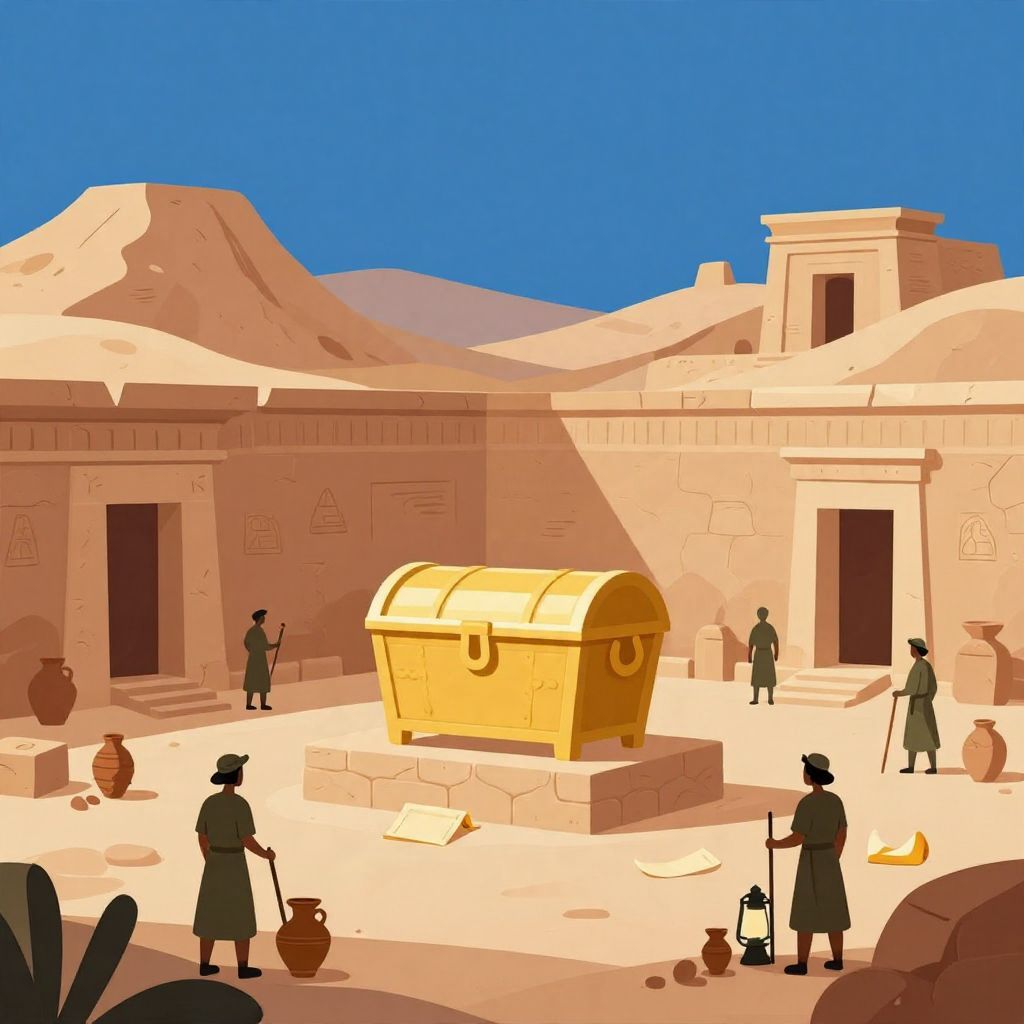
Where is the Ark located? The short historical answer is that no one can verify its current location. The Ark of the Covenant is known from ancient Israelite tradition and biblical texts, but after the First Temple period it disappears from the historical record. What follows is a mix of history, archaeology, religious memory, and later legend.
Because the Ark is one of the most famous lost objects in history, many people ask whether it was hidden, destroyed, or taken away. The evidence is fragmentary, and the most careful answer is that its fate remains unknown.
Where Is the Ark Located?
The Ark of the Covenant has no confirmed modern location. Historically, it was said to have been kept in the inner sanctuary of the Jerusalem Temple before vanishing from the record around the time of the Babylonian destruction of Jerusalem in 586 BCE. Later claims place it in Ethiopia, beneath the Temple Mount, or in secret storage, but none is universally accepted by historians.
What the Ark Was in Ancient History
In biblical tradition, the Ark was a sacred chest associated with the covenant between God and the Israelites. It was said to contain the tablets of the law given to Moses. In the historical memory of ancient Israel, the Ark symbolized divine presence, legitimacy, and national identity.
Its role in early Israelite tradition
The Ark appears in narratives about the wilderness period, the conquest of Canaan, and the early monarchy. These texts present it as a portable holy object carried in procession and placed in sacred spaces. Whether every detail reflects literal history is debated, but the Ark clearly held deep religious meaning for later Israelite and Jewish tradition.
From Shiloh to Jerusalem
According to biblical accounts, the Ark was at times housed at Shiloh and later brought to Jerusalem by King David. Under Solomon, it was placed in the Temple’s innermost chamber, the Holy of Holies. That setting is important because it marks the Ark’s transition from a mobile cult object to the central sacred symbol of the Jerusalem sanctuary.
What History Can Actually Confirm
Historians can say with some confidence that the Ark was part of ancient Israelite religious tradition and that it was associated with the Jerusalem Temple before the Babylonian conquest. Beyond that point, direct evidence disappears. No archaeological discovery has securely identified the Ark itself, and no ancient source gives a reliable, continuous account of its later fate.
The Babylonian destruction and the missing Ark
When the Babylonians destroyed Jerusalem and the First Temple in 586 BCE, many sacred objects were looted, destroyed, or carried away. The biblical books that describe this period do not clearly explain what happened to the Ark. Its absence from later inventories of Temple vessels has led many scholars to conclude that it was lost by then, hidden before the invasion, or already no longer in use.
Why the silence matters
The lack of a clear post-586 BCE reference is one reason the Ark became a mystery. If it had survived openly in the Second Temple period, one would expect stronger historical traces. Instead, later Jewish sources often speak of the Ark as something remembered, mourned, or expected in the future rather than as an object with a known location.
Major Traditions About the Ark’s Location
Several traditions attempt to explain where the Ark went. These accounts are historically interesting, but they should be treated differently from verified evidence. Some are medieval or much later, while others reflect religious hope more than recoverable history.
1. Hidden before the Babylonian conquest
One common tradition says the Ark was hidden before the Babylonians captured Jerusalem. This idea is plausible in a general sense because priests or officials may have tried to protect sacred objects during a crisis. However, there is no surviving contemporary record proving that such a concealment occurred.
2. Buried beneath the Temple Mount
Another tradition places the Ark somewhere beneath the Temple Mount in Jerusalem. This claim appears in various later religious and popular accounts. It is difficult to test archaeologically because the site is sacred and heavily restricted, and there is no accepted evidence that the Ark lies there.
3. Taken to Ethiopia
The best-known alternative tradition is the Ethiopian claim that the Ark was brought to Aksum and is now preserved in a church there. This story is central to Ethiopian Orthodox tradition and has enormous cultural importance. Historically, however, it is not supported by independent ancient evidence that would allow historians to confirm the Ark’s presence there.
4. Destroyed or lost in antiquity
A more cautious historical view is that the Ark may simply have been destroyed, dismantled, or lost during the upheavals of the late First Temple period. Sacred objects made of wood and metal rarely survive millennia unless deliberately preserved. From a historian’s perspective, this is at least as plausible as any surviving-location theory.
Why the Ark Became Such a Powerful Mystery
The Ark’s uncertain fate matters because it sits at the intersection of history and sacred memory. It was not just an artifact; it represented covenant, authority, and divine presence. Once it disappeared, that absence itself became meaningful, inviting speculation, hope, and myth-making across centuries.
Religious meaning after its disappearance
In Jewish tradition, the Ark’s loss was tied to the trauma of exile and the destruction of the Temple. The absence of the Ark helped shape later ideas about holiness, memory, and restoration. In some texts and traditions, the Ark is not merely missing but destined to return in an ideal future age.
Influence on later culture
Over time, the Ark became a subject of fascination far beyond ancient religion. It appears in literature, art, theology, and modern popular culture. That enduring interest often blurs the line between historical inquiry and legend, which is why careful source criticism is essential.
What Archaeology Has and Has Not Found
Despite centuries of searching, archaeology has not produced the Ark of the Covenant. No excavation has yielded an object that scholars agree is the biblical Ark. Claims of discovery tend to rely on private reports, religious testimony, or speculative interpretations rather than verifiable archaeological publication.
The problem of evidence
To identify an object as the Ark, historians would need more than a story. They would need secure archaeological context, material analysis, and a chain of evidence connecting the object to ancient Israelite worship. That standard has not been met.
Why absence is not proof of survival
Sometimes people argue that because the Ark has never been found, it must still exist somewhere hidden. Historically, that is not a strong conclusion. Many ancient objects are missing simply because they were destroyed, reused, or lost. The absence of evidence does not prove survival.
How Historians Approach the Question
Historians separate three different layers in the Ark story: the ancient religious tradition, the historical setting of First Temple Jerusalem, and the later legends that try to explain what happened after the Temple’s fall. That method does not dismiss belief; it simply distinguishes what can be demonstrated from what is remembered or imagined.
Established points
- The Ark is an important object in ancient Israelite and Jewish tradition.
- It was associated with the Jerusalem Temple before the Babylonian destruction.
- No verified evidence confirms its present location.
Uncertain or disputed points
- Whether the Ark survived the Babylonian conquest.
- Whether it was hidden in Jerusalem or elsewhere.
- Whether later traditions about Ethiopia or other locations preserve any historical memory.
So, Where Is the Ark Located Today?
The most responsible answer is that the Ark’s location is unknown. From a historical standpoint, there is no confirmed place where it can be said to exist today. The strongest evidence places it in the religious life of ancient Israel and Jerusalem; after that, its trail goes cold.
That uncertainty is part of why the Ark remains so compelling. It is a rare object whose historical significance is matched by the power of its disappearance. If you want to explore the biblical world that shaped the Ark tradition, see where Canaan was; for another ancient history question with a large legacy, you may also enjoy where Alexander the Great was from.