
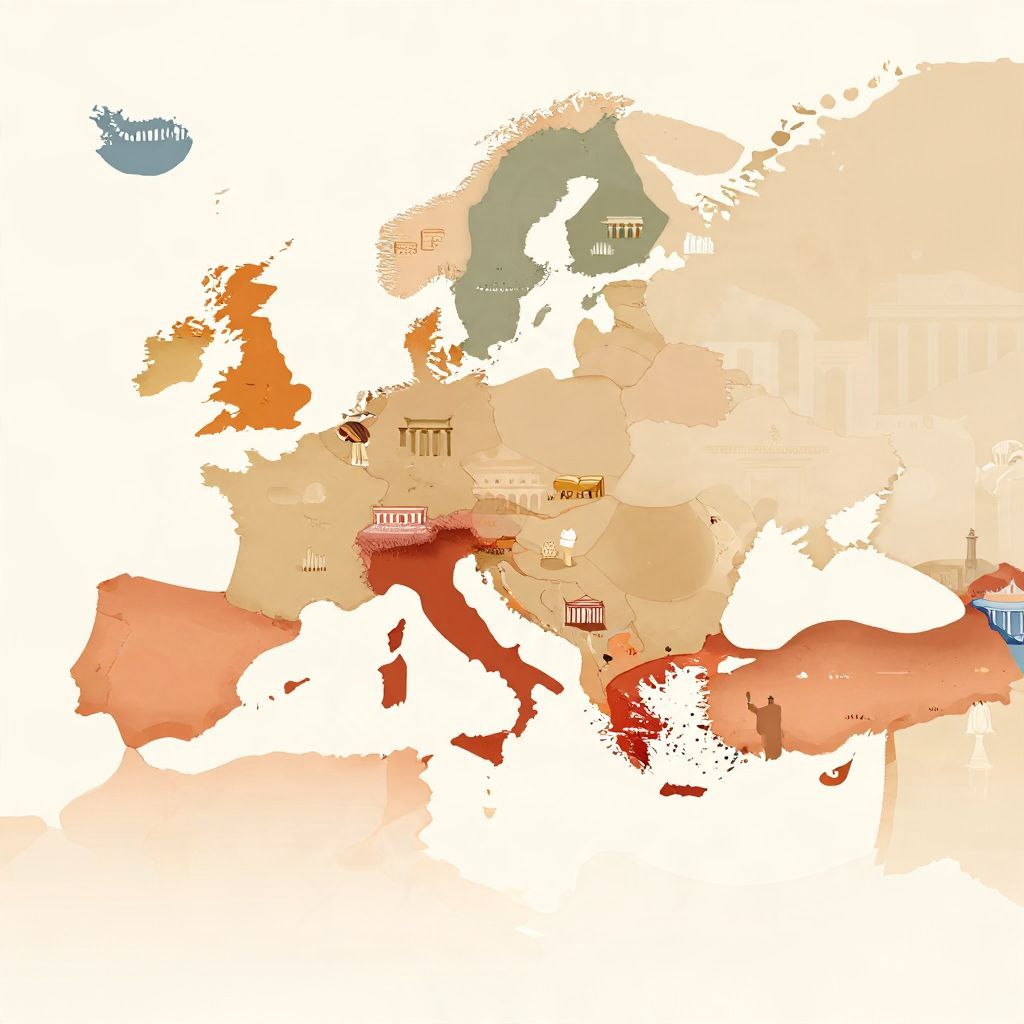
Latin was spoken first in central Italy, especially in and around ancient Rome, and then across much of the Roman world. It began as the language of the Latins in the region of Latium, but Roman expansion carried it into Europe, North Africa, and parts of the Near East.
Over time, Latin became both an everyday spoken language and a language of government, law, the army, trade, and later the Christian Church. Its history is really the history of Rome’s rise, expansion, and long cultural legacy.
Where Was Latin Spoken?
Latin was originally spoken in Latium, the region of central Italy around Rome, and later throughout the Roman Republic and Roman Empire. As Roman power expanded, Latin spread across Italy, Gaul, Iberia, North Africa, the Balkans, and parts of Britain and the eastern Mediterranean. In many places it became the language of administration and daily life, especially in the western empire.
The Original Homeland of Latin
Latin began as one of several ancient Italic languages spoken in central Italy. Its earliest speakers were the Latins, a people living in Latium, the area around the Tiber River and the future city of Rome. This was not yet a world language; it was a regional tongue used by small communities in a landscape of neighboring peoples and languages.
Latium and the early Latin-speaking world
Latium lay in central-western Italy, south of Etruria and north of Campania. Early Latin speakers lived among other Italic groups, including speakers of Oscan and Umbrian, as well as nearby Etruscans. Latin was therefore part of a multilingual ancient Italy, not an isolated language from the start.
The city of Rome, founded in this same region according to traditional chronology in the 8th century BCE, became the most important Latin-speaking center. As Rome grew from a local city-state into a regional power, its language gained prestige and political influence.
How Latin Spread Across the Roman World
Latin spread mainly through conquest, settlement, military service, trade, and administration. Roman soldiers, officials, merchants, and colonists carried the language into newly controlled territories. In the western provinces, Latin often became the dominant public language over generations, especially in towns and cities.
Rome’s expansion and language change
During the Roman Republic and later the Roman Empire, Latin moved far beyond its original home. The process was gradual rather than instant. In some places, local languages remained strong for centuries; in others, Latin became common more quickly because of Roman colonies, army camps, and urban life.
The spread of Latin was especially strong in regions that became deeply Romanized:
- Italy, where Latin became dominant across the peninsula
- Gaul (roughly modern France and parts of Belgium and Switzerland)
- Iberia (modern Spain and Portugal)
- North Africa, especially in Roman cities and coastal areas
- Britain, though Latin never replaced local languages everywhere
- Parts of the Balkans and the Danubian frontier
In the eastern Mediterranean, Greek remained far more dominant than Latin in many cities and provinces. There, Latin was important in administration, the army, and law, but it did not replace Greek as the main everyday language in most areas.
Latin as a Spoken Language in Daily Life
Latin was not only a written language of elite literature. Millions of people used spoken Latin in daily life across the empire, especially in the western provinces. This everyday speech is often called Vulgar Latin, meaning the common spoken form rather than “bad” Latin.
Classical Latin and Vulgar Latin
Classical Latin was the formal literary language used by educated writers such as Cicero, Virgil, and Caesar. Vulgar Latin was the spoken language of ordinary people: soldiers, farmers, shopkeepers, artisans, and families. The two were related, but not identical. Over time, spoken Latin changed from place to place, which is why the Romance languages later developed.
This distinction matters because when people ask where Latin was spoken, they may mean either the polished language of books and inscriptions or the living speech of everyday people. Both existed, but the spoken form was more varied and more widespread.
Where Latin Was Most Strongly Established
Latin became deeply rooted in the western half of the Roman Empire. In many provinces it replaced or overshadowed local languages in urban life, law, and commerce. In some areas it survived the fall of Roman political power and evolved into new languages.
Italy
Italy remained the core Latin-speaking region. Even after Rome’s imperial expansion, Italy continued to be the symbolic and administrative center of Latin culture. Latin was the language of Roman identity, public life, and later Christian scholarship in the West.
Gaul
In Gaul, Latin spread widely after Roman conquest and settlement. Local Celtic languages did not disappear immediately, but Latin became increasingly common in cities, administration, and eventually many rural areas. Centuries later, the Latin spoken in Gaul developed into forms that became French and related languages.
Iberia
Roman rule in Iberia brought Latin to a large and diverse peninsula. As in Gaul, local languages and identities persisted for a time, but Latin eventually became the main language of public life and later the ancestor of Spanish, Portuguese, Catalan, and other Romance languages.
North Africa
Latin was spoken in Roman North Africa, especially in urban centers such as Carthage and surrounding regions. It coexisted with Punic, Berber languages, and Greek in different settings. North African Latin was important in administration and Christian literature, though Arabic later became dominant after the Islamic conquests.
Britain
Latin was spoken in Roman Britain by soldiers, administrators, merchants, and some urban populations. Its reach was more limited than in Gaul or Iberia, and after Roman withdrawal in the early 5th century CE, Latin did not remain the main everyday language of most of the island. Still, it left a lasting mark on place names, inscriptions, and later church life.
Latin Outside the Western Empire
Latin was also present in the eastern provinces of the Roman Empire, but usually as a secondary language. Greek remained the main language of education, literature, and everyday urban communication in much of the East. Latin had prestige because it was the language of Roman power, but it did not replace Greek on the same scale.
The eastern Mediterranean
In areas such as Greece, Asia Minor, Syria, and Egypt, Latin was used by Roman officials, soldiers, and legal authorities. It was important in military and governmental contexts, but Greek remained more widely spoken by the local population. This bilingual reality is one reason the Roman Empire was not linguistically uniform.
How Long Was Latin Spoken?
Latin was spoken for many centuries, beginning in the early first millennium BCE and continuing in changing forms long after the fall of the Western Roman Empire. As a living spoken language, it gradually evolved into the Romance languages rather than disappearing all at once.
From ancient Latin to Romance languages
By late antiquity, the spoken Latin of different regions had begun to diverge significantly. After Rome’s political collapse in the West, local varieties of Vulgar Latin developed more independently. Over time these became French, Spanish, Portuguese, Italian, Romanian, and other Romance languages. In that sense, Latin never fully “died”; it transformed.
Written Latin remained important for centuries after spoken Latin changed. Medieval scholars, clerics, and administrators continued to use Latin as a learned and international language across Europe, even though it was no longer anyone’s native tongue in the same way.
Why Latin Spread So Widely
Latin spread because Roman power was durable, organized, and attractive to many communities. People adopted Latin for practical reasons: to deal with officials, join the army, trade in cities, or participate in Roman institutions. Over time, language shift often followed social and political change.
Key forces behind Latin’s expansion
- Military conquest brought Roman rule to new territories
- Colonies and settlements introduced Latin-speaking populations
- Administration and law made Latin useful for public life
- Urbanization encouraged language mixing and adoption
- Trade and mobility spread Latin across long distances
- Christianity later reinforced Latin in the western church
Language change was usually uneven. Elites often adopted Latin first, followed by urban populations, and later rural communities. In some regions, local languages persisted alongside Latin for generations before fading or blending.
What Latin Was Not
It is easy to imagine Latin as a single, fixed language spoken everywhere in exactly the same way, but that is not historically accurate. Latin varied by region, class, and period. It was also not the only language of the Roman world. Greek, Punic, Hebrew, Aramaic, Egyptian, Celtic, Berber, and many other languages remained important in different places.
Not all Roman subjects spoke Latin
Roman rule did not erase linguistic diversity. Many people in the empire never became fluent in Latin, especially in the eastern provinces. Even in the West, the degree of Latinization differed from one region to another. The Roman Empire was multilingual, with Latin serving as the most important unifying language in the West rather than a universal mother tongue.
The Lasting Legacy of Latin
The historical question “Where was Latin spoken?” leads to a broader answer: Latin was spoken first in Latium, then across the Roman Empire, and later in transformed forms throughout much of Europe and beyond. Its legacy survives not only in the Romance languages but also in law, religion, science, and scholarship.
In the end, Latin was both a local Italian language and an imperial language of enormous reach. It began in one small region, expanded with Roman power, and outlived the empire by becoming the ancestor of new languages and a learned language of Europe for centuries. For related background, see Is Latin a Language? and How Old Is Latin?.