
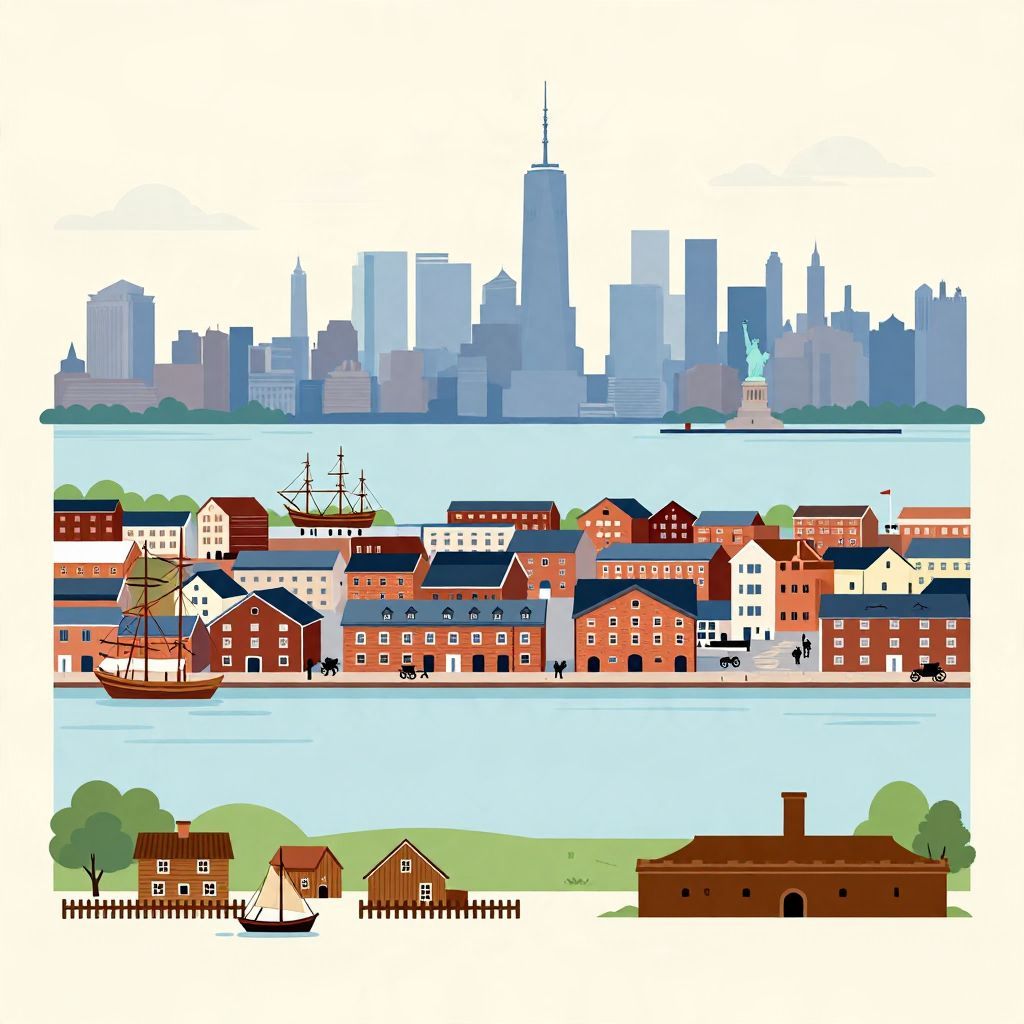
How old is New York City? The short answer is that the city is usually dated from 1624, when the Dutch established a settlement at New Amsterdam in the area that is now lower Manhattan. That makes New York City about 402 years old in 2026, though the exact “birthday” depends on whether you mean the first European settlement, the formal founding of the colony, or the city’s later incorporation.
Because New York grew through colonization, conquest, and expansion, its age is best understood as a historical timeline rather than a single moment. The land was home to Indigenous peoples long before Europeans arrived, and the city’s modern identity developed over centuries of change.
How old is New York City?
New York City is generally considered to be founded in 1624, when the Dutch West India Company established a settlement in the region. If counted from that year, the city is 402 years old in 2026. Some people instead use 1626, when the Dutch purchased Manhattan, or 1898, when the modern five-borough city was consolidated.
The earliest history of the New York area
Long before New York City existed, the region was inhabited by Indigenous peoples, especially the Lenape. Their communities lived, fished, farmed, and traded across the harbor, rivers, and islands that would later become the city. This is an important reminder that the city’s history did not begin with Europeans.
When explorers from Europe reached the area in the early 1600s, they entered a landscape already shaped by Native settlement and diplomacy. The harbor’s deep water, access to the Hudson River, and position between inland trade routes made it strategically valuable.
Henry Hudson and Dutch claims
In 1609, the English explorer Henry Hudson, sailing for the Dutch, explored the river that now bears his name. His voyage helped convince Dutch merchants that the region could support trade, especially in furs. Dutch interest soon turned into colonial settlement.
Why 1624 is usually treated as the founding year
The year 1624 is commonly used because that was when the Dutch West India Company began establishing a permanent colonial presence in the area. A small group of settlers arrived in New Netherland, and the colony started taking shape. In historical terms, this is the clearest early date for the city’s origin.
Still, historians sometimes discuss 1625 or 1626 as well. The reason is simple: colonial beginnings are often messy. Settlement, administration, land purchase, and urban development did not happen all at once. Different milestones can matter depending on the question being asked.
1626 and the Manhattan purchase
In 1626, the Dutch are traditionally said to have purchased Manhattan from the Lenape. This event is famous, but it should be understood carefully. The transaction was not a modern real-estate sale in the contemporary sense; it reflected very different ideas about land use, ownership, and authority. Even so, it became a major turning point in the history of the settlement.
New Amsterdam becomes New York
In 1664, English forces seized New Netherland from the Dutch, and New Amsterdam was renamed New York in honor of the Duke of York. This was one of the most important political changes in the city’s early history. The population, trade networks, and street patterns were already established, but sovereignty shifted from Dutch to English control.
The name change did not erase the city’s Dutch past. Many local customs, property lines, and commercial habits survived. New York’s later identity was shaped by this layered colonial inheritance, which helped make it a place of cultural mixing from the beginning.
From colonial port to revolutionary city
During the 1700s, New York grew into a busy colonial port. Its location made it a center for commerce, shipping, and immigration. By the time of the American Revolution, it was one of the most important cities in British North America.
The city played a major role in the Revolution, though not always as a heroic stronghold. British forces occupied New York from 1776 to 1783, making it a strategic military base. After the war, the city emerged as a crucial economic center in the new United States.
New York as the first U.S. capital
New York City briefly served as the first capital of the United States under the Constitution. George Washington took the oath of office there in 1789. The federal government later moved to Philadelphia and then to Washington, D.C., but New York had already established itself as a national center of finance and trade.
How the modern city took shape
The city we know today was not created all at once. It developed through annexation, immigration, infrastructure, and political consolidation. During the 19th century, New York expanded rapidly as millions of immigrants arrived through its harbor, especially from Ireland, Germany, Italy, and Eastern Europe.
Industrial growth, tenement housing, and the rise of Wall Street transformed the city into a global metropolis. At the same time, inequality, overcrowding, and periodic violence shaped everyday life. New York’s growth was dramatic, but it also came with social conflict and public health challenges.
The consolidation of 1898
A major milestone came in 1898, when the city of New York was consolidated into the five boroughs: Manhattan, Brooklyn, Queens, the Bronx, and Staten Island. This created the modern city government and gave New York its current municipal form.
For that reason, some people informally think of New York City as “founded” in 1898. But historically, that date refers to the unification of separate local governments, not the beginning of the city itself. The older settlement dates are still the more accurate answer to the question of age.
So which date should you use?
The best answer depends on context. If you are asking when the city first began as a European settlement, use 1624. If you mean the Dutch purchase often associated with Manhattan’s early colonial history, mention 1626. If you mean the present-day five-borough municipality, use 1898.
- 1624 — first Dutch settlement in New Netherland; most common founding date
- 1626 — traditional date of the Manhattan purchase
- 1664 — English takeover and renaming to New York
- 1789 — New York serves as the first U.S. capital
- 1898 — consolidation into the modern five-borough city
Why New York’s age is more complicated than it seems
Questions about a city’s age often assume there is one exact birthday. In reality, cities usually develop over time. New York is a good example because its history includes Indigenous settlement, Dutch colonization, English rule, independence, and modern consolidation. Each stage matters for a different reason.
That complexity also reflects the city’s character. New York has never been a place with a single origin story. It has always been shaped by movement: people arriving, leaving, trading, governing, rebuilding, and redefining the city’s boundaries and identity.
What New York’s long history means today
New York City’s age helps explain why it feels both ancient and modern. Its streets preserve traces of colonial settlement, its institutions reflect centuries of political change, and its neighborhoods show waves of immigration and reinvention. The city’s past is not just old; it is layered.
So, how old is New York City? Most historians would answer: about 402 years old, counting from the Dutch settlement of 1624. But the fuller story is that New York’s history began long before that, with the Lenape, and continued through many turning points that turned a colonial outpost into one of the world’s great cities. For more on related history questions, see what is the oldest city in America and whether Gangs of New York is a true story.