
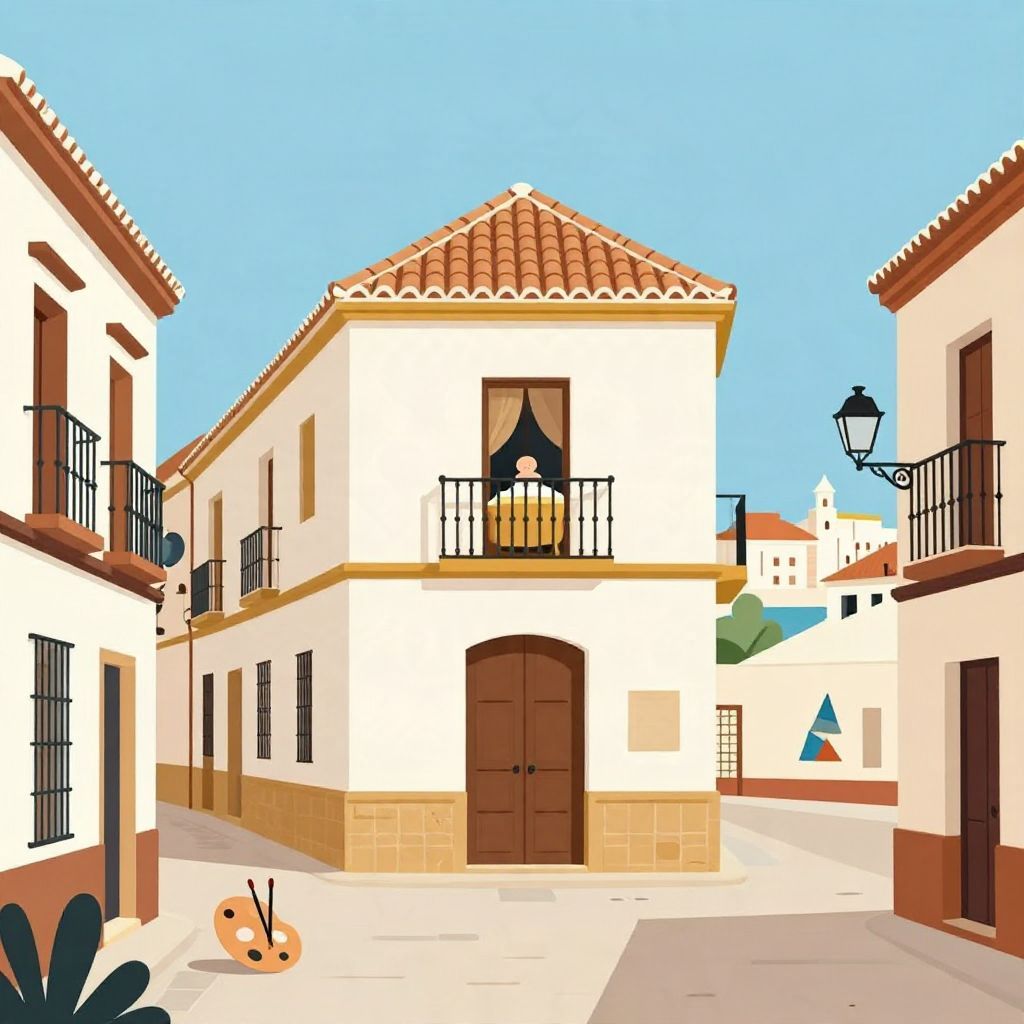
When people ask, “Where was Picasso born?” they are usually looking for the exact place tied to one of the most influential artists of the modern era. The answer is straightforward, but the background matters too, because Picasso’s birthplace helps explain the Spanish roots that shaped his early life and identity.
Pablo Picasso was born in Málaga, Spain, on October 25, 1881. He entered the world in the southern Andalusian port city, a place that belonged to the Kingdom of Spain and that remained central to his personal story even after he spent much of his adult life in France.
Where Was Picasso Born?
Picasso was born in Málaga, a historic city on Spain’s southern Mediterranean coast. More precisely, he was born at 36 Plaza de la Merced, in the center of Málaga. The city was part of Andalusia, a region known for its layered cultural history, maritime trade, and strong artistic traditions. Although Picasso later became associated with Paris and modern art in general, his birthplace was unmistakably Spanish.
The exact birthplace in Málaga
The house where Picasso was born stood in one of Málaga’s central squares, Plaza de la Merced. Today it is closely associated with his memory, but in 1881 it was simply a family residence in a busy urban neighborhood. The location matters because it places Picasso not in an isolated rural setting, but in a commercial and culturally active city that connected southern Spain to broader Mediterranean and European currents.
Why Málaga Matters in Picasso’s Early Life
Málaga was more than a birth certificate detail. It was the first environment that surrounded Picasso with the sights, sounds, and social rhythms of Andalusia. The city’s festivals, bullfighting culture, religious processions, and coastal atmosphere belonged to a region with a distinctive artistic identity. Even though Picasso left Málaga while still young, his Andalusian origins remained part of how he understood himself.
Andalusia and Spanish identity
Picasso’s birthplace in Andalusia is important because the region had long been associated with a rich blend of influences: Roman, Islamic, Jewish, Christian, and Mediterranean. That deep historical mixture did not determine Picasso’s art in any simple way, but it formed part of the cultural world into which he was born. His later work would move far beyond regional tradition, yet his Spanish beginnings never disappeared from his biography.
Picasso’s Family Background at Birth
Picasso was born into a family with strong ties to education and the arts. His father, José Ruiz Blasco, was a painter and art teacher, which gave the young Picasso an unusually direct introduction to drawing and painting. His mother, María Picasso y López, came from a family with roots in the region. The family environment in Málaga helped create the conditions in which his talent could be noticed early.
What his name tells us
Picasso’s full name was Pablo Ruiz Picasso. In Spanish naming customs, a person often carries both paternal and maternal surnames. He later chose to use his mother’s surname professionally, becoming known simply as Picasso. That decision helped distinguish him as an artist and gave his name the global recognition it has today.
The Historical Context of Málaga in 1881
To understand Picasso’s birth, it helps to place it in the Spain of the late 19th century. In 1881, Spain was a constitutional monarchy under King Alfonso XII, following a period of political instability, civil conflict, and shifting governments. Málaga itself was a modernizing port city, shaped by trade, industry, and urban growth, even as much of Spain still faced economic inequality and social tension.
A city between tradition and modernity
Málaga in the late 1800s was not a sleepy provincial town. It had factories, shipping links, and a lively urban culture. At the same time, it remained strongly connected to older Andalusian traditions. That combination of change and continuity is part of the historical backdrop to Picasso’s birth. He was born into a Spain that was not yet modern in the contemporary sense, but was already moving toward the social and cultural transformations of the 20th century.
How Picasso’s Birthplace Influenced His Later Life
Picasso did not spend his entire childhood in Málaga. His family moved several times, including to La Coruña and later Barcelona, where his artistic development accelerated. Still, Málaga remained the place of origin. For historians and biographers, birthplace matters because it anchors a life in time and space. In Picasso’s case, it marks the starting point of a career that would eventually reshape painting, sculpture, printmaking, and collage.
From Málaga to the wider art world
Picasso’s later fame often overshadows his beginnings, but his trajectory was not accidental. Being born in a family with artistic support, in a city connected to wider cultural currents, gave him early exposure to visual culture. His move away from Málaga did not erase its importance; instead, it became one of several places that formed his identity before he became an international figure.
What Is Known and What Is Sometimes Misunderstood
There is little serious dispute about where Picasso was born. The established historical record places his birth in Málaga on October 25, 1881. Confusion sometimes arises because people associate him more strongly with France, where he lived for much of his adult life, or with Barcelona, where he trained and matured as an artist. But those are later chapters in his story, not the answer to his birthplace.
Birthplace versus nationality and career
Picasso’s life shows why birthplace and identity are not the same thing. He was Spanish by birth and early upbringing, yet he became a central figure in the international art world, especially in Paris. He later lived in France for decades and is often discussed in the context of French modernism. Even so, his birth in Málaga remains a fixed historical fact and a key part of his biography.
Picasso’s Early Years After Málaga
Picasso’s family did not remain in the city for long. His father’s teaching posts took the family to other Spanish cities, and the young Picasso moved through different cultural settings during childhood and adolescence. These moves exposed him to varied artistic influences and helped him develop with unusual speed. His birthplace was the beginning, but his formation was shaped by movement across Spain.
A brief timeline of the early years
- 1881: Born in Málaga, Spain.
- Early 1890s: Family life and artistic training continue in other Spanish cities.
- 1895: The family moves to Barcelona, where Picasso’s artistic development deepens.
- 1904: He settles in Paris, the city most associated with his mature career.
Why the Birthplace Still Matters Today
Picasso’s birthplace continues to attract interest because it offers a concrete link between a global artistic icon and a specific historical place. Museums, memorial sites, and public memory in Málaga reflect that connection. For visitors and readers alike, the question “Where was Picasso born?” opens a wider story about how local history can shape a world-famous individual.
Historical memory and cultural heritage
Málaga has embraced its association with Picasso as part of its cultural heritage. That does not mean the city “created” his genius, but it does mean his birthplace has become a meaningful part of how the city presents its own history. In this way, Picasso’s birth site is both a biographical fact and a symbol of the relationship between place and artistic identity.
In short, Picasso was born in Málaga, Spain, in 1881. His birthplace is the starting point of a life that would move from Andalusia to Barcelona and then to Paris, but the historical answer remains clear: the artist known worldwide as Picasso began his life in southern Spain. If you are interested in related cultural history, you may also enjoy learning about the Spanish Civil War or Paris in the 19th century.