
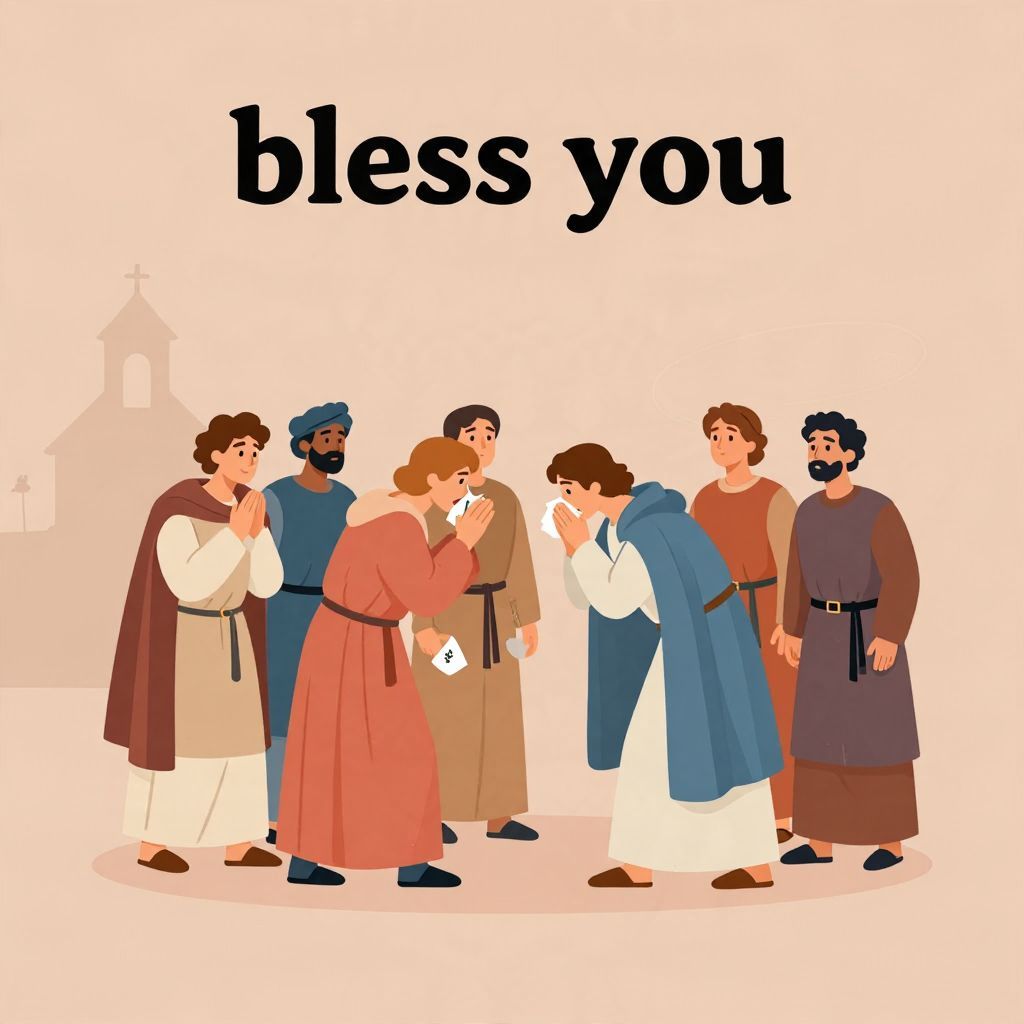
Why do we say “bless you” when someone sneezes? The short answer is that the phrase grew out of older beliefs that a sneeze could signal danger, illness, or even a spiritual threat. Over time, a practical response to a bodily reflex became a polite custom, and in some places a religious wish for protection.
The tradition is old, but its exact origin is not certain. Different explanations developed in different eras, and the custom changed as medical knowledge, religion, and social manners changed too.
Why Do We Say “Bless You” When Someone Sneezes?
We say “bless you” because sneezing was once thought to be a sign of vulnerability, illness, or bad luck, so people offered a blessing as protection. The phrase became a social courtesy in Christian Europe and later a general polite response. Today, it survives mostly as a habit rather than a literal religious act.
The Ancient Background: Sneezing as a Sign
Long before modern medicine, people tried to explain sudden sneezing through religion, superstition, and observation. A sneeze could seem alarming because it was abrupt, noisy, and sometimes repeated during illness. In societies without germ theory, it was natural to attach meaning to such a dramatic bodily event.
Ancient beliefs about the body and the soul
In the ancient world, many cultures believed that the body and spirit were closely connected. A sneeze might be interpreted as the body reacting to an outside force, or even as a moment when the soul was briefly exposed. That idea is not supported by modern science, but it helps explain why people developed protective responses.
In classical antiquity, sneezing could be treated as an omen. Greek and Roman writers recorded both favorable and unfavorable interpretations depending on context. In some traditions, a sneeze was a sign from the gods; in others, it was simply a bodily event that deserved acknowledgment. What matters historically is that sneezing was not seen as medically neutral in the way it is today.
Plague and fear of illness
Another important reason the custom endured was fear of disease. During periods of epidemic illness, especially in premodern Europe, a sneeze could be associated with sickness spreading through a household or city. People did not know about viruses or bacteria, but they did understand that illness could pass from person to person. A blessing could function as both comfort and protection.
How Christianity Shaped the Phrase
Christianity gave the custom a stronger and more recognizable form in Europe. Blessings were central to Christian life, and asking for divine protection in everyday moments was common. Over time, saying “God bless you” after a sneeze became a socially acceptable way to respond, especially in Christian communities.
Pope Gregory I and the plague tradition
One popular explanation links the phrase to Pope Gregory I, who led the church from 590 to 604, during a time of plague in Rome. According to later tradition, he encouraged people to say a blessing when someone sneezed because sneezing could be a sign of illness. This story is widely repeated, but historians treat it cautiously because it comes from later retellings rather than firm contemporary evidence.
Even if the Gregory story is not fully verifiable, it reflects a real historical setting: plague, fear, and religious responses to disease. In that world, a blessing after a sneeze made emotional and spiritual sense. It was a small ritual of care in a dangerous age.
“God bless you” as a social formula
By the medieval and early modern periods, “God bless you” had become more than a spontaneous prayer. It was a formula of courtesy. Like other polite phrases, it could be used without deep theological intent. The words remained religious in form, but everyday usage gradually made them part of ordinary manners.
This shift is important. Many customs begin as meaningful religious or symbolic acts and later become habits that people repeat automatically. “Bless you” is one of the clearest examples of that process.
Why Sneezing Needed a Response in the First Place
To understand the custom, it helps to ask why people felt a sneeze required any response at all. The answer lies in the combination of danger, etiquette, and symbolism. A sneeze interrupts conversation, can spread droplets, and was once linked to illness. Responding quickly with a blessing signaled attention and goodwill.
A moment of vulnerability
A sneeze leaves a person briefly unable to speak normally and sometimes physically exposed. In older belief systems, that moment could seem spiritually risky. A blessing offered reassurance that the person was safe, protected, or at least remembered by others.
Politeness and social order
As societies became more formalized, small gestures helped maintain social harmony. Saying “bless you” after a sneeze became one of those gestures. It was brief, easy to learn, and widely understood. Even people who did not believe in the original superstition could still use it as a sign of manners.
Different Explanations Across Europe and Beyond
The custom did not develop in exactly the same way everywhere. In some places, people said a blessing because of Christian tradition; in others, the response was tied to local beliefs about luck, the soul, or health. The history of the phrase is therefore less a single origin story than a cluster of related customs.
Folklore and popular legends
One common folk explanation says that sneezing expels evil spirits, so a blessing helps prevent harm. Another says the heart briefly stops during a sneeze, so the blessing is a wish for life and recovery. These ideas are popular, but they are not reliable historical explanations for the phrase’s origin. The heart-stopping claim is especially a modern myth, not an ancient fact behind the custom.
What historians can say with confidence is that people across many cultures have attached meaning to sneezing. The specific wording “bless you” is tied most clearly to Christian Europe, but the broader instinct to respond to a sneeze is much older and more widespread.
Language and translation
The English phrase “bless you” is only one version of a broader tradition. Other languages use different expressions, some religious and some secular. That variety shows how the custom adapted to local culture. The underlying impulse is similar: acknowledge the sneeze, wish the person well, and restore the flow of social interaction.
When Did “Bless You” Become Common in English?
It is difficult to give an exact first date for the English phrase. Customs usually spread gradually, first among religious communities and then into broader society. By the early modern period, the response to sneezing was familiar enough that it could be treated as normal everyday speech.
From religious blessing to automatic reply
In earlier centuries, saying “God bless you” after a sneeze may have sounded like a genuine prayer. As the phrase spread, it became less about theology and more about social convention. People kept saying it because everyone expected it. That is how many traditions survive: repetition gives them authority even after their original meaning fades.
Why the shorter “bless you” survived
The shortened form became common because it is quicker and less explicitly religious than “God bless you.” In modern English-speaking societies, many people use “bless you” simply as a polite reflex. Others still prefer the longer form for religious reasons. Both versions reflect the same historical inheritance.
What Modern Medicine Changed
Modern medicine changed the explanation for sneezing, but not the custom itself. Today we know that sneezing is a natural reflex, often triggered by irritation in the nose. We also understand that colds and allergies can cause repeated sneezing. Scientific knowledge removed the old mystery, but social habits are often slower to disappear than beliefs.
Health awareness and etiquette
In the modern world, the response to a sneeze can also reflect hygiene. People may say “bless you” out of habit, but they may also be signaling concern or acknowledgment. During outbreaks of contagious illness, sneezing has taken on renewed public attention, though the phrase itself remains mostly ceremonial.
Why the custom persists
The phrase lasts because it is short, familiar, and socially useful. It does not require agreement about religion or superstition. Even in secular settings, it works as a small act of kindness. Few traditions survive for centuries unless they serve more than one purpose, and “bless you” does exactly that.
So What Is the Real Historical Answer?
The real historical answer is that “bless you” began as a protective response to a sneeze in a world shaped by religion, superstition, and fear of disease. Christianity helped make the phrase widespread in Europe, but the custom also drew on older ideas about omens and vulnerability. Over time, it became a polite social habit, largely detached from its original beliefs.
That is why the phrase still feels natural today: it is both ancient and ordinary. A tiny everyday expression carries a long history of fear, faith, and courtesy. If you want to explore how customs develop and spread, see what is a tradition? and what is cultural divergence?