
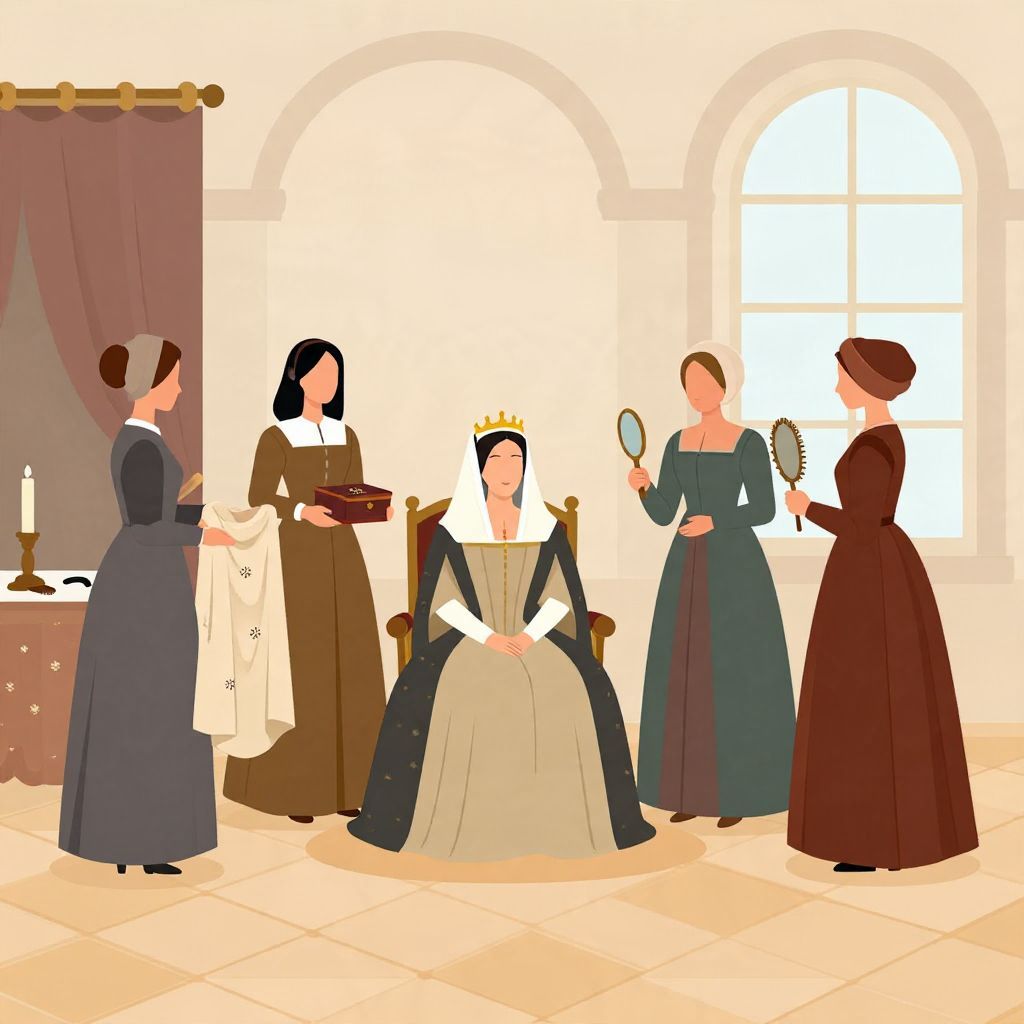
What are ladies in waiting? In historical terms, they were women who attended and assisted a queen, princess, or other high-ranking noblewoman in a royal or aristocratic household. Their role was part companionship, part household service, and part court politics, and it changed over time depending on the country and period.
They were not simply servants, nor were they always close friends. Ladies in waiting could be noblewomen themselves, chosen for status as much as skill, and they often lived near the center of power. Their duties reveal how royal courts worked, how elite women were educated and supervised, and how influence could be exercised behind the scenes.
What are ladies in waiting?
Ladies in waiting were female attendants who served a queen or other noblewoman in a royal household. They helped with personal care, dress, travel, ceremonies, and daily company. In many courts they were gentlewomen of rank, making the role both a service position and a path to influence, patronage, and political visibility.
The basic meaning of the term
The phrase generally refers to women who “waited upon” a mistress of high rank. In practice, that could mean helping her dress, accompanying her in public, managing her private rooms, or keeping her company during long hours of court life. The exact title and duties varied widely by time and place.
Not the same as ordinary servants
Although the job included practical tasks, ladies in waiting were often socially distinct from kitchen staff, maids, or other household workers. Many were born into noble or gentry families. Their presence reflected the hierarchy of the court: they were attendants, but also members of the elite world surrounding the ruler.
Where did ladies in waiting come from?
The custom developed in medieval and early modern European courts, where royal households became highly organized centers of power. Similar forms of female attendance existed in other cultures too, but the English phrase “lady in waiting” is most closely associated with European monarchy, especially from the Middle Ages onward.
Medieval court households
By the later Middle Ages, royal households had become structured institutions. Queens and princesses needed attendants for privacy, security, ceremony, and administration. Women of rank were placed around them to provide companionship and to ensure that a royal woman was never entirely alone in public or private settings.
Influence from aristocratic culture
In elite society, women were expected to move within carefully managed social spaces. A lady in waiting could represent her family’s interests at court, strengthen alliances, and observe political developments. Because courts were centers of gift-giving, patronage, and access to the monarch, even a seemingly domestic role could carry real political weight.
What did ladies in waiting do?
They assisted with the daily life of their mistress, but their work extended beyond chores. A lady in waiting might help with clothing, grooming, correspondence, travel arrangements, entertainment, and ceremonial appearances. She also provided conversation, emotional support, and a trusted presence in a world where rank and etiquette mattered constantly.
Typical duties
- Helping the queen or noblewoman dress and prepare for public appearances
- Accompanying her to religious services, meals, hunts, and ceremonies
- Reading letters, delivering messages, or managing small personal tasks
- Providing companionship in private apartments or during travel
- Assisting with court rituals and formal receptions
Why the role mattered
At court, access was power. A lady in waiting might hear private conversations, witness negotiations, or help control who could approach the queen. In some cases, she became a confidante who could influence appointments, favors, or information flow. That made the role socially important even when its duties looked domestic on the surface.
Were ladies in waiting noblewomen?
Often, yes. In many European courts, ladies in waiting were drawn from noble or gentry families. Their status made them suitable companions for a queen, and their families benefited from the prestige of court service. However, the exact social background varied by country, century, and the rank of the woman being served.
Why elite families wanted the post
Court service offered visibility, proximity to power, and opportunities for marriage or patronage. A family might place a daughter at court to enhance its standing, build connections, or secure favor. For the woman herself, the position could provide education in manners, politics, languages, and courtly behavior.
Education and training
Many ladies in waiting were expected to be polished, literate, and capable of navigating etiquette. They needed discretion, loyalty, and social intelligence. In some settings they also served as examples of refined female conduct, helping to shape the image of the queen they attended.
How did the role differ by country and period?
The title “lady in waiting” is most familiar in English, but comparable offices existed across Europe. The structure of a queen’s household in France, Spain, England, Scotland, and other monarchies could differ considerably. Some courts had tightly defined ranks; others used broader household titles with overlapping responsibilities.
England and Britain
In English and later British history, the queen’s household included women with titles such as ladies of the bedchamber, maids of honor, and women of the bedchamber, alongside ladies in waiting in the broader sense. These positions changed over time, especially as the monarchy became more ceremonial and less directly governing.
France and other European courts
French courts were often highly formalized, with carefully ranked female attendants. In Spain and other Catholic monarchies, queens’ households also followed strict ceremonial rules. Across Europe, the core idea remained similar: elite women served a royal mistress in both practical and symbolic ways.
Outside Europe
Comparable roles existed in imperial and court cultures elsewhere, though the terminology differs. In some Asian, Middle Eastern, and African courts, women attendants served rulers, consorts, and princesses in structured palace households. Historians usually avoid forcing the European term onto these systems, since the social meanings were not identical.
What was life like for a lady in waiting?
Life at court could be prestigious, but it was also demanding. A lady in waiting lived under scrutiny, followed strict etiquette, and often had little privacy. She might enjoy fine clothing, access to elite society, and the excitement of court events, yet she also had to manage competition, hierarchy, and political tension.
Privileges and pressures
Some ladies in waiting received lodging, meals, clothing allowances, or gifts. They attended banquets, masques, hunts, and ceremonies. But they were also expected to be loyal, discreet, and always ready to serve. Court life could be unstable, especially when a queen fell from favor or a political faction changed power.
Marriage and career prospects
For many women, court service was temporary. It could lead to a favorable marriage or a long-term place in an aristocratic household. For others, especially widows or unmarried women of rank, it could become a lasting role. In some cases, ladies in waiting remained close to a queen for decades.
Famous ladies in waiting and historical influence
Some ladies in waiting became historically significant because they were politically active, socially influential, or closely connected to major events. Their importance often came not from formal office alone, but from access to rulers and the ability to shape information, alliances, and reputations.
Examples from royal history
At the Tudor and Stuart courts, women in the queen’s household could become central figures in factional politics. In France, court women sometimes acted as intermediaries between noble families and the crown. Across Europe, a trusted attendant might help manage petitions, relay messages, or support a queen during crisis.
When the role became political
Because queens were often expected to embody dynastic legitimacy, the women around them could become part of larger struggles over succession, religion, or patronage. A lady in waiting might be remembered in chronicles not for her domestic duties, but for her loyalty, influence, or involvement in court intrigue.
How did the role change over time?
The role of ladies in waiting evolved as monarchy itself changed. In the medieval period, royal households were practical centers of governance and daily life. In the early modern era, courts became more ceremonial and more politically theatrical. By the nineteenth and twentieth centuries, the role often became largely ceremonial and representational.
From household service to ceremonial attendance
As monarchies modernized, the daily administrative burden on queens diminished. Ladies in waiting increasingly became companions, organizers of appearances, and symbols of continuity rather than active household managers. In some modern monarchies, the position survives in a reduced and more formalized form.
Why the term still matters
The phrase remains useful because it captures a specific historical relationship: a woman of standing attending a royal or noble mistress in a world shaped by rank, etiquette, and access. It also reminds us that women’s roles at court were not marginal; they were often central to how power was experienced and displayed.
Key facts about ladies in waiting
- They were female attendants to queens, princesses, or noblewomen.
- Many were from noble or gentry families rather than ordinary servant backgrounds.
- Their duties included companionship, personal assistance, travel, and ceremonial attendance.
- They could have political influence because they were close to power.
- The role varied by country, period, and court culture.
- In modern monarchies, the position is often ceremonial rather than administrative.
Why ladies in waiting matter in history
Ladies in waiting help historians understand how courts functioned as social systems, not just political institutions. Their presence shows how gender, rank, and access shaped power. They were part of the machinery of monarchy, but also individuals who could advise, observe, and sometimes influence events from within the queen’s inner circle.
So, what are ladies in waiting? They were elite female attendants who served royal or noble women, combining personal service, companionship, and social influence in one of history’s most carefully ordered environments. For related reading, see what is a lady in waiting to the queen and what is a lady in waiting.