
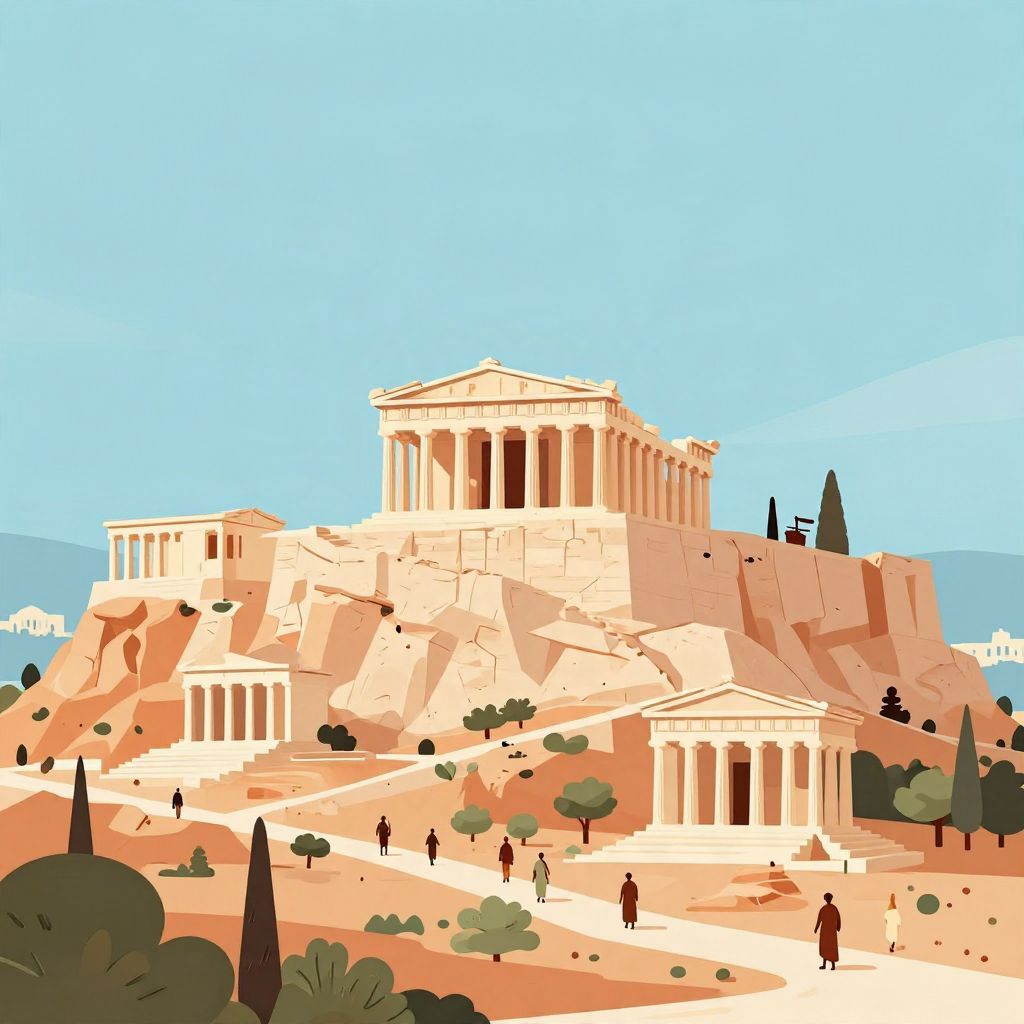
What is the Acropolis, and why does it matter so much in ancient and modern history? The word usually refers to the famous hilltop complex in Athens, but it also describes a type of fortified high place used by many Greek cities. In the Athenian case, the Acropolis became a sacred, political, and architectural center that still shapes how people think about classical Greece.
Its ruins are best known for the Parthenon, yet the site’s history stretches from the Bronze Age through Roman, Byzantine, Ottoman, and modern Greek times. Understanding the Acropolis means seeing both the monument itself and the long story of power, worship, war, and preservation attached to it.
What Is the Acropolis?
The Acropolis is a steep, elevated citadel in Athens that served as a religious and civic center in ancient Greece. More broadly, “acropolis” means “upper city” in Greek, and many Greek settlements had one. Athens’ Acropolis became the most famous because of its temples, sculptures, and role in the city’s identity.
The meaning of the word
The term comes from the Greek words akron meaning “highest point” and polis meaning “city.” In practical terms, an acropolis was a defensible hill where people could seek refuge and where important shrines or public buildings were often placed. The Athenian Acropolis is the best-known example, but it was not unique in form or function.
Why Athens’ Acropolis stands out
Athens’ Acropolis became exceptional because it was transformed into a monumental sanctuary during the city’s rise in the 5th century BCE. The buildings there were not just decorative. They expressed Athenian wealth, religious devotion, and political confidence after the Persian Wars, making the site a symbol of classical civilization.
Where Is the Acropolis and What Does It Include?
The Acropolis of Athens rises above the modern city on a limestone hill in central Athens. Its most famous structures include the Parthenon, the Erechtheion, the Propylaea, and the Temple of Athena Nike. Together, these buildings formed a sacred precinct dedicated mainly to Athena, the city’s patron goddess.
The main monuments
- The Parthenon — the largest and most famous temple, built in the mid-5th century BCE.
- The Propylaea — the monumental gateway that marked the entrance to the sanctuary.
- The Erechtheion — an irregular temple associated with older cults and sacred traditions.
- The Temple of Athena Nike — a small temple celebrating victory and divine protection.
Other features of the hill
The Acropolis also contained altars, shrines, statues, and traces of earlier buildings. Some remains belong to earlier fortifications and sanctuaries from the Mycenaean and Archaic periods. The site was never just a single temple complex; it was a layered sacred landscape that changed over centuries.
Origins: How Old Is the Acropolis?
The Acropolis has very ancient origins. People used the hill long before the classical monuments were built, and archaeological evidence suggests settlement there as early as the Bronze Age. By the Mycenaean period, roughly the second millennium BCE, the hill already had defensive importance and may have held a palace or fortified center.
Bronze Age and early settlement
Archaeologists have found remains that indicate continuous or repeated use of the hill over a long period. The Acropolis’ natural defenses made it a logical place for settlement, storage, and refuge. Like many elevated sites in the ancient world, it combined practical security with symbolic authority.
Archaic Athens
By the 6th century BCE, the Acropolis had become a major religious center. Temples and votive offerings accumulated there, and the site increasingly reflected the city’s growing status. Some early monuments were destroyed during the Persian sack of Athens in 480 BCE, an event that deeply shaped later rebuilding.
Why Was the Acropolis Important in Ancient Athens?
The Acropolis mattered because it linked religion, politics, and civic identity. It was the home of Athena’s cult, the setting for major festivals, and a visible statement of Athenian power. In a city-state world where religion and public life were closely connected, such a sanctuary was never merely architectural.
Religious significance
Athena was believed to protect the city, and many rituals on the Acropolis honored her. The Panathenaic festival, one of Athens’ most important celebrations, culminated in offerings brought to the goddess. The sacred objects, statues, and temples on the hill reinforced the idea that Athens enjoyed divine favor.
Political and civic meaning
The Acropolis also projected Athenian identity. After the Persian Wars, Athens rebuilt the site on a grand scale, especially under the leadership associated with Pericles. That rebuilding was not only an act of piety. It was also a political statement about Athenian recovery, ambition, and leadership in the Greek world.
The Classical Rebuilding of the Acropolis
The most famous phase of construction took place in the 5th century BCE, especially between about 447 and 406 BCE. This was the era when the Parthenon and other major buildings were erected. The program drew on the labor, resources, and artistic talent of Athens and its allies in the Delian League.
The Parthenon
The Parthenon was dedicated to Athena Parthenos, “Athena the Virgin.” It was designed by the architects Iktinos and Kallikrates, with sculptural work traditionally associated with Phidias. The temple combined religious purpose with extraordinary artistic ambition, and its proportions and decoration became models for later architecture.
Art and symbolism
The sculptural program on the Parthenon presented myths, gods, and civic ideals. These images were not random decoration. They helped communicate themes of order, victory, and Athenian excellence. The Acropolis as a whole turned stone, myth, and religion into a public language of power.
Why the rebuilding was controversial
Even in antiquity, the rebuilding of the Acropolis was tied to political debate. Some Athenians likely saw the expense as justified by honor and prestige; others may have questioned the scale of spending. Modern historians also note that the project depended on imperial resources, which complicates any simple story of democratic achievement.
What Happened to the Acropolis After Classical Greece?
The Acropolis did not freeze in time after the classical period. It continued to be used, altered, damaged, and repurposed for more than two millennia. Its later history shows how ancient monuments can acquire new meanings under changing religions and empires.
Hellenistic and Roman periods
Under later Greek rulers and then the Romans, the Acropolis remained important, though its political centrality shifted. New dedications and repairs were added, and visitors from across the Mediterranean admired the site. Romans often treated Athens as a cultural center, and the Acropolis benefited from that prestige even as the city’s political power declined.
Byzantine, Frankish, and Ottoman use
In the Christian Byzantine era, some temples were converted for new religious use. Later, under Frankish and Ottoman rule, the Acropolis became a fortified site again. The Parthenon was turned into a church and later a mosque. These changes show that the hill remained strategically useful long after its classical heyday.
War and damage
The Acropolis suffered major damage in the 17th century when a Venetian bombardment struck the Parthenon, which the Ottomans were using as a gunpowder store. This explosion caused severe destruction. Many sculptures were also removed in the 19th century, most famously the so-called Elgin Marbles, a subject of continuing debate over cultural heritage and ownership.
What Makes the Acropolis a World Heritage Site?
The Acropolis is recognized internationally because it is one of the most important surviving ensembles of ancient architecture and sculpture. It illustrates the artistic achievements of classical Greece, but it also reveals the long history of adaptation, conflict, and conservation that shaped the monument we see today.
Preservation and restoration
Modern restoration work has aimed to stabilize the structures while respecting archaeological evidence. This is a difficult task because past repairs were sometimes inaccurate and because the site has been altered repeatedly over centuries. Preservation of the Acropolis is therefore not just about keeping stones in place; it is about managing a fragile historical record.
Why it still matters
Today, the Acropolis is both an archaeological site and a global symbol. It appears in discussions of democracy, classical art, tourism, and cultural identity. At the same time, historians and archaeologists emphasize that it should be understood in context: as a product of ancient religion, civic power, imperial wealth, and later reuse.
Key Facts About the Acropolis
- Location: Athens, Greece.
- Meaning of the name: “Upper city” or high city.
- Most famous building: The Parthenon.
- Main period of classical construction: Mid-5th century BCE.
- Primary ancient dedication: Athena, patron goddess of Athens.
- Historical significance: Religious sanctuary, civic symbol, and architectural landmark.
Why the Acropolis Still Captures Attention
The Acropolis endures because it is more than a ruin. It is a record of changing civilizations layered onto one hill: Bronze Age settlement, classical sanctuaries, Roman admiration, Christian conversion, Ottoman fortification, and modern preservation. Few sites show so clearly how history accumulates rather than replaces itself.
So, what is the Acropolis? It is both a physical place and a historical idea: the elevated heart of Athens, where religion, politics, art, and memory came together. If you want to explore how monuments are protected and interpreted over time, you may also enjoy reading about cultural preservation in architecture and the wider role of leadership in ancient societies through royal advisors.