
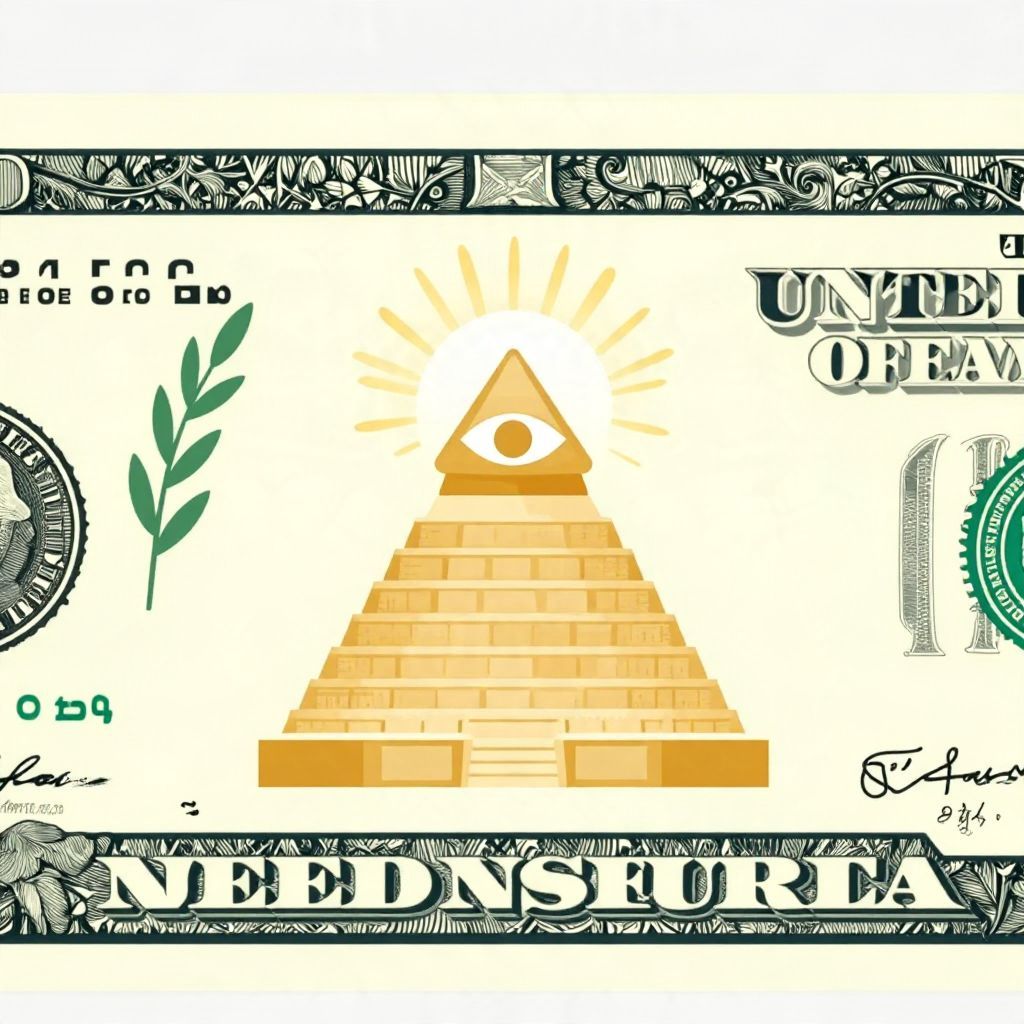
Why is there a pyramid on the dollar bill? The short answer is that the pyramid is part of the Great Seal of the United States, a national emblem adopted in 1782. It was not added to the dollar bill because of ancient Egypt or secret societies, but because American leaders wanted symbols of strength, endurance, and a nation still being built.
The pyramid and the eye above it have sparked speculation for generations, yet their historical meaning is grounded in the political culture of the late 18th century. To understand it, you have to look at the creation of the Great Seal, the symbolism chosen by the founders, and how that image eventually appeared on U.S. currency in the 20th century.
Why Is There a Pyramid On The Dollar Bill?
The pyramid appears on the dollar bill because it is part of the reverse side of the Great Seal of the United States, which was printed on the one-dollar note beginning in 1935. The design symbolizes strength, permanence, and an unfinished nation, while the eye and mottoes reflect the ideals and language of the Revolutionary era rather than any hidden Egyptian origin.
The Great Seal: The Real Source of the Pyramid
The pyramid on the dollar bill is not a standalone dollar symbol. It comes from the Great Seal of the United States, the official emblem used by the federal government. The seal was approved in 1782 after several committees and proposals, during the final years of the American Revolution.
The reverse side of the seal shows an unfinished pyramid with 13 steps, representing the original 13 states. Above it floats an eye in a triangle, often called the Eye of Providence. Around it are the Latin phrases Annuit Coeptis and Novus Ordo Seclorum, which were meant to express divine favor and the beginning of a new era.
Why a pyramid?
In the 18th century, a pyramid was a powerful symbol of durability. It was one of the most enduring structures known to the educated world, associated with ancient civilizations and the survival of monuments across time. American designers used it to suggest that the new republic could become equally lasting.
The pyramid was also deliberately unfinished. That detail mattered. The United States in 1782 was still young, fragile, and incomplete. The unfinished pyramid implied that the nation was a work in progress, one that could grow stronger over time.
Who Designed the Symbolism?
The Great Seal was not the invention of a single person. It emerged through a series of proposals by committees appointed by the Continental Congress. Several prominent figures contributed ideas, including Benjamin Franklin, John Adams, and Thomas Jefferson, though none of their individual designs was adopted outright.
The final design was largely shaped by the third committee and later refined by the artist and heraldic expert William Barton, whose ideas influenced the eventual seal. The seal’s final form was approved on June 20, 1782.
The meaning of the Latin mottoes
- Annuit Coeptis is commonly understood as “He has favored our undertakings.”
- Novus Ordo Seclorum is often translated as “A new order of the ages” or “a new order of the centuries.”
These phrases were chosen to express the Revolution’s sense of historical change. They were not a coded message about world domination, as later conspiracy theories claimed. Instead, they reflected the founders’ belief that the American republic marked the start of a new political era.
How the Pyramid Reached the Dollar Bill
Although the Great Seal existed from the 18th century, it did not appear on the one-dollar bill until much later. The modern version of the seal was placed on the back of the $1 Federal Reserve Note in 1935, during the presidency of Franklin D. Roosevelt.
The Treasury Department wanted to update the design of the note, and the Great Seal was chosen as a patriotic emblem. The front of the bill carried George Washington’s portrait, while the back displayed both sides of the seal. This is why the pyramid became so familiar to the public: millions of Americans saw it on everyday currency.
Why 1935 matters
The 1935 redesign was important because it standardized the modern look of the one-dollar bill. Before then, U.S. paper money had gone through many variations. The Great Seal’s presence on the bill helped turn a government emblem into a widely recognized national image.
That visibility also gave the pyramid a life beyond official symbolism. Once it appeared on currency, people began to read into it, especially because the eye and Latin phrases looked unusual to modern viewers unfamiliar with 18th-century emblematic language.
What the Pyramid Was Meant to Represent
Historically, the pyramid on the Great Seal was intended to communicate several ideas at once:
- Strength — pyramids were seen as monumental and durable.
- Longevity — the structure suggested a nation built to last.
- Growth — the unfinished top implied future development.
- Unity — the 13 steps represented the original states.
These meanings fit the political mood of the early republic. The United States had just won independence, but its survival was uncertain. Leaders wanted symbols that projected confidence without denying the country’s immaturity.
Why an eye above the pyramid?
The eye is usually interpreted as the Eye of Providence, a traditional symbol of divine watchfulness. In the 18th century, such imagery was common in religious and political art. It was not unique to the United States and did not necessarily imply any secret organization.
Placed above the pyramid, the eye suggested that the new nation was under divine guidance. That idea fit the religious and moral language of the period, when many public symbols blended civic and spiritual meaning.
Common Myths and Misunderstandings
Because the pyramid and eye look unusual, they have inspired many myths. The most famous is the claim that the symbol proves the influence of the Illuminati or Freemasons. There is no solid historical evidence that the Great Seal was designed as a secret society emblem.
That does not mean the founders had no symbolic influences. Eighteenth-century political culture was full of classical references, biblical language, and emblem books. Some designers and statesmen were also associated with fraternal organizations, but the pyramid itself is best understood as part of mainstream Enlightenment-era symbolism, not as proof of hidden control.
Why conspiracy theories spread
Several factors helped these theories grow:
- The design is visually unusual and easy to interpret symbolically.
- The Latin mottoes are unfamiliar to most readers.
- The Great Seal appears on currency, which gives it an air of official mystery.
- Modern conspiracy culture often treats old symbols as secret codes.
In reality, the seal’s imagery is public, documented, and historically traceable. Its meaning comes from the political world of the American Revolution, not from hidden archives or secret rituals.
Historical Context: Why Symbolism Mattered in 1782
The founders were creating a republic in a world where symbols mattered deeply. European states used coats of arms, crowns, eagles, lions, and mottoes to project authority. The United States needed its own visual language to claim legitimacy among nations.
The Great Seal served that purpose. It combined classical and biblical imagery with republican ideals. The eagle on the obverse represented strength and independence; the pyramid on the reverse represented endurance and future possibility. Together, they communicated that the new country was both rooted in history and open to the future.
The influence of the Enlightenment
The seal also reflects Enlightenment thinking. Eighteenth-century Americans often believed that history moved forward through reason, virtue, and political experiment. A “new order of the ages” was a bold claim, but it fit the revolutionary belief that the United States was inaugurating a new kind of government.
The pyramid, then, was not chosen because it was Egyptian in a narrow sense. It was chosen because ancient forms could be repurposed to express modern ambition.
What the Pyramid Does Not Mean
It is important not to read the symbol too literally. The pyramid on the dollar bill does not mean the United States was founded on ancient Egyptian religion, nor does it prove that the founders were sending secret messages. Historical evidence supports a more ordinary explanation: they were using a respected emblem of permanence and civic aspiration.
Likewise, the seal does not mean the United States was already complete. The unfinished pyramid suggests the opposite. It acknowledges that the republic had been started, but not finished, and that its future depended on the actions of its citizens.
The Lasting Significance of the Pyramid
Today, the pyramid on the dollar bill remains one of the most recognizable symbols in American life. Its endurance shows how a small design choice can outlive its original context and take on new meanings over time. For some people, it is a sign of national identity; for others, a source of curiosity or suspicion.
Historically, though, its meaning is clear enough. The pyramid is there because the United States adopted the Great Seal in 1782, and because the seal was later printed on the one-dollar bill in 1935. It represents permanence, growth, and the idea that the American republic was still under construction.
So the pyramid on the dollar bill is not a mystery from ancient Egypt. It is a Revolutionary-era emblem of a young nation trying to imagine its future. If you want to explore more American symbols and their origins, you can also look into broader historical context on American history and national symbolism.