
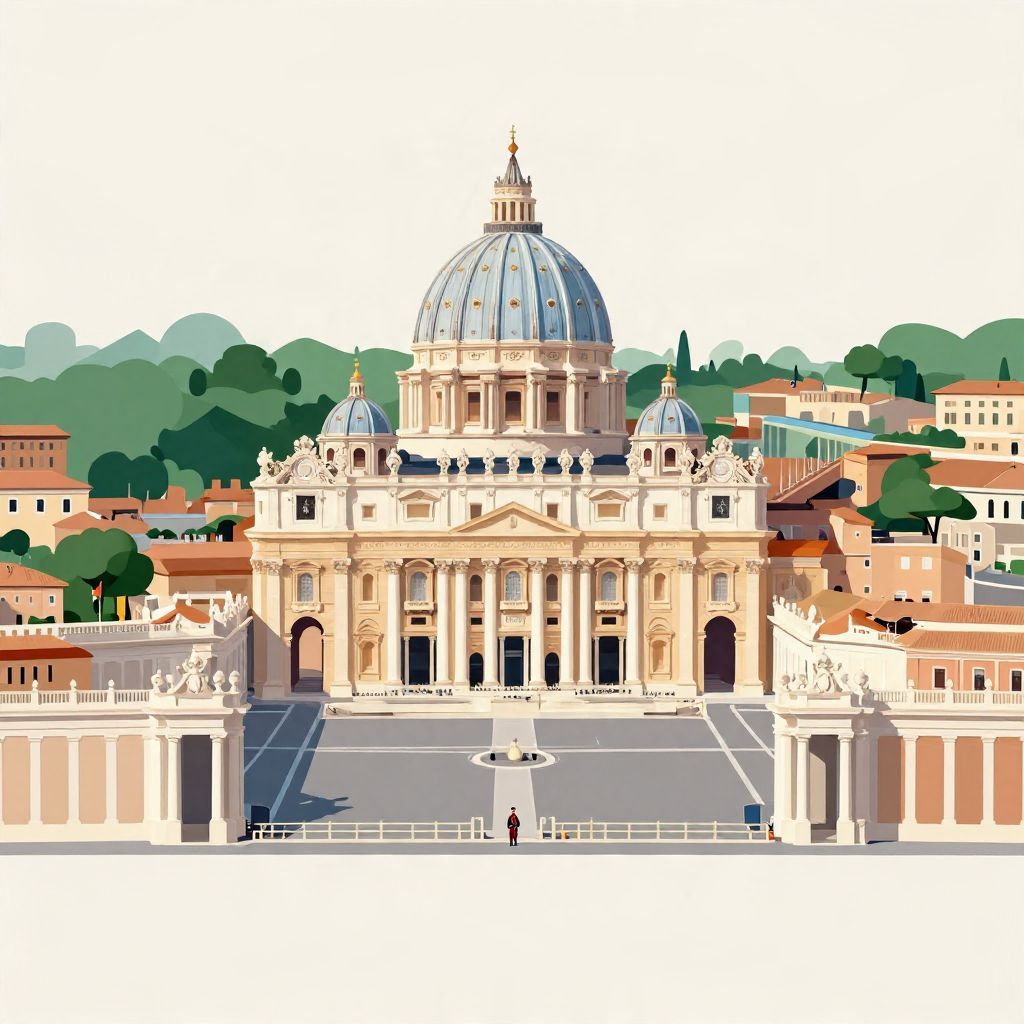
Is the Vatican its own country? Yes—today the Vatican is a sovereign state, officially called Vatican City State. It is the world’s smallest independent country by area and population, and it exists to provide a territorial base for the pope and the central administration of the Roman Catholic Church.
That answer, though, only makes sense in historical context. The Vatican’s status was not ancient or inevitable; it emerged from a long struggle between the papacy and Italian unification, ending with the Lateran Treaty of 1929.
Is the Vatican its own country?
Yes. The Vatican is a sovereign city-state recognized in international law as Vatican City State. It has its own territory, government, laws, and diplomatic relations, although it is closely tied to the Holy See, the central authority of the Catholic Church. The Vatican is independent, but it is not the same thing as the Holy See.
What is the difference between the Vatican and the Holy See?
The distinction is important. The Holy See is the governing office of the pope and the Catholic Church’s central authority; the Vatican City State is the physical territory that guarantees the Holy See’s independence. In practice, people often say “the Vatican” when they mean either one, but historically and legally they are not identical.
Holy See
The Holy See is the older institution. Its roots go back to the early Christian church in Rome and the authority claimed by the bishops of Rome, later known as popes. It conducts diplomacy, appoints bishops, and represents the Catholic Church internationally.
Vatican City State
The Vatican City State is the modern political entity created in 1929. It is a tiny sovereign territory of about 44 hectares, enclosed within Rome, built to ensure that the pope would not depend on any other government for his independence.
How the Vatican became a country
The Vatican became its own country because of a modern political conflict, not because it had always been one. For centuries, the popes ruled the Papal States, a large territory in central Italy. That changed during the 19th-century unification of Italy, when the papal territories were absorbed into the new Italian state and the pope lost temporal power.
The Papal States before Italian unification
From the Middle Ages until the 1800s, the pope was not only a religious leader but also a temporal ruler. The Papal States gave the papacy land, revenue, and political authority. This arrangement helped preserve papal independence in a fragmented Italy, but it also tied the church to the politics of the Italian peninsula.
The loss of the Papal States
Italian unification, or Risorgimento, reshaped the peninsula in the 19th century. As nationalist forces unified Italy, papal territory steadily shrank. In 1870, Italian troops entered Rome and annexed the city, ending the Papal States. The pope refused to accept the new order and withdrew into the Vatican area, creating what became known as the “Roman Question.”
The Roman Question
For nearly 60 years, the pope and the Kingdom of Italy remained in conflict over sovereignty in Rome. The popes considered themselves “prisoners in the Vatican,” while the Italian state claimed Rome as its capital. The dispute was not merely symbolic: it involved property, authority, and the question of whether the papacy could remain politically independent without its own territory.
The Lateran Treaty of 1929
The Vatican became a sovereign state through the Lateran Treaty, signed on 11 February 1929 between the Holy See and Italy under Benito Mussolini’s government. The treaty recognized Vatican City State as independent, settled financial claims, and established Catholicism’s special place in Italy at the time. This agreement formally ended the Roman Question.
Why the treaty mattered
The treaty solved a practical problem. The papacy needed guaranteed independence from Italian control, while Italy wanted a stable settlement with the Catholic Church. By creating a tiny sovereign state around St. Peter’s Basilica and the papal residence, the treaty gave the pope territorial security without restoring the old Papal States.
What the Vatican gained
- International recognition as a sovereign state
- A fixed territory centered on Vatican Hill
- Control over its own internal governance
- Protection for papal independence from outside political pressure
How the Vatican is governed
The Vatican is a monarchy, but not in the usual hereditary sense. It is an elective absolute monarchy in which the pope holds supreme legislative, executive, and judicial authority. In practice, administration is carried out by officials and departments of the Holy See, but ultimate authority rests with the pope during his reign.
The pope as head of state
The pope serves as both the spiritual leader of the Catholic Church and the head of state of Vatican City. When a pope dies or resigns, the state does not pass to a family member; instead, a conclave of cardinals elects the next pope. This makes the Vatican unusual among modern states.
Citizenship and population
Vatican citizenship is also unusual. It is generally granted only to people serving the Holy See or Vatican City in specific roles, such as clergy, diplomats, or certain staff. It is usually temporary and tied to office, not birthplace. As a result, the population is very small and constantly changing.
What makes the Vatican different from other countries?
The Vatican is a country, but it is unlike most countries in several ways. It has no ordinary civilian population, no agriculture, and no broad industrial economy. Its purpose is not national self-sufficiency in the usual sense; it exists to preserve the independence of the papacy and support the church’s global mission.
Key features of Vatican sovereignty
- Own territory inside Rome
- Own laws and administration
- Own postal system, police, and media services
- Diplomatic relations through the Holy See
- International recognition as a sovereign entity
Why it is not just a neighborhood in Rome
Although the Vatican is physically inside Italy, it is not governed by Italy. Its sovereignty is protected by treaty and recognized internationally. That means Italian law does not simply apply there in the same way it applies elsewhere in Rome, and the pope is not an Italian official.
Historical significance of Vatican City State
The creation of Vatican City State had consequences far beyond its tiny borders. It stabilized relations between Italy and the Catholic Church, allowed the papacy to act independently in global affairs, and created a durable solution to a conflict that had lasted for decades. Its existence also shows how modern states can be created to solve a specific historical problem.
A small state with global influence
Despite its size, the Vatican has outsized influence because the Catholic Church is worldwide. The pope’s moral authority, diplomatic role, and leadership of a large religious community give the Vatican significance far beyond what its territory would suggest.
Why historians care about it
Historians see the Vatican as a reminder that sovereignty is not only about land or population. It is also about authority, legitimacy, and the ability to act independently. The Vatican’s creation in 1929 was a modern political compromise rooted in centuries of church-state conflict.
So, is the Vatican its own country?
Yes—the Vatican is its own country, but more precisely it is a sovereign city-state created in 1929 to secure the independence of the Holy See. Its origins lie in the collapse of the Papal States, the unification of Italy, and the Lateran Treaty that ended a long dispute over papal sovereignty. In other words, the Vatican is a real country, but one whose purpose is unusually tied to religion and history.
If you want to explore more history topics, you might also be interested in how the Roman Empire shaped medieval Europe or how Italian unification changed the map of Europe.