
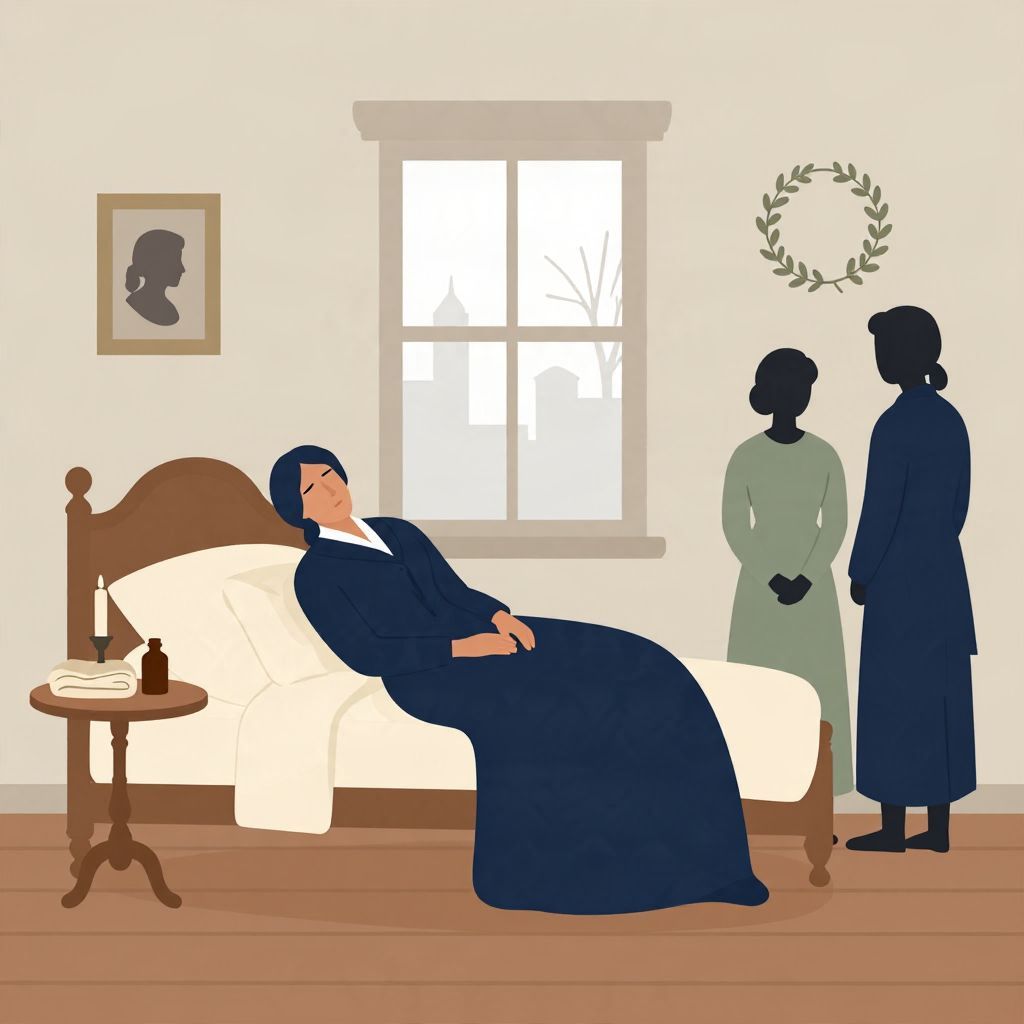
How did Peggy Schuyler die? The short answer is that Margaret “Peggy” Schuyler Van Rensselaer died of a long illness in 1801, at the age of 42. Historical records do not point to a dramatic or violent end; instead, her death appears to have been the result of declining health, likely after years of vulnerability that were common in the early republic.
Peggy Schuyler is best known today as one of the Schuyler sisters from Revolutionary-era New York and as a figure in the wider Hamilton family story. Her death matters because it reminds us that even people connected to prominent political families lived in a world where disease, limited medical care, and early mortality shaped everyday life.
How did Peggy Schuyler die?
Peggy Schuyler died in 1801 after an extended illness. She was not killed in battle, did not die in childbirth, and was not the victim of a widely documented accident or scandal. Surviving historical accounts indicate that her health had been failing for some time before her death, but the exact medical cause was not clearly recorded in the way modern death certificates would be.
What historians can say with confidence
What is firmly established is that Peggy died in Albany, New York, in 1801, and that she was still relatively young by modern standards. Because early nineteenth-century medical documentation was often incomplete, historians usually describe her death as the result of illness rather than naming a precise diagnosis. That caution is important: there is no strong evidence for a single definitive cause such as tuberculosis, cancer, or another specific disease.
What is uncertain
Some later retellings try to supply a more exact medical explanation, but those claims are often speculative. In the absence of detailed clinical records, it is better to say that Peggy Schuyler died from illness after a period of declining health. That answer is less dramatic, but it is also more historically responsible.
Who was Peggy Schuyler?
Peggy Schuyler was born September 19, 1758, into one of New York’s influential Patriot families. She was the daughter of Philip Schuyler, a Continental Army general and later U.S. senator, and Catherine Van Rensselaer Schuyler. Peggy grew up in a household at the center of politics, war, and elite colonial society.
She is often remembered as the middle Schuyler sister, between Angelica and Eliza. In popular memory, especially through the musical Hamilton, the sisters are portrayed as witty and politically aware. That broad impression is fair, though the details of Peggy’s life are sometimes overshadowed by the more abundant surviving correspondence of her sisters.
Her marriage and later life
Peggy married her cousin, Stephen Van Rensselaer III, in 1783. He was from another powerful New York family and later became a major landowner and political figure. Their marriage connected two prominent dynastic households in post-Revolutionary New York. Peggy had children, though not all survived to adulthood, a reminder of the fragility of family life in the period.
By the late 1790s, Peggy was living in a world still marked by the physical strain and medical uncertainty of the era. Even privileged families had little protection against chronic disease, infection, or complications that today might be treatable.
What happened in the years before her death?
Peggy’s final years unfolded during the early national period, when the United States was still defining its institutions and elite families were adjusting to a new political order. Her father remained influential, and her sisters were part of the social and political networks that connected New York, Philadelphia, and the emerging federal capital.
At the same time, Peggy herself appears to have lived more privately than her famous relatives. She was not a national public figure in the way her father or husband were. That relative privacy is one reason her death is less documented than those of more famous Revolutionary figures.
Why the records are limited
Early American families did not always preserve medical details with precision. Death notices, family letters, and later biographies might mention that someone was “ill” or “declining,” but they rarely recorded diagnoses in modern terms. Physicians also worked with limited knowledge of infection, internal disease, and long-term conditions. As a result, historians often have to reconstruct a person’s final illness from indirect evidence.
Why does Peggy Schuyler’s death matter?
Peggy Schuyler’s death matters because it places a famous Revolutionary family back into the ordinary historical reality of the era: death was common, medicine was limited, and even elite households were vulnerable to illness. Her story is not only about one woman’s life, but also about the health conditions of early America.
It shows the limits of elite status
The Schuylers were wealthy, connected, and politically powerful, yet those advantages did not guarantee long life. In the early 1800s, people could die from infections, chronic disease, childbirth-related complications, or illnesses that modern medicine might manage. Peggy’s death is a reminder that status could shape comfort and access, but not always survival.
It helps correct popular simplifications
Modern audiences often encounter Peggy as a supporting character in the Hamilton story. That cultural visibility can create the impression that her life was defined mainly by her family’s fame. In reality, her death reminds us that she was a historical person with her own household, health struggles, and place in the early republic.
It adds depth to the Schuyler family story
The Schuyler sisters are often discussed together, but their lives were not interchangeable. Eliza lived into the mid-nineteenth century and became a major guardian of Alexander Hamilton’s legacy. Angelica spent much of her life abroad. Peggy, by contrast, died comparatively young. Her shorter life changed the family’s later history and the shape of the surviving record.
Timeline of Peggy Schuyler’s life and death
- 1758 — Margaret “Peggy” Schuyler is born in Albany, New York.
- 1770s — She comes of age during the American Revolution, in a politically active family.
- 1783 — She marries Stephen Van Rensselaer III.
- Late 1790s — Her health begins to decline, though the exact illness is not clearly documented.
- 1801 — Peggy Schuyler dies in Albany after an extended illness.
How Peggy Schuyler is remembered today
Today, Peggy Schuyler is remembered partly through Revolutionary history and partly through popular culture. Her name appears in biographies of the Schuyler family, studies of early New York society, and modern retellings of the Hamilton era. Because she died young and left fewer surviving personal papers than some of her relatives, she is sometimes less visible in the historical record than she deserves.
That said, her life still offers valuable insight into women’s roles in elite Revolutionary families. She was part of a network that shaped politics, marriage alliances, property, and social influence in the new nation. Her death closes one chapter of that story, but it also helps historians understand the human cost of life in the eighteenth and early nineteenth centuries.
Bottom line
Peggy Schuyler died in 1801 after a prolonged illness, likely in Albany, New York. The exact medical cause is not securely known, and it is best not to overstate what the evidence can prove. Her death matters because it reflects the realities of early American life: limited medicine, high mortality, and the vulnerability of even the most prominent families. For readers interested in related historical lives and deaths, you may also want to explore how Marie Antoinette died and how Rodney King died.