
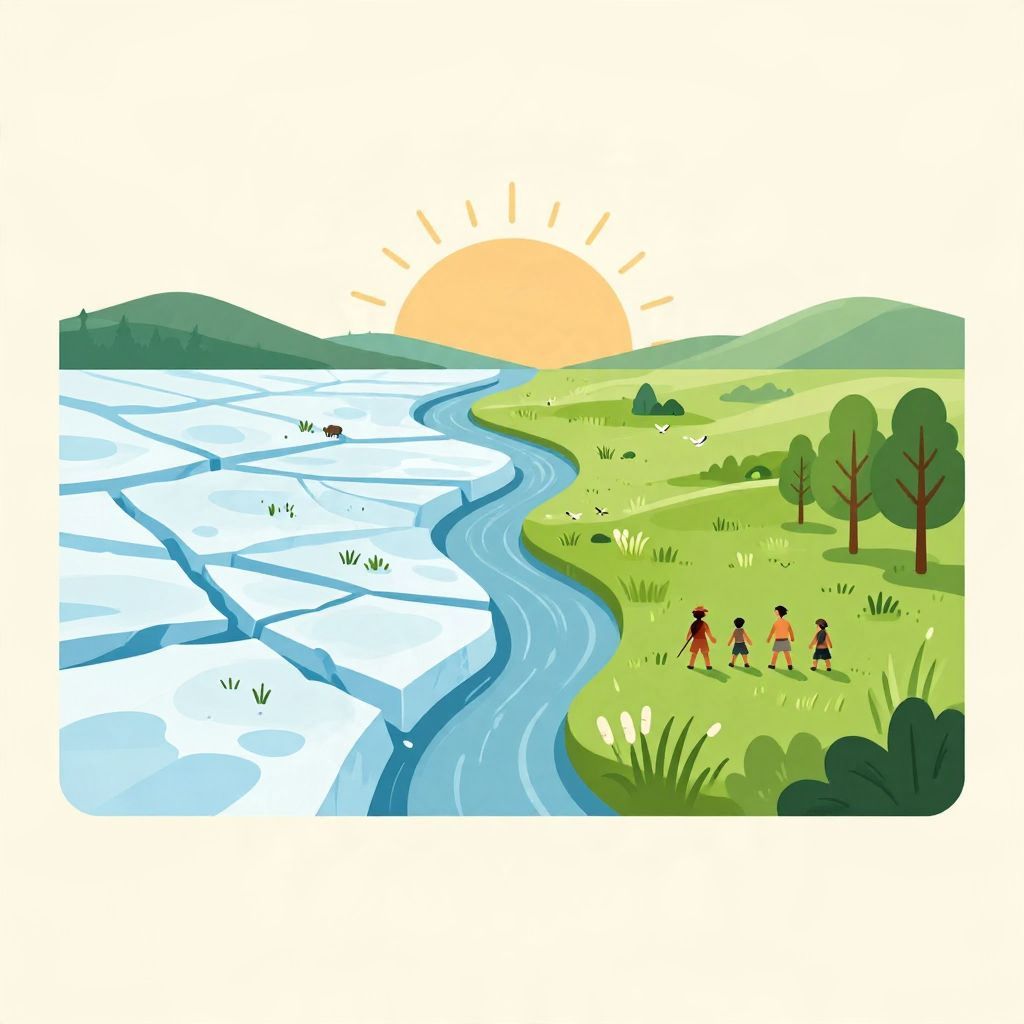
The Holocene began at the end of the last Ice Age, when Earth’s climate shifted into the warmer, more stable conditions that still define the modern epoch. The standard scientific start date is 11,700 years before present, which corresponds to about 9700 BCE.
That date matters because it marks a major turning point in human history as well as in geology. Ice sheets retreated, sea levels rose, ecosystems changed, and farming eventually became possible in many regions. The story of the Holocene is therefore both a climate story and a human story.
When did the Holocene start?
The Holocene officially started about 11,700 years ago, at the end of the last glacial period. In calendar terms, that is usually given as 9700 BCE or 11,700 years before 1950, the reference point used by geologists for “before present.” This date is the internationally accepted boundary between the Pleistocene and the Holocene.
Why that date was chosen
Geologists did not pick the Holocene start date at random. It is tied to evidence from ice cores and other climate records showing a rapid warming at the end of the Younger Dryas, a brief return to cold conditions after the last Ice Age. Around 11,700 years ago, temperatures rose into a more stable warm period that has lasted to the present.
The Younger Dryas and the climate shift
The Younger Dryas was a sharp cold spell that interrupted the warming trend after the Last Glacial Maximum. When it ended, the climate changed quickly. Ice sheets began to shrink, forests expanded in many regions, and the global environment became more favorable for settled human communities. The Holocene boundary is placed at this transition because it represents a clear and globally recognizable change in Earth’s climate system.
The formal geological definition
Modern geology uses a precise boundary known as a Global Boundary Stratotype Section and Point, or GSSP. For the Holocene, that boundary was formally defined using evidence from the Greenland ice core record. The official start is set at a specific point in the ice-core chronology, corresponding to the end of the Younger Dryas and the beginning of the Holocene warm stage.
What happened at the start of the Holocene?
The start of the Holocene did not mean a suddenly perfect climate everywhere, but it did mark a long-term shift away from the extreme cold and unstable conditions of the Ice Age. Glaciers retreated, sea levels rose as ice melted, and landscapes changed across continents. These changes transformed where plants, animals, and people could live.
Rising seas and changing coastlines
As the great ice sheets melted, sea levels climbed significantly over thousands of years. Coastlines moved inland in some places and disappeared in others. Land bridges that had once connected regions were submerged, reshaping migration routes for both humans and animals. The Holocene world was therefore not just warmer; it was geographically different from the Ice Age world that came before it.
New ecological conditions
Warming temperatures allowed forests, grasslands, and wetlands to spread into areas that had once been tundra or steppe. Many large Ice Age mammals died out during the transition, though extinction patterns varied by region and cause. Climate change, habitat change, and human hunting all likely played roles, and historians and scientists continue to debate the relative importance of each factor.
How the Holocene changed human history
The Holocene is the epoch in which all recorded human civilization developed. Its more stable climate created conditions that encouraged experimentation with plant cultivation, animal domestication, permanent settlements, and eventually cities and states. In that sense, the Holocene is not just a geological term; it is the environmental backdrop for nearly all of human history.
From foraging to farming
Before the Holocene, most people lived as mobile hunter-gatherers. After the climate warmed, some communities in the Near East, China, Mesoamerica, the Andes, Africa, and elsewhere began to cultivate crops and manage animals. Agriculture did not begin everywhere at once, and it did not replace foraging overnight, but the Holocene made farming more viable in many regions.
Settlements, population growth, and complexity
Reliable food production supported larger populations and more permanent villages. Over time, this helped produce social specialization, trade networks, writing systems, and governments. The rise of cities in Mesopotamia, Egypt, the Indus Valley, China, and later in the Americas and elsewhere all occurred within the Holocene. Without the climatic stability of this epoch, these developments would have been far less likely.
Was the Holocene always called the Holocene?
No. The term “Holocene” comes from Greek roots meaning “entirely recent” or “wholly new,” and it became widely used in geology during the modern scientific study of Earth history. Earlier writers sometimes used different names or broader labels for the post-Ice Age world. The current term reflects a more precise understanding of stratigraphy and climate history.
How scientists classify time
Geologists divide Earth’s history into eons, eras, periods, epochs, and ages. The Holocene is an epoch within the Quaternary Period. It follows the Pleistocene epoch, which covered most of the Ice Age. This classification helps scientists compare climate changes, fossil evidence, and sediment layers across the planet.
Is the Holocene still going on?
Yes. The Holocene is still the official geological epoch today, although some scientists have argued that human activity has changed Earth so much that a new epoch should be recognized. The most discussed proposal is the Anthropocene, but it has not replaced the Holocene in the official geological time scale.
The Anthropocene debate
The Anthropocene idea reflects the growing impact of humans on climate, biodiversity, landscapes, and geological deposits. Supporters of the term argue that industrialization, fossil fuel use, and large-scale land transformation have altered Earth systems enough to justify a new epoch. Others say the evidence is important but the formal geological case is not yet settled. For now, the Holocene remains the official name.
Why the Holocene start date matters today
Knowing when the Holocene began helps explain why human civilization emerged when it did. The climate of the epoch created opportunities for agriculture, settlement, and long-term social development. It also provides a baseline for understanding modern climate change, because the Holocene has been the relatively stable environmental window in which human societies grew.
A long period of relative stability
Compared with the dramatic swings of the Ice Age, the Holocene has been unusually stable, though not perfectly uniform. There have been droughts, cold spells, volcanic winters, and regional climate shifts, but the overall conditions were far less extreme than before 11,700 years ago. That stability helped make agriculture, states, and global civilizations possible.
Quick timeline of the Holocene start
- Before 11,700 years ago: The late Pleistocene, including the Younger Dryas cold period.
- About 11,700 years ago: The Holocene begins with rapid warming and the end of the Younger Dryas.
- After the start: Ice sheets retreat, seas rise, and ecosystems reorganize.
- Within the Holocene: Agriculture, villages, cities, states, and written history develop.
The short answer
The Holocene started about 11,700 years ago, or roughly 9700 BCE. That date marks the end of the last major cold phase of the Ice Age and the beginning of the warm epoch in which human civilization took shape. It is one of the most important boundaries in both geology and world history.
If you want to explore the broader story of Earth’s recent past, related topics such as the Ice Age, early farming, and the rise of civilization fit naturally alongside the Holocene’s history.