
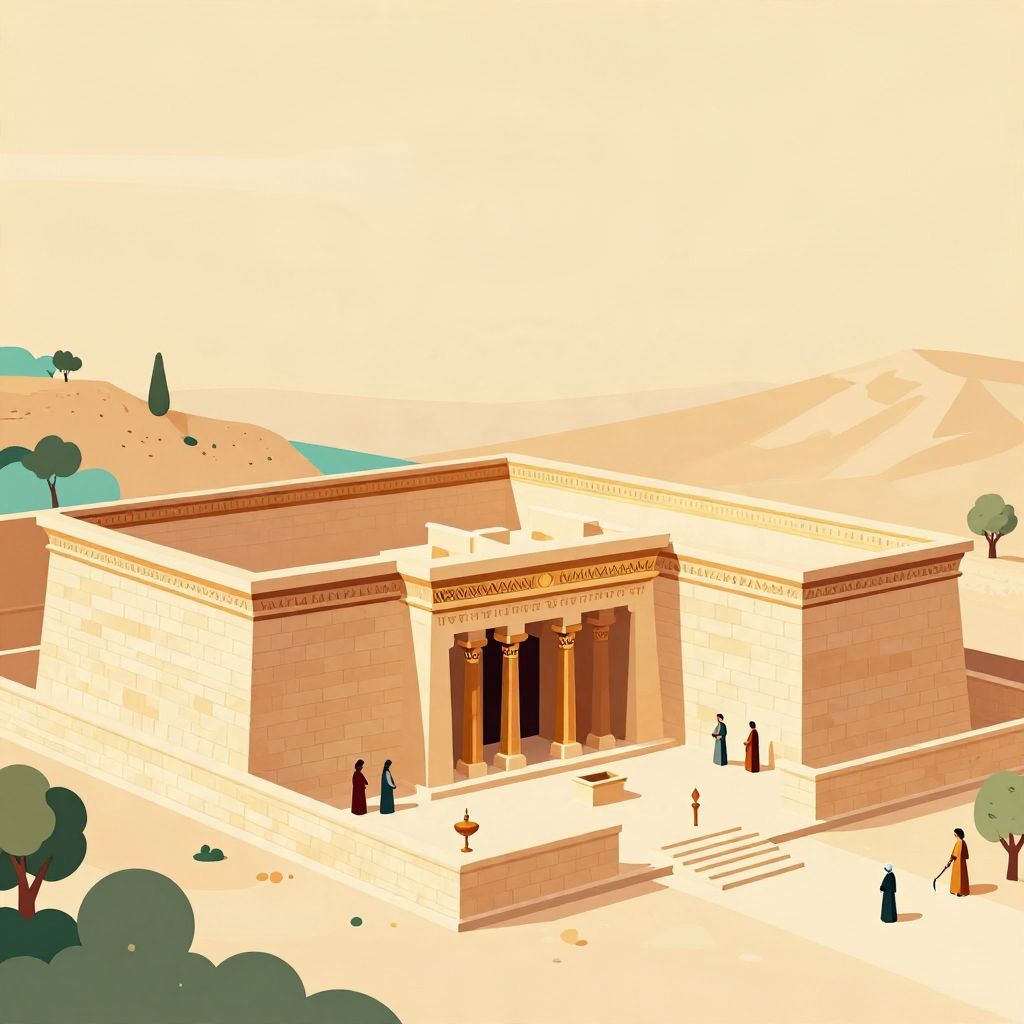
What did Solomon’s Temple look like? The short answer is that it was a small but richly symbolic royal sanctuary in ancient Jerusalem, built in the 10th century BCE if the biblical chronology is broadly followed. It was not a grand stone cathedral in the later medieval sense, but a carefully arranged temple complex centered on a rectangular building with an outer court, a main hall, and an inner sanctuary.
Because the temple was destroyed in antiquity and no undisputed remains survive, historians must reconstruct its appearance from the Hebrew Bible, comparative archaeology, and knowledge of ancient Near Eastern temples. That means some details are reasonably secure, while others remain debated or symbolic rather than strictly architectural.
What did Solomon’s Temple look like?
Solomon’s Temple was likely a rectangular, three-part structure on a raised platform in Jerusalem, with an entrance porch, a main hall, and a most sacred inner room called the Holy of Holies. It was probably built of stone and cedar, richly decorated with carved wood, gold plating, bronze furnishings, and ritual objects, though the exact appearance is uncertain.
The basic layout of the temple
The biblical description in 1 Kings 6–7 presents the temple as a carefully measured building with symbolic geometry. It is described as a long rectangular structure about 60 cubits long, 20 cubits wide, and 30 cubits high. Exact cubit lengths varied in the ancient world, so modern measurements are approximate. The temple was divided into three main spaces.
1. The porch or entrance hall
The front of the building had a porch, often called the ulam, which functioned as an entryway. It likely served as a transitional space between the outer court and the sacred interior. The Bible also describes two bronze pillars at the entrance, named Jachin and Boaz, though scholars debate whether these were structural supports, ceremonial markers, or symbolic monuments.
2. The main hall
Behind the porch was the main chamber, often called the hekal or nave. This was where priests performed ritual duties and where sacred furnishings were kept. The walls and floor were said to be lined with cedar and overlaid with gold, giving the room a brilliant, highly polished look. Carved images of palm trees, flowers, and cherubim decorated the woodwork.
3. The Holy of Holies
At the back of the building was the inner sanctuary, the debir, or Holy of Holies. This was the most sacred space in Israelite worship, associated with the presence of God and accessible only to the high priest under strict conditions. The room was likely a perfect cube according to the biblical text, emphasizing order, holiness, and separation from ordinary space.
What materials were used?
The temple was described as using high-status materials associated with kingship and sacred power: stone for the structure, cedar from Lebanon for beams and paneling, cypress or juniper for some interior work, and extensive gold overlay. Bronze was used for ritual vessels and large courtyard installations. These materials signaled wealth, international trade, and royal patronage.
Stone, cedar, and gold
Stone would have formed the load-bearing core of the building, while cedar wood created a refined interior and roof framework. Gold overlay, if used as described, would have made the temple glow in lamplight and sunlight. Ancient readers may have understood this not only as luxury but also as a visual expression of divine glory.
Bronze furnishings
Bronze objects included the great altar, basins, stands, and the famous “Sea,” a large water reservoir used in ritual purification. These items probably stood in the temple court rather than inside the sanctuary. Their scale suggests that the temple complex was designed for public sacrifice and priestly service, not private devotion alone.
What was the temple court like?
The temple was not just a single building. It was part of a larger sacred precinct with courtyards and auxiliary structures. The outer court likely contained the altar for sacrifices, washing installations, storage areas, and spaces where priests and worshippers gathered. The court would have been the most visible and active part of the site.
In the ancient Near East, temples often functioned as both religious and political centers. Solomon’s Temple likely followed that pattern. It was a national sanctuary tied to the monarchy, the priesthood, and the identity of Jerusalem as the religious center of Judah and, in later memory, of all Israel.
How much of the description is historical?
This is where caution matters. The temple’s general plan is plausible and fits the architecture of other ancient Near Eastern sanctuaries, but the biblical description was written and edited in a religious and literary context. That means it may preserve real memory, idealized reconstruction, symbolic language, or later theological interpretation, all mixed together.
What historians think is likely
- A temple stood in Jerusalem on or near the later Temple Mount.
- It probably had a tripartite plan: porch, main hall, and inner sanctuary.
- It likely included a courtyard for sacrifice and purification.
- Its decoration probably reflected royal wealth and Phoenician-style craftsmanship.
What remains uncertain
- The exact dimensions and proportions.
- Whether the two pillars were structural or symbolic.
- The precise form of the roof and windows.
- How much gold was actually used.
- How closely the biblical account matches the original building.
Why does the temple’s appearance matter?
Solomon’s Temple mattered because it was more than architecture. It represented a claim that Israel’s God had a permanent dwelling in Jerusalem and that the Davidic monarchy had divine legitimacy. Its design expressed hierarchy: ordinary space, sacred space, and the holiest space at the center. The building itself taught theology through layout and materials.
The temple also shaped later Jewish, Christian, and Islamic memory. After its destruction, it became a symbol of loss, hope, restoration, and sacred history. The Second Temple, built later on the same general site, preserved some of the older temple tradition, but Solomon’s original building remained the archetype.
What did it probably look like from the outside?
From the outside, Solomon’s Temple was likely a relatively modest rectangular building compared with later monumental temples and cathedrals. Ancient temples were often not designed as towering facades but as enclosed sacred structures within a larger compound. The most striking visual features may have been the entrance porch, the courtyard, and the gleam of metal and carved ornamentation.
If the biblical description reflects reality, the temple would have looked impressive but not colossal. Its importance came less from size than from exclusivity, craftsmanship, and sacred meaning. The surrounding court and ritual furnishings probably made the complex feel larger and more ceremonial than the building alone.
How does Solomon’s Temple compare with other ancient temples?
Scholars often compare Solomon’s Temple with temples in Phoenicia, Syria, and Mesopotamia because Israelite architecture did not develop in isolation. The use of a porch, hall, and inner sanctuary resembles other Near Eastern sacred buildings. The emphasis on cedar, bronze, and gilded ornament also fits the wider royal culture of the eastern Mediterranean.
At the same time, the temple was distinct in its aniconic tradition: the inner sanctuary is not described as containing a statue of the deity, which differs from many neighboring cult centers. Instead, the Ark of the Covenant is associated with the most sacred space, highlighting covenant and presence rather than a visible divine image.
What happened to Solomon’s Temple?
According to the biblical account, the temple was destroyed by the Babylonians in 586 BCE during the conquest of Jerusalem. That event was catastrophic for the kingdom of Judah and became one of the defining moments in Jewish history. The loss of the temple transformed it from a functioning building into a memory preserved in scripture, liturgy, and hope.
Because the original structure was destroyed so early and the Temple Mount has remained a politically and religiously sensitive site, archaeology has not produced a complete physical reconstruction. As a result, every image of Solomon’s Temple is partly an educated model, not a final certainty.
A historically grounded picture of Solomon’s Temple
So, what did Solomon’s Temple look like? It was probably a small royal temple complex in Jerusalem with a rectangular plan, a porch, a main hall, and a secluded inner sanctuary, surrounded by courtyards and ritual installations. Built of stone and cedar and adorned with bronze and gold, it would have been both functional and symbolically charged. Its exact appearance is uncertain, but its historical significance is unmistakable.
If you want to explore more about the temple’s sacred objects and Solomon’s reign, you may also find what the Ark of the Covenant looked like and how Solomon died useful for context.