
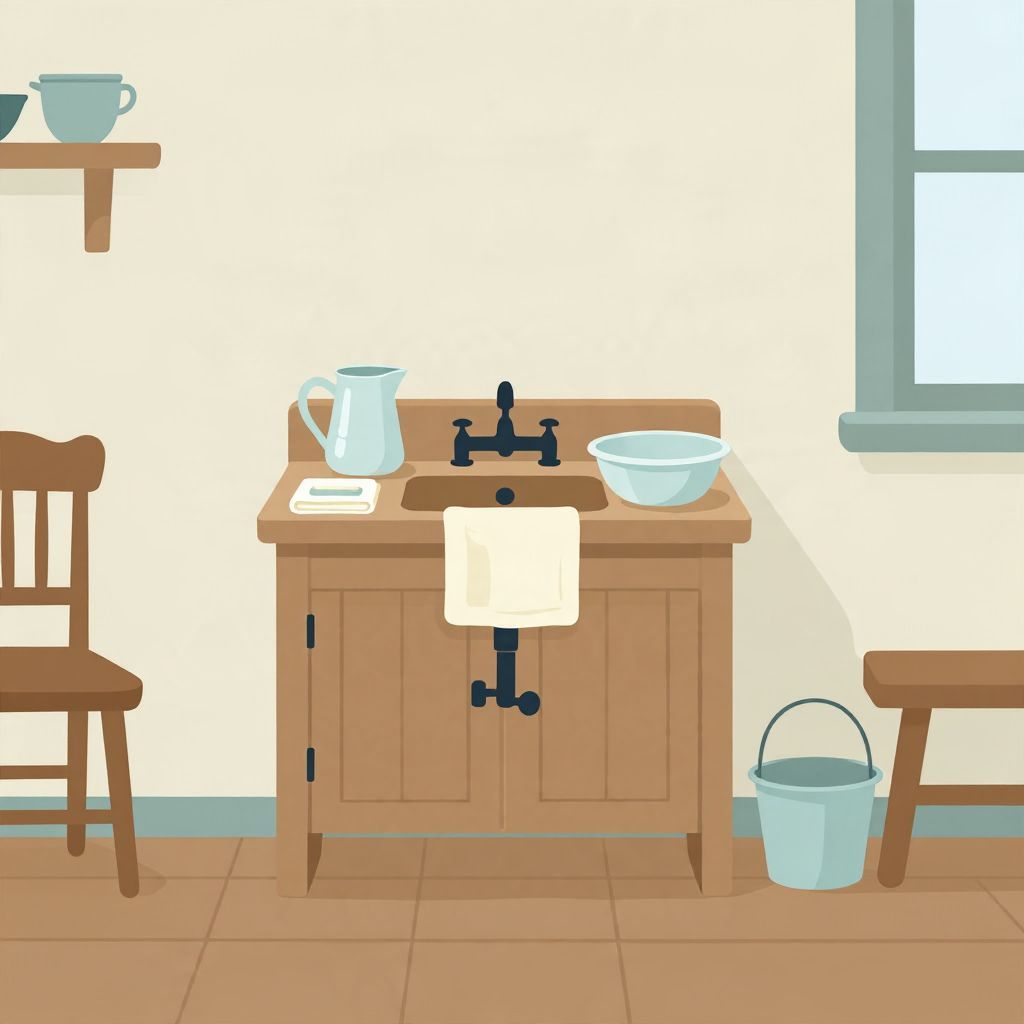
What is a dry sink? In historical terms, a dry sink was a piece of household furniture used for washing and water work before indoor plumbing became common. It usually held a basin or pitcher, or provided a place to pour and drain water, while the actual plumbing remained outside the house or absent altogether.
Dry sinks were practical objects of everyday life in the 18th, 19th, and early 20th centuries, especially in rural homes and older urban houses. They help explain how people managed cleanliness, cooking, and domestic labor long before modern sinks and running water became standard.
What is a dry sink?
A dry sink is a cabinet or stand designed to support a wash basin, pitcher, or water pail in homes without indoor plumbing. Unlike a modern sink, it did not have a faucet, drain, or water supply. It was a workaround for washing hands, dishes, and small household items in an era when water had to be carried in and carried out.
How dry sinks worked in everyday life
Dry sinks were simple but useful. A household member would place a basin on top, fill it from a pitcher or bucket, and empty it afterward. Some versions included a wooden or metal-lined top to protect the furniture from splashes. Others had a recessed basin area, drawers for soap and towels, or a cupboard below for storage.
Common uses in the home
- Washing hands and faces
- Rinsing dishes or utensils
- Holding a wash basin for shaving or grooming
- Storing water pails, soaps, and cloths
- Serving as a general utility station in kitchens or bedrooms
Because water was heavy and labor-intensive to transport, a dry sink reduced mess and made daily routines more manageable. It was not a luxury object in most homes; it was a practical response to the limitations of pre-plumbing domestic life.
When and why dry sinks appeared
Dry sinks became especially common in the 19th century, though the basic idea was older. Their rise was tied to the slow spread of indoor plumbing, piped water, and sewer systems. In many places, especially in North America and parts of Europe, those systems did not become widespread until the late 19th and early 20th centuries.
The historical setting
Before modern plumbing, households relied on wells, pumps, cisterns, springs, rain barrels, or nearby streams. Water had to be fetched manually and heated on stoves or hearths. In that setting, a dry sink fit naturally into domestic architecture as a dedicated place for water-related chores.
Dry sinks also reflect the broader history of household labor. Much of the work of keeping a home clean was physically demanding and time-consuming. A dry sink did not eliminate that labor, but it organized it and made it a little easier.
What a dry sink looked like
Dry sinks varied widely in design. Some were plain wooden cabinets; others were well-made pieces of furniture with decorative trim. Many were built by local carpenters or made at home rather than mass-produced. Materials and style depended on region, income, and available wood.
Typical features
- Cabinet base: often with a door or drawers for storage
- Top surface: flat, recessed, or fitted with a metal or stone insert
- Back splash: sometimes added to protect the wall
- Open shelf or compartment: for basins, pitchers, or towels
- Durable finish: meant to withstand moisture and frequent use
Some dry sinks were freestanding furniture pieces, while others were built into kitchens or washrooms. In older homes, they might sit near a stove, a back door, or a utility area where water could be brought in and waste water carried out easily.
Dry sinks and the history of plumbing
The dry sink belongs to the long transition from water carried by hand to water delivered through pipes. That transition unfolded unevenly. Wealthy urban households often gained indoor plumbing earlier, while rural homes and poorer neighborhoods waited much longer. Dry sinks remained useful wherever plumbing was incomplete or unreliable.
Why they mattered before modern sinks
Modern sinks assume a connected system: pressurized water in, drainage out, and usually a sewer or septic system beneath. A dry sink shows what came before that system existed. It is a reminder that “sink” originally meant a place to receive water, not necessarily a plumbed fixture.
In that sense, the dry sink is historically important because it marks a stage in domestic technology. It sits between the basin-and-pitcher world and the fully plumbed kitchen or bathroom.
Dry sinks in rural and urban homes
Dry sinks are often associated with farmhouses, but they were not limited to the countryside. Many older city homes also lacked plumbing for long periods, especially in basements, servant spaces, or older buildings adapted over time. Rural homes, however, tended to keep dry sinks in use longer because plumbing arrived later and infrastructure was harder to install.
Regional variation
In North America, dry sinks are especially associated with 19th-century domestic life in the United States and Canada. In Europe, similar furniture and wash stands existed under different names and forms. The exact design varied by region, but the function was broadly the same: a place to manage water without a built-in sink.
Because of that, dry sinks should be understood less as a single standardized invention and more as a family of practical household solutions.
How dry sinks differ from washstands and kitchen sinks
Dry sinks are sometimes confused with washstands or early kitchen sinks, but there are important differences. A washstand was usually a lighter piece of bedroom furniture for personal washing, often with a basin and pitcher. A dry sink was generally sturdier, more utility-focused, and often placed in a kitchen or service area.
Key distinctions
- Washstand: usually for personal grooming and bedroom use
- Dry sink: a utility cabinet for washing tasks without plumbing
- Modern sink: permanently connected to water supply and drainage
Some historical pieces blur these categories, which is why museum labels and antique dealers may use the term “dry sink” somewhat loosely. Still, the central idea remains the same: it is a sink-like station without running water.
Materials, craftsmanship, and social meaning
Dry sinks were made from wood most often, though some had stone, marble, zinc, tin, or metal-lined tops to resist moisture. Their construction reveals a great deal about local craftsmanship and household priorities. In modest homes, they were plain and functional. In better-off homes, they could be handsome furniture pieces that matched the room’s style.
What dry sinks tell historians
These objects are useful evidence for historians because they show how people adapted domestic space to technological limits. They also reveal the division of labor within households, especially the repetitive work of carrying water, cleaning, and maintaining order. In that sense, a dry sink is not just furniture; it is a record of everyday survival and adaptation.
Antique dry sinks are now often collected as decorative furniture, which can obscure their original purpose. Their modern value as antiques should not be confused with their historical role as hard-working household tools.
Why dry sinks declined
Dry sinks began to disappear as indoor plumbing became standard in homes. Once kitchens and bathrooms had running water and drains, the need for a separate water station faded. By the mid-20th century, dry sinks were largely obsolete in new construction, though older homes sometimes kept them as storage furniture or decorative pieces.
The broader transition
The decline of the dry sink followed major changes in public health, urban infrastructure, and domestic design. Piped water improved convenience and sanitation, while sewer systems reduced the need to carry waste water away by hand. The modern kitchen gradually replaced a patchwork of utility furniture with built-in fixtures.
That change was not immediate or universal. Many households used a mix of old and new arrangements for decades, especially in rural areas. The dry sink often survived as one part of that mixed domestic world.
Why the dry sink still matters historically
The dry sink may seem ordinary, but it captures a major historical shift: the move from labor-intensive household systems to modern plumbing. It also reminds us that domestic history is not just about grand inventions. Small objects can reveal how ordinary people lived, worked, and adapted to changing technology.
For historians, the dry sink is evidence of a world where water was precious, labor was physical, and home design had to compensate for missing infrastructure. It is a modest object with a large story behind it.
In summary
A dry sink was a non-plumbed cabinet or stand used for washing and water-related chores before indoor plumbing became common. Most common in the 19th and early 20th centuries, it reflects the practical realities of pre-modern domestic life and the gradual arrival of modern household infrastructure. For related domestic history, you may also be interested in what a bath house was and broader historical household organization such as what a duchy was.