
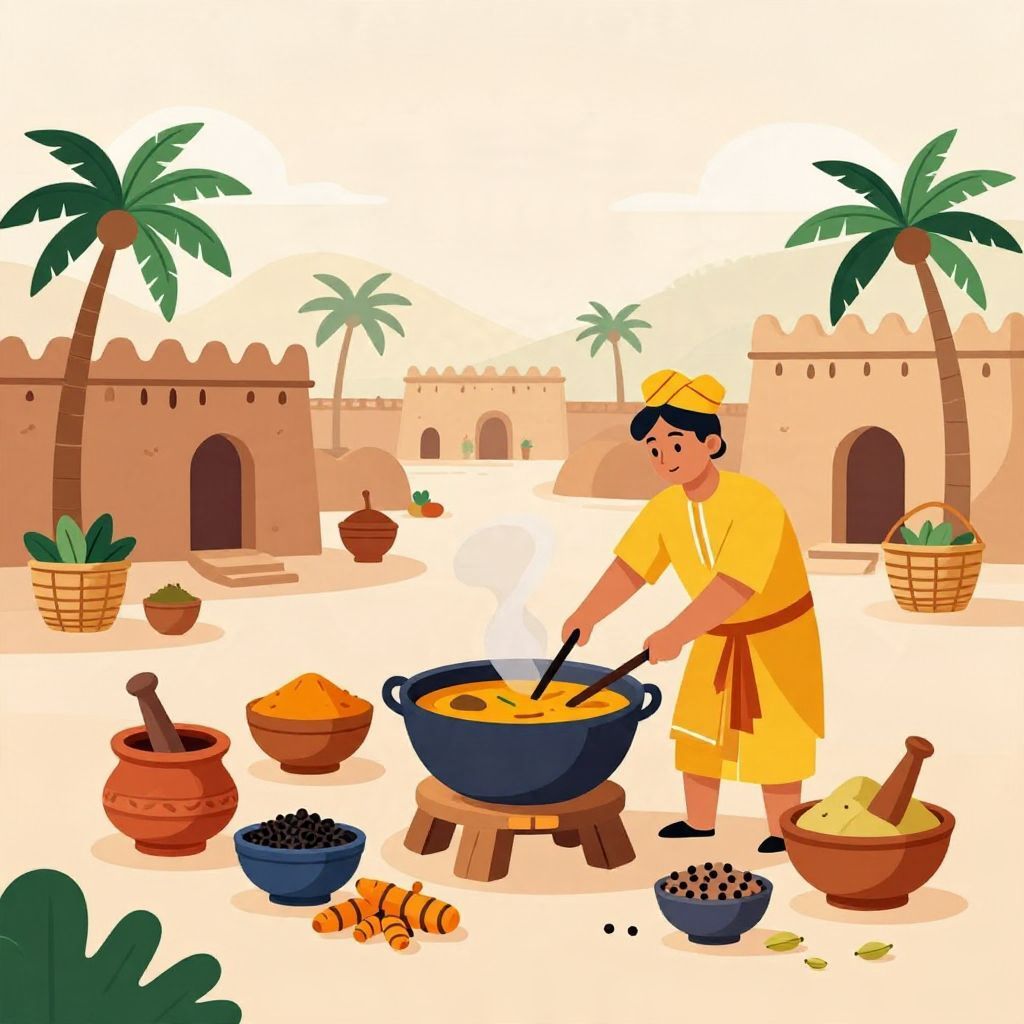
Where is curry from? The shortest historical answer is that curry comes from South Asia, especially the Indian subcontinent, where spiced sauces, stews, and seasoning blends developed over many centuries. The word “curry” is newer than the food traditions behind it, and its modern meaning was shaped by trade, empire, and global migration.
Because “curry” can mean different things in different places, the answer depends on whether you mean the word, the dish, or the broader family of spiced foods. All three have a long history, but their origins do not point to a single inventor or exact birthplace.
Where is curry from?
Curry is from South Asia, particularly the Indian subcontinent. Its roots lie in ancient and medieval Indian cooking traditions that used spices, herbs, aromatics, yogurt, lentils, and sauces to build complex flavors. The modern English word “curry” later emerged through contact with South Asian food during the colonial era, especially in British India.
The South Asian roots of curry
Long before the word “curry” existed in English, people across South Asia were cooking with combinations of spices such as cumin, coriander, turmeric, mustard seed, ginger, garlic, and black pepper. Archaeological and textual evidence shows that spiced cooking was deeply embedded in the region’s food culture by ancient times, though recipes varied widely by place, religion, season, and social class.
Ancient and early medieval food traditions
In the Indian subcontinent, cooking traditions developed around local grains, pulses, vegetables, dairy, and regional spices. Rather than a single “curry,” there were many related dishes: thick stews, thin gravies, dry spice-seasoned preparations, lentil dishes, and meat or fish cooked with aromatic sauces. These traditions were shaped by geography, from coastal seafood cuisines to inland vegetarian and agrarian diets.
Spice use was not only about heat. It helped preserve food, balanced rich ingredients, and reflected long-standing ideas about taste and health. In South Asian culinary systems, spices were often combined in deliberate ways, creating layered flavors that later outsiders would group under the broad label “curry.”
The origin of the word “curry”
The English word “curry” is generally traced to South Asian words such as the Tamil kari, which can mean sauce, relish, or spiced dish. Similar terms appear in other South Asian languages, and scholars note that the exact linguistic path is not perfectly certain. What is clear is that British traders and administrators encountered a wide range of local dishes and then used one umbrella term for them.
That means “curry” as an English category is not the same thing as a single Indian dish. It is a colonial-era label applied to many different foods from South Asia. Over time, the word spread globally and came to describe dishes far beyond its original cultural setting.
How curry became a global food
Curry became internationally familiar through trade, migration, and empire. European merchants reached South Asia from the late medieval period onward, but British rule in India from the 18th century had the greatest impact on how curry was named, written about, and adapted. British cooks, travelers, and households borrowed and simplified South Asian recipes, then carried them into Britain and other parts of the empire.
British India and the making of “curry”
During the colonial period, British officials and settlers encountered local dishes that were often more varied and regionally specific than the single word “curry” suggests. They adapted these foods to available ingredients and changing tastes. By the 18th and 19th centuries, curry recipes had appeared in English-language cookbooks, usually as Anglo-Indian versions rather than exact reproductions of South Asian originals.
This process mattered because it transformed curry from a broad family of South Asian dishes into a recognizable global style. In British kitchens, curry powder also became popular. That spice blend was a convenience product, not a traditional South Asian invention in the same form, and it helped standardize a food culture that was originally much more diverse.
Migration and regional adaptations
As South Asians migrated to other parts of the world, they brought their food traditions with them. In the Caribbean, East Africa, Southeast Asia, and later Europe and North America, curry was adapted to local ingredients and tastes. This is why curry can mean very different dishes in different countries: a Japanese curry, a Thai curry, and an Indian curry are connected by history but not identical in origin or method.
In each place, curry became part of a new local cuisine. Sometimes it kept close ties to South Asian cooking; sometimes it changed dramatically. The result is a global food identity built from movement, exchange, and reinvention.
Is curry one dish or many?
Curry is best understood as a broad category rather than one fixed recipe. In South Asia alone, there are countless regional dishes that might be translated or described as curry, but they differ in ingredients, texture, spice profile, and cooking technique. Some are watery; others are rich and thick. Some use meat or fish, while others are vegetarian or vegan.
Examples of regional diversity
- North Indian dishes may use onion, tomato, dairy, or nut-based gravies.
- South Indian dishes often feature coconut, tamarind, curry leaves, mustard seed, and lentils.
- Coastal cuisines may emphasize fish, shellfish, and souring agents.
- Vegetarian traditions often center on legumes, paneer, vegetables, and yogurt-based sauces.
This diversity is one reason historians are careful about the word “curry.” It is useful as a modern label, but it can flatten a very old and varied food history.
What historians can say with confidence
The strongest historical conclusion is that curry’s culinary roots are in South Asia, especially the Indian subcontinent, where spiced dishes developed over a long period. The English term “curry” was later shaped by colonial contact and European attempts to classify unfamiliar foods. So if someone asks where curry is from, the best answer is both geographic and historical: it is South Asian in origin, but its modern name and worldwide popularity were formed through empire and migration.
What remains uncertain
Some details of the word’s etymology are debated, and no single moment marks the “invention” of curry. That is because curry is not one recipe with one creator. It is a culinary tradition and a global category that grew over time. The historical record supports broad origins, not a simple one-place, one-date story.
Why the origin of curry matters
Understanding where curry comes from helps explain how food history works. Dishes do not remain frozen in one form; they travel, adapt, and take on new meanings. Curry’s story shows how local cooking traditions can become global symbols through trade, migration, and colonial power. It also reminds us that the names we use for food may be much newer than the food itself.
So, where is curry from? Its deepest roots are in South Asia, especially India and neighboring regions, while the word and modern global category were shaped later by British colonial history. For more food-origin history, you might also enjoy where sushi is from and where gin is from.