
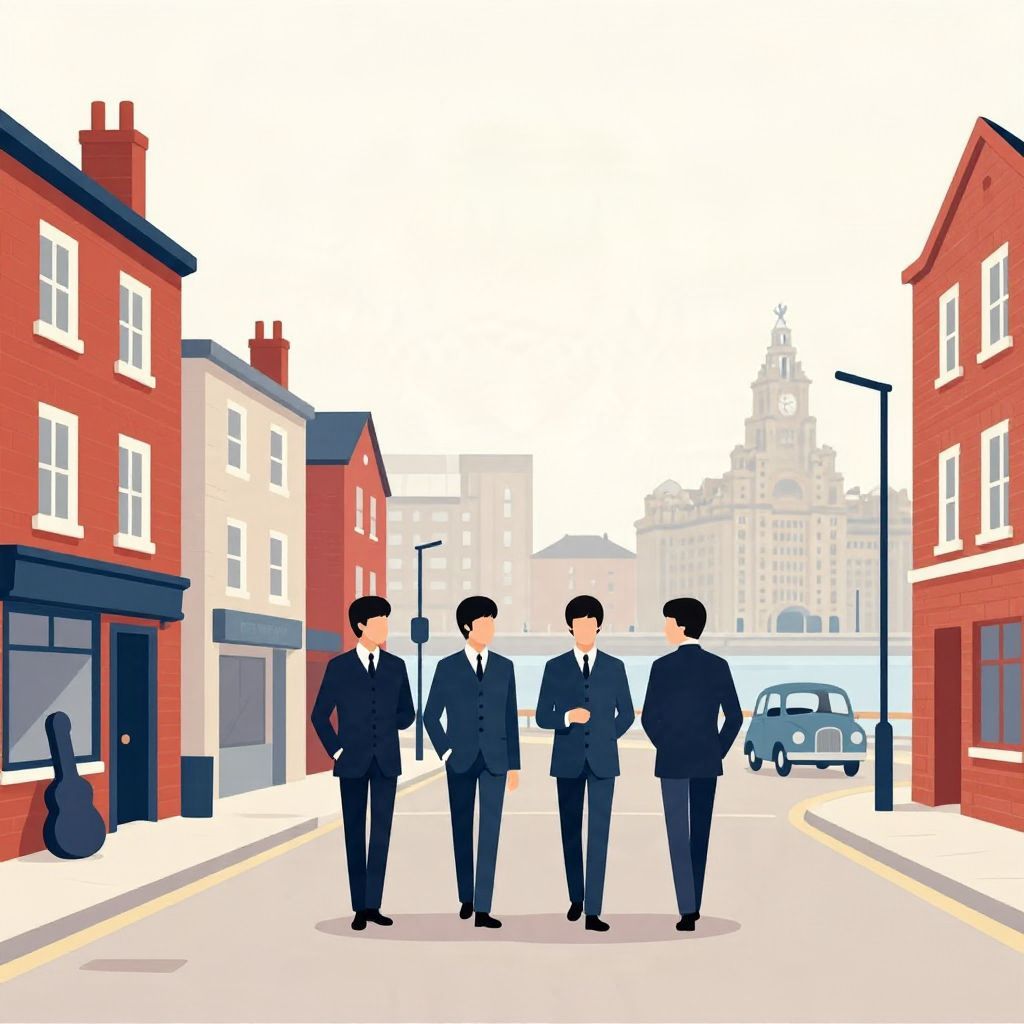
Where are the Beatles from? The shortest accurate answer is that the Beatles were from Liverpool, England. All four original members—John Lennon, Paul McCartney, George Harrison, and Ringo Starr—were born in or near Liverpool, and the city shaped their early lives, musical tastes, and identity as a band.
But the story is a little richer than a single hometown. The Beatles emerged from Liverpool’s postwar working-class culture, its port-city openness to American music, and the local clubs and dance halls that gave young musicians a place to learn, perform, and meet one another.
Where Are The Beatles From?
The Beatles are from Liverpool, a major port city in northwest England. John Lennon, Paul McCartney, George Harrison, and Ringo Starr were all Liverpool-born, and the group formed there in the late 1950s before becoming famous in the early 1960s. Their origin is both geographical and cultural: Liverpool helped create the sound and spirit that made them distinct.
Liverpool: The City That Made the Beatles
Liverpool mattered because it was more than a birthplace. In the decades after World War II, it was a busy working port with strong ties to the United States through shipping, radio, records, and visiting sailors. That meant local teenagers often heard American rock and roll, rhythm and blues, and skiffle earlier or more intensely than many others in Britain.
The city also had a lively youth music scene. Coffee bars, church halls, clubs, and school events gave aspiring musicians a place to practice. Liverpool’s neighborhoods were close enough that young people from different parts of the city could easily meet, form bands, and swap influences. The Beatles grew out of that environment rather than appearing fully formed.
A postwar city with a global ear
After the war, Liverpool faced economic hardship, but it remained culturally open. American records reached the city through trade routes and radio signals, and local teenagers embraced them. This helps explain why the Beatles’ early repertoire mixed skiffle, rock and roll, and American rhythm and blues with their own songwriting. Their sound was local, but it was also international from the beginning.
Who in the Beatles Was From Liverpool?
All four original Beatles were from the Liverpool area. John Lennon was born in Liverpool in 1940. Paul McCartney was born in Liverpool in 1942. George Harrison was born in Liverpool in 1943. Ringo Starr was born Richard Starkey in Liverpool in 1940. That shared geography is one reason the band is so strongly associated with the city.
- John Lennon — born in Liverpool, 1940
- Paul McCartney — born in Liverpool, 1942
- George Harrison — born in Liverpool, 1943
- Ringo Starr — born in Liverpool, 1940
Although the four came from different parts of the city and had different family backgrounds, they shared the experience of growing up in the same urban world. That common setting influenced their accents, humor, and outlook, and it later contributed to the public image of the Beatles as unmistakably “Liverpool lads.”
How the Beatles Formed in Liverpool
The Beatles did not begin as the famous four-piece that the world came to know. Their history started in the late 1950s with school bands, local performances, and changing lineups. John Lennon formed a skiffle group called the Quarrymen in 1956. Paul McCartney joined soon after, and George Harrison followed in 1958. The lineup evolved over time, with the group playing in Liverpool and nearby Hamburg before settling into the classic formation.
From school bands to a real group
In the early years, the band was still developing its identity. They played covers, learned stagecraft through repetition, and absorbed the energy of live performance. Hamburg, in particular, was important because it forced them to play long sets night after night, sharpening their musicianship and tightening their chemistry. Still, the roots of the band remained in Liverpool, where the members first met and where their earliest audience was formed.
The Cavern Club and local fame
One of the most important places in Beatles history was the Cavern Club in Liverpool. The band performed there frequently in the early 1960s, building a strong local following. This was the kind of grassroots success that mattered before national fame arrived. Liverpool audiences helped turn a promising local act into a band ready for wider attention.
Why Liverpool Produced the Beatles
Historians and music writers often point to several reasons Liverpool became a cradle of Beatlemania. First, it was a port city with access to foreign music. Second, it had a large youth population eager for new cultural forms. Third, it offered enough venues for bands to practice and perform. The Beatles were not inevitable, but Liverpool made their rise possible.
The city also encouraged a blend of humor, competitiveness, and resilience. Liverpool’s working-class culture helped shape the Beatles’ public image and their informal, witty style in interviews. Their backgrounds were not aristocratic or polished; they were ordinary young men from an industrial city who learned to succeed through talent, discipline, and timing.
Skiffle and the British youth scene
Before the Beatles became famous, skiffle was a major influence on British teenagers. Skiffle combined folk, blues, and homemade instrumentation, making it easy for young people to start bands without expensive equipment. Lennon’s early group was skiffle-based, and this genre helped create a generation of musicians who later moved into rock and roll. Liverpool was one of the places where that movement took root especially strongly.
What About “The Beatles Are from Britain”?
It is also correct, in a broader sense, to say the Beatles were from Britain or the United Kingdom. But that answer is less precise than Liverpool. Since the question asks where they are from, the most accurate historical response is the city and region that formed them. Their national identity was British, but their local identity was Liverpool through and through.
This distinction matters because the Beatles’ story is often told as a national one: Britain exporting a new sound to the world in the 1960s. Yet the band’s character was deeply local. Their speech patterns, social references, and early experiences were shaped by Liverpool, not by London or by a generic “British” background.
How Liverpool Shaped the Beatles’ Identity
The Beatles’ Liverpool roots influenced more than their biographies. They affected how the band sounded, spoke, and presented itself. Their accents were instantly recognizable. Their humor was quick and self-deprecating. Their early songs often reflected the emotional directness and melodic strength associated with the city’s music scene. Even after they became global stars, they remained linked to Liverpool in the public imagination.
That connection also became part of the city’s modern identity. Liverpool embraced the Beatles as a defining part of its heritage, and later generations of visitors came to see the places associated with the band’s early life. The Beatles, in turn, helped transform Liverpool’s reputation from an industrial port city into one of the world’s most famous cultural destinations.
Not just a hometown, but a shared memory
The Beatles’ origin story is important because it shows how place can shape culture. They were not simply four talented individuals who happened to meet. They were products of a specific urban environment at a specific historical moment. Liverpool gave them access to music, audiences, and a shared social world that helped turn youthful ambition into history.
The Beatles’ Origins in Timeline Form
A simple chronology helps clarify how their Liverpool story unfolded:
- 1940–1943: John Lennon, Paul McCartney, George Harrison, and Ringo Starr are born in Liverpool.
- 1956: John Lennon forms the Quarrymen in Liverpool.
- 1958: George Harrison joins the group; the future Beatles begin to take shape.
- Late 1950s to early 1960s: The band plays Liverpool venues and develops its live style.
- 1960–1962: The group performs in Hamburg and refines its sound before national breakthrough.
- 1963 onward: The Beatles become internationally famous, but their Liverpool identity remains central.
Why the Question Still Matters
People still ask where the Beatles are from because the answer opens a larger historical story. Knowing their hometown helps explain their music, their accents, their early influences, and their rise from local performers to global icons. It also reminds us that major cultural movements often begin in specific neighborhoods, clubs, and cities rather than in abstract “eras.”
The Beatles were from Liverpool, and that fact is more than trivia. It is the key to understanding how a postwar English port city helped produce one of the most influential bands in modern history. If you want to place their breakup in context, you may also find it useful to read about what year the Beatles broke up and the wider cultural world of the era, including figures like Michael Jackson.