
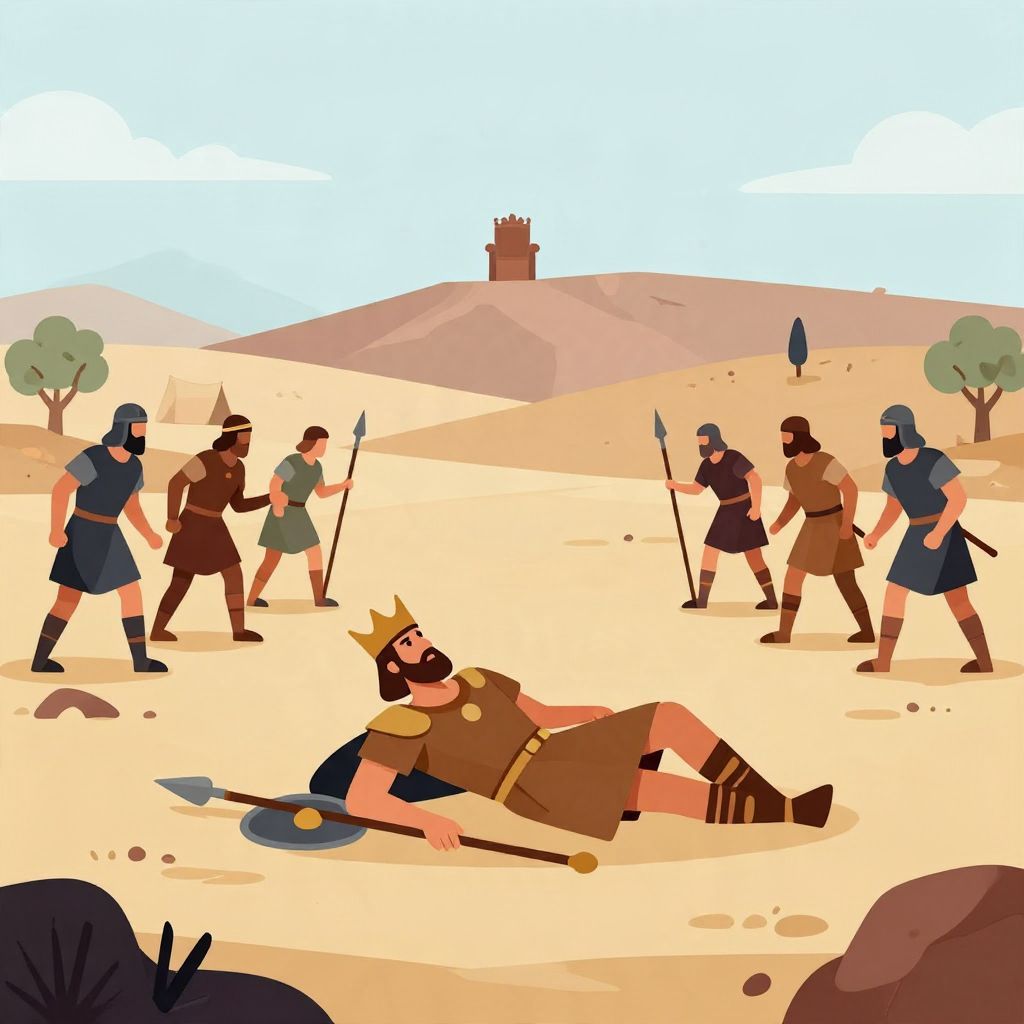
What happened to King Saul is one of the central turning points in the early history of ancient Israel. In the biblical narrative, Saul rises as Israel’s first king, wins important military victories, then falls into conflict, fear, and political decline before dying in battle against the Philistines.
His story matters because it marks the transition from Israel’s first monarchy to the rise of David. Historians treat the account as a blend of religious narrative, political memory, and ancient tradition, so the broad sequence is clear even when some details remain debated.
What happened to King Saul?
King Saul began as Israel’s first monarch, but his reign ended in defeat and death at Mount Gilboa, probably in the early 10th century BCE. According to the biblical account, he was wounded in battle against the Philistines and died by suicide rather than be captured. His death opened the way for David’s rise.
Saul’s rise as Israel’s first king
Saul appears in the Book of Samuel as a man from the tribe of Benjamin chosen to lead Israel in a time of military danger. The text presents him as anointed by the prophet Samuel and then publicly acclaimed by the people. This was not yet a fully developed kingdom in the later sense, but a new form of centralized leadership emerging among the Israelite tribes.
His early reign is portrayed positively. Saul organizes resistance against Israel’s enemies, especially the Philistines, who were a major power in the southern Levant. He wins support through military success and is remembered as a capable battlefield leader before his later troubles begin.
Why Saul was chosen
In the biblical tradition, Saul was selected because Israel wanted a king “like the nations” around them, meaning a stronger centralized ruler who could unify the tribes and lead war efforts. That political need helps explain why monarchy emerged in the first place. The story reflects a real historical shift from loose tribal organization toward kingship.
What went wrong during Saul’s reign?
Saul’s decline is explained in the biblical narrative through a combination of disobedience, jealousy, and political instability. He is said to have lost divine favor after failing to follow Samuel’s instructions. From that point on, the text presents him as increasingly troubled, suspicious, and vulnerable.
Modern readers should be careful here: the biblical writers were not neutral chroniclers. They shaped Saul’s story to explain why his dynasty did not endure and why David became the preferred king. That does not mean Saul was invented, but it does mean the account is theological as well as historical.
Conflict with Samuel
One of the most important episodes occurs when Saul performs or authorizes a sacrifice without waiting for Samuel. Another involves his failure to carry out a command against the Amalekites. In the narrative, these actions become proof that Saul is no longer fit to rule. Samuel then announces that God has rejected Saul as king.
Historically, these scenes likely preserve memory of a political rupture between royal authority and prophetic or priestly authority. They also help explain why the biblical tradition later favors David’s line over Saul’s.
Conflict with David
Saul’s relationship with David is another major turning point. David first enters the story as a talented warrior and musician, then becomes a celebrated military figure after defeating Goliath in the famous narrative. Saul’s growing fear of David is a sign of political tension: David is not merely a court favorite but a potential rival.
The text describes Saul attempting to kill David several times. Whether every detail is historical in a literal sense is uncertain, but the broader pattern is plausible. Courts in the ancient Near East were often unstable places, and succession struggles were common. Saul’s fear of losing power fits that wider political world.
The final battle: Saul’s death at Mount Gilboa
Saul’s end comes in battle against the Philistines at Mount Gilboa. This is the clearest answer to the question of what happened to him: he died in military defeat, along with several of his sons, including Jonathan, who was David’s close friend.
The biblical account in 1 Samuel says Saul was badly wounded by Philistine archers and asked his armor-bearer to kill him so he would not be captured and abused. When the armor-bearer refused, Saul fell on his own sword. His armor-bearer then died as well. This is the traditional account most readers know.
Was Saul killed or did he kill himself?
There is an important textual issue here. A later account in 2 Samuel tells a different version, in which an Amalekite claims he found Saul dying and finished him at Saul’s request. David has the Amalekite executed for claiming to have killed “the Lord’s anointed.” Many scholars think this later report may reflect literary shaping or a different tradition, but the central fact remains the same: Saul died after the battle at Gilboa.
Because the sources differ, historians usually say Saul either died by suicide or was mortally wounded and then died shortly afterward. The exact mechanism is less certain than the historical conclusion that he perished in the Philistine defeat.
What happened after Saul died?
Saul’s death did not immediately end his family’s claim to rule. His son Ish-bosheth was made king over part of Israel, while David was anointed king over Judah. This created a period of division and rivalry before David eventually became king over a united Israel.
In practical terms, Saul’s death weakened the old royal line and accelerated the rise of David. Politically, it was a succession crisis. Religiously and literarily, it became a lesson about obedience, legitimacy, and the transfer of divine favor from one king to another.
The fate of Saul’s family
The biblical narrative says that Saul’s descendants faced a difficult future. Jonathan dies with Saul at Gilboa, while other sons are also lost in the battle. Ish-bosheth rules only briefly before being assassinated. Later, David seeks to show favor to Jonathan’s son Mephibosheth, which may reflect both personal loyalty and a political effort to manage the memory of Saul’s house.
This aftermath suggests that Saul’s line did not disappear instantly, but it did not survive as a lasting dynasty. David’s house became the dominant royal line in biblical history.
How historians understand Saul today
Saul is a difficult figure for historians because the main source is the biblical text, which combines history, theology, and royal memory. Archaeological evidence for Saul himself is limited, and there is no independent contemporary record that tells his full story. As a result, scholars work with probabilities rather than absolute certainty.
Most historians accept that an early monarchy emerged in Israel around the late 11th or early 10th century BCE and that Saul was one of its earliest rulers, if not the first. The details of his reign, however, are filtered through later authors who wanted to explain the rise of David and the legitimacy of Judah’s royal line.
What is likely historical?
- Saul probably existed as an early Israelite king or war leader.
- He likely ruled during a time of conflict with the Philistines.
- He probably died in battle at or near Mount Gilboa.
- His death created a succession struggle that David ultimately won.
What is harder to verify?
- Every detail of Saul’s emotional decline.
- The exact nature of his conflict with Samuel.
- Whether he died by suicide or by another’s hand after being wounded.
- The precise chronology of his reign.
Why Saul’s story still matters
Saul’s story is not just about one king’s tragic end. It shows how early kingship in Israel was unstable, contested, and deeply tied to military survival. It also reveals how later writers interpreted political change through religious meaning. Saul becomes the first king who fails, while David becomes the model king who follows.
That contrast shaped centuries of biblical tradition. Saul is remembered as a tragic figure: chosen, successful, then undone by fear, conflict, and defeat. His death at Gilboa is the decisive event that ends his reign and opens the door to a new royal era.
In short, King Saul died after Israel’s defeat by the Philistines, probably at Mount Gilboa, and his death triggered a succession struggle that eventually brought David to power. For readers interested in the details of his final moments or David’s later rise, see how Saul died and when King David lived.