
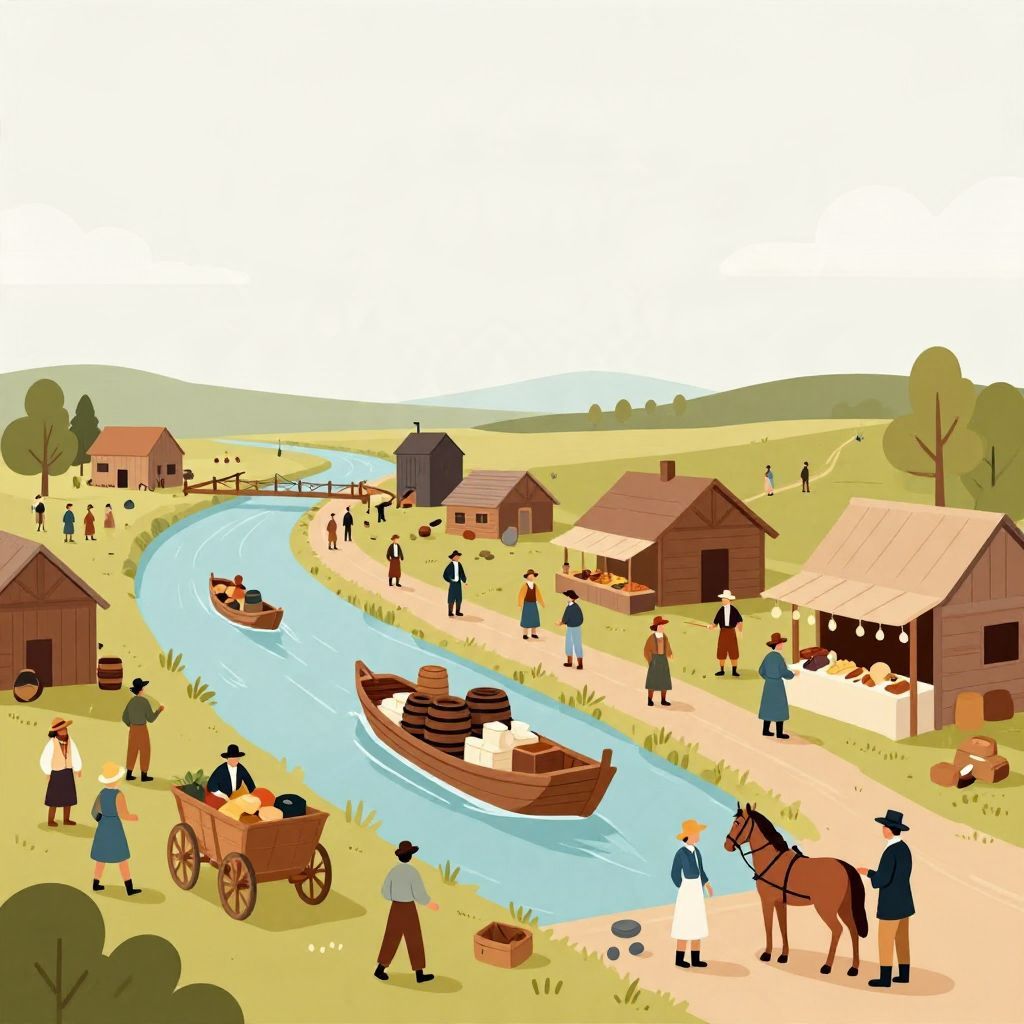
What is the Market Revolution? It was the major transformation of the American economy in the early 19th century, when many people shifted from local, household production to a wider market economy connected by roads, canals, steamboats, and later railroads. Farmers, artisans, merchants, and laborers increasingly produced goods for sale rather than only for family use.
This change did not happen overnight. It developed unevenly from roughly the 1790s through the 1840s and reshaped work, class relations, regional economies, and daily life in the United States. Historians use the term to describe both economic growth and the social disruption that came with it.
What Is the Market Revolution?
The Market Revolution was the early 19th-century transition in the United States from a largely local, subsistence-based economy to a more integrated market economy. Improved transportation, expanding credit, and new forms of production linked distant regions and encouraged people to buy, sell, and specialize more than before.
A simple definition
In practical terms, the Market Revolution meant that more Americans began making goods for profit, purchasing more of what they needed, and participating in national and international markets. It changed how work was organized, how families earned money, and how regions of the country depended on one another.
Why historians use this term
“Market Revolution” is a historical label, not a single event or law. It helps explain a broad set of changes: the rise of commercial farming, wage labor, factories, banking, transportation networks, and consumer culture. The phrase is especially associated with historians of the 20th century, who used it to capture the scale of economic change in the early republic.
Background: Why Did the Market Revolution Happen?
The Market Revolution grew out of several older developments. After independence, the United States had access to more land, greater internal mobility, and a growing population. At the same time, inventions, capital investment, and transportation improvements made it easier to produce and move goods over long distances.
Population growth and westward expansion
Between the late 18th and mid-19th centuries, the U.S. population expanded rapidly. Families moved westward into the Ohio Valley, Kentucky, Tennessee, and beyond. New settlements created demand for tools, cloth, food, and transport, while also producing surplus crops for sale. This expansion tied frontier households to distant markets.
Transportation improvements
Canals, turnpikes, steamboats, and railroads reduced the cost and time of moving goods. The Erie Canal, completed in 1825, became a famous example because it linked the Great Lakes region to New York City and helped turn the Northeast into a commercial hub. Steamboats transformed river travel, especially on the Mississippi and Ohio systems.
Technological and financial change
New machinery and business practices encouraged larger-scale production. Factories, especially in textiles, concentrated labor and capital in one place. Banks and credit systems expanded commerce by making it easier to borrow, invest, and speculate. These changes did not eliminate older forms of work, but they made market exchange far more important than before.
Key Features of the Market Revolution
The Market Revolution affected different parts of the country in different ways, but several patterns stand out. Americans became more connected to regional and national markets, production became more specialized, and labor became more divided by gender, race, and class.
Commercial agriculture
Many farmers shifted from growing mostly for their own households to producing cash crops for sale. In the North, farmers increasingly sold wheat, dairy products, livestock, and other goods. In the South, cotton became the dominant export crop. This commercialization made rural households more dependent on prices, credit, and transportation networks.
Factory production
Factories appeared first in textiles and other light manufacturing. The Lowell system in Massachusetts became well known for employing young women in textile mills under close supervision. Factory production increased output and lowered costs, but it also introduced new routines of discipline, timekeeping, and wage labor.
Wage labor and changing work patterns
As markets expanded, more people worked for wages rather than as independent producers. Artisans faced competition from mass-produced goods, and many laborers became dependent on employers rather than household production. This shift altered the meaning of work, status, and independence in American society.
Consumer culture
People bought more manufactured goods than before, including cloth, tools, dishes, and imported items. Advertisements, stores, and credit encouraged consumption. For many Americans, participation in the market was not only about selling crops or labor; it was also about purchasing goods that signaled comfort, respectability, and modernity.
How the Market Revolution Changed American Society
The Market Revolution was not just an economic story. It reshaped family life, social hierarchy, politics, and reform movements. As the economy became more commercial, many Americans experienced both opportunity and insecurity.
Class divisions became more visible
As some merchants, manufacturers, and large farmers accumulated wealth, others became wage earners or small producers struggling to keep up. Cities and mill towns developed sharper distinctions between employers and employees. These divisions contributed to labor activism, political debate, and anxieties about inequality.
Gender roles shifted
Economic change affected men and women differently. In many middle-class households, men were increasingly associated with paid work and public life, while women were linked to domestic labor and moral influence. Yet women also worked in mills, shops, and home-based production. The Market Revolution both reinforced and complicated ideas about separate gender roles.
Family labor and household economies changed
In earlier rural economies, families often worked together to produce much of what they used. As markets expanded, households became more specialized. Some members sold crops or labor while others managed domestic production, childcare, and consumption. This did not erase family cooperation, but it changed the balance between household self-sufficiency and market dependence.
Regional differences deepened
The North, South, and West developed in increasingly different ways. The North saw more manufacturing, urban growth, and wage labor. The South became more deeply tied to plantation agriculture and cotton exports. The West supplied food and raw materials while also absorbing migrants. These regional differences helped lay the groundwork for later political conflict.
The Market Revolution and Slavery
Any explanation of the Market Revolution must include slavery. The economic expansion of the early 19th century did not simply replace unfree labor with free labor; in the South, it intensified slavery’s profitability and geographic reach.
Cotton and the slave economy
The cotton boom, accelerated by the cotton gin and rising demand from textile mills in the United States and Britain, made enslaved labor even more valuable. Plantation slavery expanded westward into the Deep South. In this sense, the Market Revolution and slavery were deeply connected: industrial capitalism in one region and coerced labor in another grew together.
Contradictions of freedom and exploitation
Many Americans celebrated the market as a realm of opportunity and mobility, but those ideals rested alongside exclusion, coercion, and inequality. Enslaved people had no freedom to participate in markets on equal terms, and free laborers often faced harsh conditions and limited security. The era’s economic dynamism was real, but so were its injustices.
Important Dates and Developments
The Market Revolution unfolded over several decades rather than a single moment. A brief timeline helps show how the process developed.
- 1790s–1810s: Early industrial experiments, expanding trade, and growing transportation needs after the American Revolution.
- 1815–1825: Postwar growth, road building, canal planning, and stronger domestic manufacturing after the War of 1812.
- 1825: Completion of the Erie Canal, a landmark in internal improvements.
- 1830s: Rapid growth of textile mills, steamboat traffic, and commercial agriculture.
- 1840s: Railroads and telegraphy begin to knit the national economy together even more tightly.
These dates are approximate markers of a broader transformation. Different regions experienced change at different speeds, and older patterns of local exchange continued alongside new commercial systems.
Political and Cultural Consequences
The Market Revolution influenced politics as well as economics. Americans argued over banks, tariffs, internal improvements, and the proper role of government in encouraging growth. These debates helped shape the political parties of the era.
Debates over economic policy
Some leaders supported tariffs, roads, canals, and banks because they believed government should promote development. Others distrusted concentrated financial power and feared that commercial growth would harm ordinary citizens. These disagreements became central to the politics of the early republic.
Reform movements
Rapid change also inspired reform. Temperance, abolitionism, women’s rights activism, and labor organizing all grew in an era when people were reconsidering work, morality, and social order. The Market Revolution did not cause these movements by itself, but it created conditions that made them more urgent.
Religious and moral responses
Many Americans interpreted the upheaval through religion. The Second Great Awakening, a broad Protestant revival movement, encouraged people to seek moral renewal in a rapidly changing society. Some reformers saw commercial society as a threat to virtue; others believed it could be improved through discipline and self-control.
Was the Market Revolution Good or Bad?
Historians generally avoid judging the Market Revolution as purely good or bad because it produced both growth and disruption. It expanded opportunity for some people, especially entrepreneurs, merchants, and farmers with access to land and transport. It also created insecurity, inequality, and exploitation for many others.
Benefits
- Greater access to goods and services
- Faster transportation and communication
- Expanded trade and economic specialization
- New opportunities for some workers, farmers, and business owners
Costs
- More dependence on wages, credit, and prices
- Sharper class divisions
- Growth of slavery in the South
- Disruption of older household and artisan economies
The best historical answer is that the Market Revolution transformed American life in contradictory ways. It helped create a modern economy, but it also exposed deep inequalities that would shape the nation’s future.
Why the Market Revolution Matters
The Market Revolution matters because it helps explain how the United States became a more interconnected, commercial, and divided society in the decades before the Civil War. It changed where people lived, how they worked, what they bought, and how they understood freedom.
It also shows that economic change is never just about money. The Market Revolution altered family life, labor systems, politics, and regional identities. Its effects were uneven, and its benefits were distributed unequally. Understanding it is essential to understanding the early United States.
In short, the Market Revolution was the era when America moved from a patchwork of local economies toward a national market system, with profound consequences for work, society, and slavery. For related background, see also what was the Commercial Revolution and what is mercantilism.