
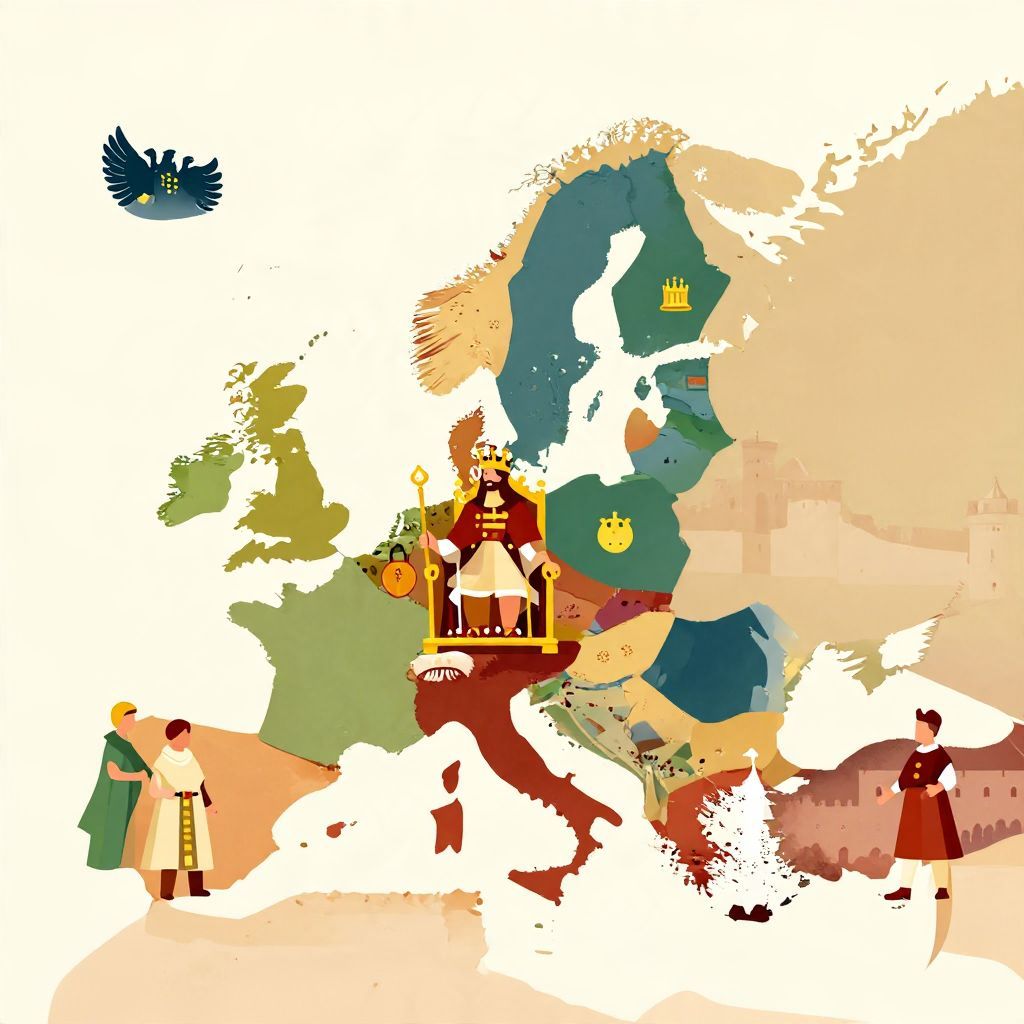
The Holy Roman Empire was a long-lasting political and religious union in central Europe that existed from the early Middle Ages until 1806. It was not a single nation-state like modern France or Germany, but a loose collection of kingdoms, duchies, bishoprics, and free cities held together by an elected emperor and shared traditions.
Its history is often confusing because the name sounds more unified than the empire really was. To understand what it was, you need to look at its origins in the post-Roman world, its relationship to the medieval Church, and the gradual way imperial power weakened over time.
What Was the Holy Roman Empire?
The Holy Roman Empire was a decentralized empire in central Europe, founded in 962 and dissolved in 1806. It linked many semi-independent territories under an emperor, but real authority was divided among princes, bishops, and city governments. “Holy” reflected its Christian legitimacy, “Roman” claimed continuity with ancient Rome, and “Empire” signaled imperial status rather than modern statehood.
How Did the Holy Roman Empire Begin?
The empire grew out of the collapse of Carolingian rule after Charlemagne’s empire fragmented in the ninth century. In 962, Otto I, king of East Francia, was crowned emperor by the pope in Rome. That coronation is usually treated as the empire’s beginning, though its roots lay in earlier medieval kingship and Frankish traditions.
From Charlemagne to Otto I
Charlemagne had been crowned emperor in 800, creating an important precedent for western imperial rule. After his empire broke apart, eastern Frankish rulers inherited much of the old Carolingian political and military structure. Otto I strengthened royal authority, defeated rival nobles, and presented himself as protector of the Church. His imperial coronation gave the new empire prestige and a sacred mission.
Why “Holy,” “Roman,” and “Empire”?
The name was not fixed at the start. Medieval rulers and writers gradually developed it to express legitimacy. “Roman” suggested that the emperor stood in the tradition of the ancient Roman emperors, even though the empire’s center was in Germany and Italy. “Holy” emphasized the emperor’s role in defending Christianity and working with the papacy, although that relationship often became tense.
How Was the Empire Governed?
The Holy Roman Empire was never ruled like a centralized monarchy. The emperor had prestige, legal authority, and some direct lands, but much power remained with local rulers. Over time, the empire became a complex federation of territories, with princes, bishops, abbots, counts, and imperial cities all holding privileges that limited imperial control.
The Emperor and the Princes
Emperors were usually elected, not automatically inherited. The most powerful princes chose the king of the Romans, who could later be crowned emperor. This election system made the emperor dependent on elite support. It also meant that imperial politics often involved negotiation, compromise, and conflict rather than simple dynastic succession.
The Role of the Church
Church institutions were central to the empire’s structure. Bishops and abbots often governed land and collected revenues, and emperors frequently relied on them as administrators because they did not pass their offices to children. This arrangement helped emperors balance secular nobles, but it also led to major disputes over who had the right to appoint church leaders.
What Was the Investiture Controversy?
One of the most important conflicts in medieval European history was the Investiture Controversy of the late eleventh and early twelfth centuries. It was a struggle between emperors and popes over who could appoint bishops and invest them with symbols of office. The dispute weakened imperial control and showed that the emperor could not simply command the Church.
Why It Mattered
The controversy was not just about ritual. Bishops controlled land, soldiers, and political influence, so appointment meant power. The conflict culminated in the confrontation between Emperor Henry IV and Pope Gregory VII, followed by the famous but often oversimplified episode at Canossa in 1077. The eventual compromise reduced imperial dominance over the Church and strengthened papal authority.
What Lands Did the Empire Include?
The empire’s territory changed over time, but its core lay in much of present-day Germany, Austria, Switzerland, the Czech lands, parts of northern and central Italy, and the Low Countries at various times. It was not a fixed border state. Instead, it was a political framework that incorporated many different regions and legal jurisdictions.
A Patchwork of Territories
- Kingdoms and duchies such as Saxony, Bavaria, Swabia, and Bohemia
- Ecclesiastical states ruled by bishops and archbishops
- Free imperial cities with special autonomy
- Counties, margraviates, and principalities of varying size
This patchwork made the empire durable but difficult to govern. Local rulers guarded their privileges fiercely, and imperial law had to accommodate a wide range of customs, languages, and political arrangements.
How Powerful Was the Holy Roman Empire?
The empire was powerful in some periods and fragmented in others. Under strong rulers such as Otto I, Frederick I Barbarossa, and Charles V, it could project authority across Europe. But its structure limited centralization. Compared with later modern states, it was less a unified government than a shared political order.
Medieval Strength and Imperial Prestige
In the High Middle Ages, emperors could mobilize armies, influence papal politics, and intervene in Italy. Frederick I Barbarossa, for example, tried to reinforce imperial rights in northern Italy and preserve imperial dignity. Yet even then, success depended on alliances, negotiation, and military campaigns that were often costly and uncertain.
Why Centralization Failed
Several forces worked against a strong centralized empire: the election of rulers, the independence of territorial princes, the power of the Church, and the geographic spread of the empire. Unlike France or England, the Holy Roman Empire did not develop a single royal bureaucracy capable of absorbing local authority. Instead, power dispersed over centuries.
What Happened in the Reformation Era?
The Protestant Reformation in the sixteenth century transformed the empire. Martin Luther’s challenge to the Catholic Church spread quickly through imperial territories, and rulers used religion to assert greater independence. The empire became a major arena of confessional conflict between Catholics and Protestants.
Religious Division and Political Conflict
The emperor, especially under Charles V, tried to preserve Catholic unity, but the empire’s structure made enforcement difficult. Many princes adopted Protestantism, partly from conviction and partly to strengthen their own authority. The result was not only religious division but also a political struggle over sovereignty within the empire.
The Peace of Augsburg
The Peace of Augsburg in 1555 recognized Lutheranism alongside Catholicism within the empire. It did not create religious freedom in the modern sense, but it did acknowledge that rulers could choose the confession of their territories. This compromise stabilized the empire temporarily while also confirming its fragmented nature.
How Did the Thirty Years’ War Change the Empire?
The Thirty Years’ War (1618–1648) was one of the most destructive conflicts in European history and a turning point for the Holy Roman Empire. It began as a religious and constitutional crisis inside the empire and expanded into a wider European war involving major powers such as Spain, Sweden, France, and the Habsburgs.
The Peace of Westphalia
The Peace of Westphalia in 1648 did not abolish the empire, but it changed it profoundly. It confirmed the autonomy of many imperial states, strengthened the legal rights of princes, and limited the emperor’s ability to impose uniform policy. The empire survived, but as a looser constitutional structure than before.
Who Were the Habsburgs?
From the fifteenth century until the empire’s end, the imperial title was held almost continuously by the Habsburg dynasty. This gave the empire a degree of continuity, even though the emperor still depended on the cooperation of other rulers. The Habsburgs also ruled extensive lands outside the empire, especially in Austria, Bohemia, Hungary, and Spain at different times.
Charles V and Imperial Ambition
Charles V is one of the best-known emperors because his rule combined the imperial title with vast dynastic possessions. He faced Protestant reform, Ottoman expansion, and French rivalry. His reign showed both the prestige of the empire and its limits: no emperor, however powerful, could easily control all the forces shaping Europe.
Was the Holy Roman Empire Really Roman?
In a strict sense, no. The empire was not a direct continuation of the ancient Roman Empire in political or cultural terms. Its institutions, language, and geography were medieval and early modern, not classical. But the claim to Roman continuity mattered symbolically. It gave emperors a prestigious lineage and linked them to universal Christian authority.
A Medieval Idea of Empire
Medieval Europeans did not think about empire the way modern historians do. They saw the Roman past as a source of legitimacy, order, and sacred history. The Holy Roman Empire used that memory to justify its existence, even though its actual government looked very different from ancient Rome or from modern empires.
Why Did the Holy Roman Empire End?
The empire ended in 1806, during the upheaval caused by Napoleon’s rise in Europe. By then, many imperial institutions had already weakened, and the empire had become increasingly obsolete in the face of modern warfare, nationalism, and stronger centralized states. Emperor Francis II formally dissolved the empire after creating the Austrian Empire two years earlier.
Napoleon and the Final Collapse
French military victories and the reorganization of German territories under Napoleonic influence made the old imperial structure impossible to maintain. The dissolution was not a sudden collapse from nowhere; it was the end point of centuries of decentralization and external pressure. The empire had survived by adaptation, but it could not survive the age of modern state power.
Why Does the Holy Roman Empire Matter Today?
The Holy Roman Empire matters because it shaped the political map of central Europe for nearly a thousand years and influenced ideas about sovereignty, religion, and constitutional government. It shows that empires were not always centralized machines; some were negotiated systems of layered authority. Its history also helps explain the later development of Germany and Austria.
In short, the Holy Roman Empire was a medieval and early modern imperial framework that united many European territories without turning them into one nation. It was powerful, fragmented, sacred, political, and constantly changing. For related context, see when the Holy Roman Empire fell and how big the Roman Empire was.