
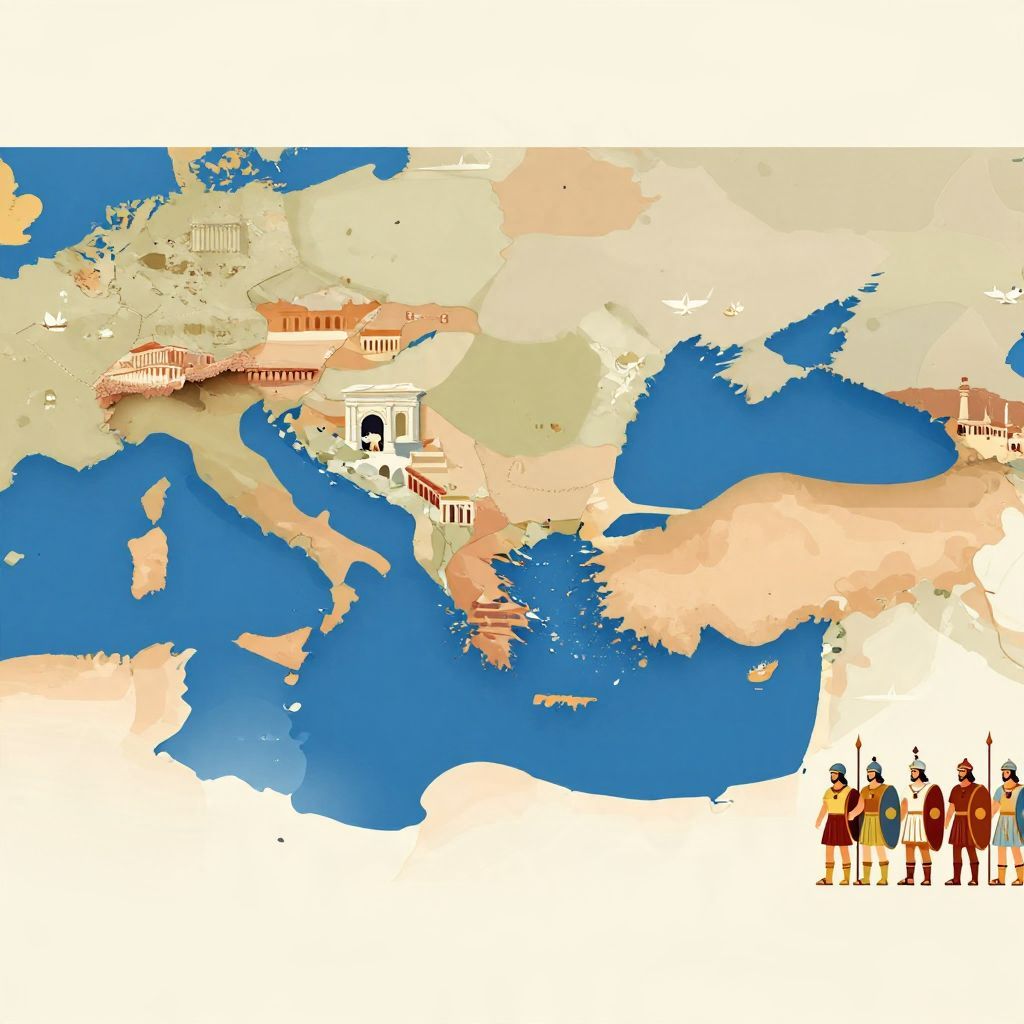
The Roman Empire was one of the largest and longest-lasting states in world history. At its greatest extent under Emperor Trajan in the early 2nd century CE, it stretched across much of Europe, North Africa, and the Near East, controlling an enormous and diverse population. But “how big” the empire was depends on whether you mean land area, population, or influence.
Its size changed over time as Rome expanded, peaked, and then gradually contracted. To understand the Roman Empire’s true scale, it helps to look at its geography, its growth, and the legacy it left behind.
How Big Was The Roman Empire?
At its height, the Roman Empire covered roughly 5 million square kilometers, or about 1.9 million square miles, though estimates vary. It ruled an estimated 50 to 90 million people, making it one of the most populous empires of antiquity. Its borders reached from Britain to Mesopotamia and from the Rhine and Danube to the Sahara.
The Rise of Rome: From City-State to Empire
Rome began as a small city on the Italian peninsula, traditionally dated to 753 BCE, though that founding date is legendary rather than certain. For centuries it was a republic, not an empire. Through military conquest, diplomacy, and alliances, Rome absorbed first Italy and then lands around the Mediterranean.
Why Rome Expanded So Far
Rome’s expansion was driven by a mix of security concerns, competition among elites, access to land and wealth, and a political culture that rewarded military success. Victories brought plunder, slaves, prestige, and new provinces. As Rome defeated rivals such as Carthage, Macedonia, and the Seleucid Kingdom, it transformed from a regional power into a Mediterranean superstate.
From Republic to Imperial Rule
The Roman Republic became increasingly unstable in the 1st century BCE. Civil wars, ambitious generals, and political violence undermined republican institutions. After the rise of Augustus, who became Rome’s first emperor in 27 BCE, the state took on a new form. The empire did not replace Rome overnight; rather, it preserved many republican institutions while concentrating real power in the hands of one ruler and his administration.
The Roman Empire at Its Greatest Extent
The empire reached its largest territorial extent under Trajan around 117 CE. By then, Roman control extended from the Atlantic coast of Hispania to the Euphrates frontier, and from the Scottish border region in Britain to Egypt and the deserts of North Africa. This was the broadest map of Roman rule, though not all areas were equally settled or fully integrated.
Main Regions of the Empire
- Western Europe: Hispania, Gaul, much of Britain, and parts of the Rhine frontier.
- Central and Southeastern Europe: Italy, the Balkans, Greece, and the Danubian provinces.
- North Africa: Egypt, Cyrenaica, Africa Proconsularis, and other coastal territories.
- Near East: Syria, Judea, Anatolia, and parts of Mesopotamia at times.
Rome’s borders were not fixed lines in the modern sense. They were often military frontiers, buffer zones, and client kingdoms rather than neat national boundaries. In some places, Roman power was deep and urbanized; in others, it was thin, based on forts, roads, and local alliances.
What “Size” Really Meant in the Ancient World
Ancient empires were harder to measure than modern states. Roads were slow, communication was uneven, and control varied from province to province. A province could be Roman in law and taxation while still retaining local customs, languages, and elites. So when historians describe the Roman Empire as huge, they mean not only territory but also administrative reach and cultural influence.
How the Empire Was Governed Across Such a Vast Area
Rome’s success depended on administration. Provinces were governed by officials appointed from the center, taxes were collected, armies were stationed along frontiers, and local elites were often drawn into Roman rule. This system allowed a relatively small ruling class to manage a very large empire.
Provinces, Roads, and Army
The empire was divided into provinces, each with its own governor. Roman roads linked cities, military bases, and ports, making movement faster and more reliable. The army was essential not just for war but for maintaining order, protecting borders, and projecting Roman authority. In many regions, the presence of soldiers shaped daily life as much as imperial law did.
Urban Centers and Imperial Integration
Cities were the backbone of Roman rule. They served as centers of taxation, law, trade, and culture. Major cities such as Rome, Alexandria, Antioch, Carthage, and Ephesus connected distant regions of the empire. Urban life helped spread Roman institutions, though local traditions remained strong.
Population, Diversity, and Daily Life
The Roman Empire was not only large; it was diverse. Its population included Italians, Greeks, Egyptians, Syrians, North Africans, Iberians, Gauls, Jews, Britons, and many others. People spoke different languages, practiced different religions, and lived under varying local customs, even while sharing Roman political authority.
How Many People Lived in the Roman Empire?
Population estimates are approximate, but many historians place the empire’s population between 50 and 90 million at its peak. That range reflects uncertainty in ancient demographic data. The empire’s size mattered because it brought together an enormous share of the known world’s population under one political system.
Languages and Cultural Blending
Latin was the main language of government in the western provinces, while Greek remained dominant in the eastern Mediterranean. Many people were bilingual or multilingual. Roman rule did not erase local cultures; instead, it often blended with them. This process, sometimes called Romanization, varied greatly by region and was never complete.
How Long Did the Roman Empire Stay Large?
Rome’s greatest territorial extent was relatively brief compared with the empire’s total lifespan. The western empire began to weaken in the 3rd century CE under pressure from internal instability, economic strain, and external invasions. The eastern empire, later known as the Byzantine Empire, survived for nearly another thousand years.
Key Stages in Roman Expansion and Contraction
- 753 BCE to 509 BCE: Legendary monarchy and early city-state period.
- 509 BCE to 27 BCE: Roman Republic expands across Italy and the Mediterranean.
- 27 BCE to 117 CE: Early imperial expansion reaches its greatest extent.
- 3rd to 5th centuries CE: Crisis, division, and contraction in the western provinces.
- 476 CE: Traditional date for the fall of the Western Roman Empire.
- 1453 CE: Fall of Constantinople, ending the Eastern Roman Empire.
These dates simplify a long and uneven process. The empire did not suddenly disappear in 476 CE; many Roman institutions survived in the west, and the east remained Roman for centuries. Still, the western imperial structure fragmented, and the old imperial map changed permanently.
Why the Roman Empire Could Not Stay at Its Maximum Size
Empires face limits. Rome’s vast territory was expensive to defend, especially along long frontiers in Britain, the Rhine-Danube line, and the eastern deserts. Civil wars, succession disputes, inflation, plague, and military pressure all strained the system. The farther Rome expanded, the harder it became to govern efficiently.
Frontiers Were Costly
Rome’s borders were not just lines on a map; they were active military zones. Defending them required forts, garrisons, supply chains, and constant diplomacy. In some regions, the cost of holding territory outweighed the benefits. This is one reason why emperors sometimes abandoned or reduced control in exposed areas.
Division of the Empire
By the late 3rd and 4th centuries CE, emperors increasingly divided administrative control between eastern and western courts. This did not mean two separate civilizations at first, but it did reflect the practical difficulty of ruling such a large realm from one center. Over time, the eastern and western halves developed different political trajectories.
The Roman Empire’s Legacy
Even after its political collapse in the west, the Roman Empire remained enormously influential. Its laws, roads, cities, languages, and political ideas shaped later European and Mediterranean history. Latin evolved into the Romance languages, and Roman legal concepts influenced later legal systems.
Lasting Influence on Europe and Beyond
Roman infrastructure and urban planning left a visible mark on the landscape. The empire’s administrative model influenced later kingdoms and empires. Christianity spread within the Roman world and eventually became central to post-Roman Europe. In many ways, the Roman Empire did not simply end; it transformed and survived in altered forms.
Why Its Size Still Matters Today
People still ask how big the Roman Empire was because its scale helps explain its power. A vast territory brought wealth, soldiers, trade, and cultural exchange, but it also created tensions that no ancient state could fully solve. The empire’s size was both its strength and one of the reasons it became difficult to sustain.
So, how big was the Roman Empire? At its peak, it was a transcontinental imperial system spanning millions of square kilometers and tens of millions of people, united less by modern borders than by Roman law, armies, roads, and institutions. If you want to explore the world that made this empire possible, you may also enjoy reading about what the Roman Forum was and what language the Romans spoke.