
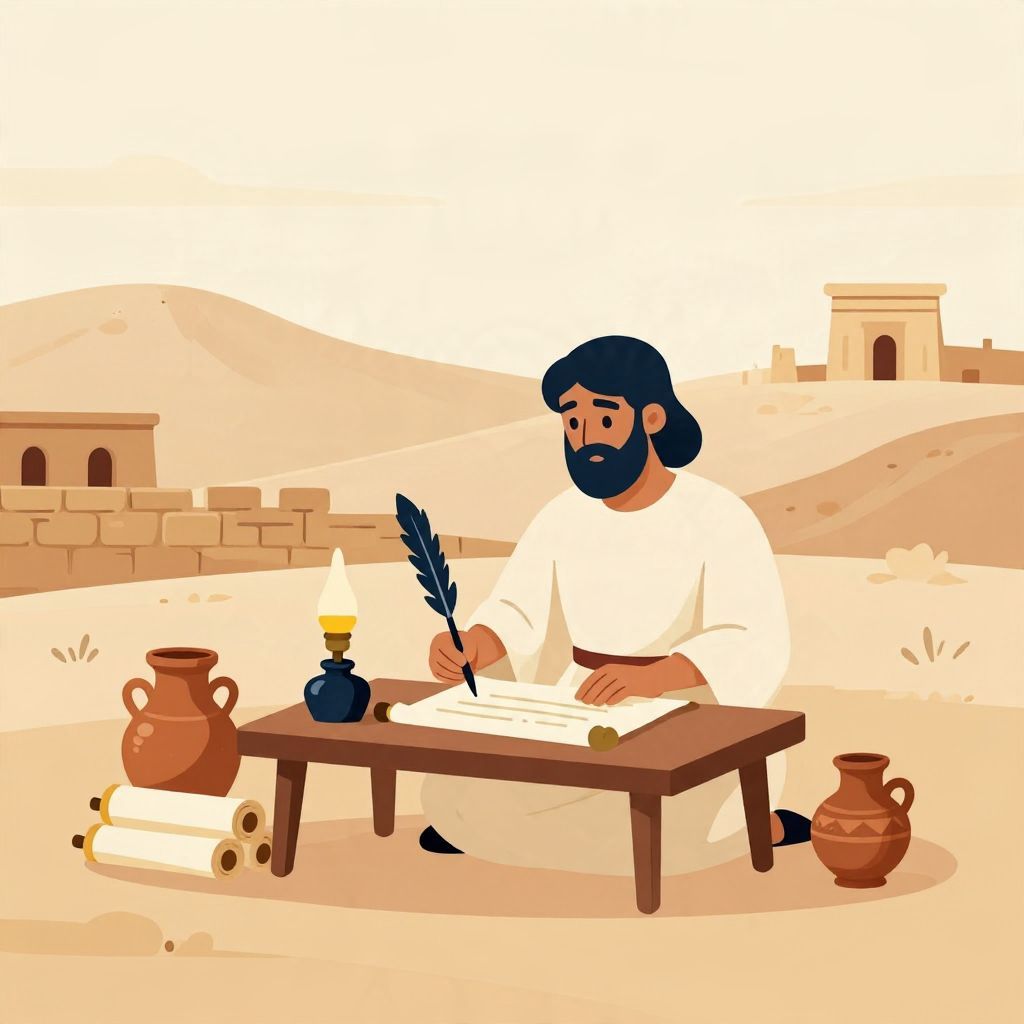
Where did the Bible come from? The short historical answer is that it emerged over many centuries in the ancient Near East, especially among the Israelites and early Christians, and was written, edited, copied, and collected in different places rather than in one single location.
Its books were composed in Hebrew, Aramaic, and Greek, then preserved by scribes and communities in places such as ancient Israel and Judah, Babylon, Egypt, and the wider Mediterranean world. The Bible is therefore not the product of one moment or one city, but of a long historical process.
Where Did the Bible Come From?
The Bible came from multiple ancient communities in the Near East and eastern Mediterranean over roughly a thousand years. Its Hebrew Bible or Old Testament grew out of Israelite and Jewish tradition, while the New Testament was written by early Christians in the first century CE. Together, these writings were later gathered into sacred collections.
The Historical Setting of the Bible
The Bible’s origins lie in the ancient world of the Levant, the region that includes modern Israel/Palestine, parts of Lebanon, Jordan, Syria, and nearby areas. This was a crossroads of empires, trade routes, migrations, and religious ideas. The Bible reflects that world: kingdoms rose and fell, exiles reshaped identity, and communities preserved their traditions in writing.
The Hebrew Bible in Ancient Israel and Judah
The oldest parts of the Hebrew Bible likely developed among Israelite and Judean communities between about the 10th and 6th centuries BCE, though many texts were edited later. These writings were tied to the history of the kingdoms of Israel and Judah, especially Jerusalem and its temple. Some traditions may preserve much older oral material, but oral origins are difficult to prove with certainty.
Scholars generally agree that the Hebrew Bible was not written all at once. Instead, laws, poems, royal traditions, prophetic sayings, and historical narratives were composed and revised over time. Scribes played a major role in preserving and shaping these texts, especially during periods of political crisis.
Exile and the Growth of Scripture
A major turning point came with the Babylonian exile in the 6th century BCE, when many Judeans were displaced after Jerusalem fell to Babylon. Exile did not end biblical writing; it helped intensify it. Communities outside the land, and later under Persian rule, had strong reasons to preserve identity through texts, laws, and sacred memory.
Many scholars see this period as crucial for the formation of biblical literature. Some books were compiled, expanded, or given final shape in Babylon, Judah, or later in Persian-period Yehud, the small province centered on Jerusalem. The Bible’s growth was therefore deeply linked to loss, survival, and reconstruction.
How the Bible Was Written and Collected
The Bible came into being through a long process of composition, editing, copying, and canon formation. It was not “found” in one place as a finished book. Rather, individual writings circulated separately before communities recognized them as authoritative and eventually bound them together into collections.
Languages of the Bible
The Hebrew Bible was written mainly in Hebrew, with some sections in Aramaic. The New Testament was written in Greek, the common literary language of the eastern Roman Empire. This multilingual character reflects the Bible’s broad historical setting and the different communities that produced and used its texts.
Translation also mattered. Jewish communities outside Judea used the Greek Septuagint, a translation of Hebrew scriptures into Greek that began in the Hellenistic period, probably in Alexandria, Egypt. This version influenced early Christians and helped shape which books were read widely.
From Scrolls to Collections
Ancient books were usually written on scrolls, not in modern bound volumes. Individual biblical books circulated as separate texts before being grouped into larger collections. Over time, communities recognized certain writings as especially authoritative for teaching, worship, and identity.
The process of canon formation differed among Jewish and Christian traditions. There was no single meeting at which “the Bible” was created in one stroke. Instead, the boundaries of scripture developed gradually, and different communities sometimes accepted different books.
Where the Old Testament Came From
The Old Testament, or Hebrew Bible, came from the religious and historical life of ancient Israelite and Jewish communities. Its core traditions were shaped in the southern Levant, but important stages of editing and preservation also took place in Babylon, Persia, and later in Judea and the wider Jewish diaspora.
Major Historical Layers
- Early traditions: Oral stories, poems, laws, and ancestral memories passed within Israelite communities.
- Monarchic period: Texts associated with kingship, temple worship, prophecy, and national history.
- Exilic period: Reworking of traditions after the destruction of Jerusalem in 586 BCE.
- Persian and later periods: Further editing, collection, and scribal preservation in Judah and diaspora centers.
Some books, such as parts of Genesis, Exodus, Samuel, Kings, Isaiah, and the Psalms, preserve material from different periods and authors. Their final forms often show signs of compilation, with older traditions woven together by later editors. This makes the Old Testament both ancient and layered.
The Role of Jerusalem
Jerusalem was central to the Bible’s development because it was the political and religious center of Judah and the location of the temple. Many biblical texts focus on Jerusalem as a sacred city, especially after the temple became the heart of worship. Yet the Bible also reflects life beyond Jerusalem, including rural villages, royal courts, and exile communities.
Where the New Testament Came From
The New Testament came from the earliest Christian movement, which began in the 1st century CE in Roman Judea and spread throughout the eastern Roman Empire. Its writings were composed by followers of Jesus and later Christian communities in places such as Judea, Syria, Asia Minor, Greece, and possibly Rome.
First-Century Christian Communities
After Jesus’s death, his followers formed communities that spoke Aramaic and Greek and interpreted his life in light of Jewish scripture. The earliest Christian writings were letters, especially those associated with Paul, written in the mid-1st century CE. The Gospels were composed later, usually dated between about 70 and 100 CE.
These texts were written to instruct believers, settle disputes, preserve memory, and explain Jesus’s significance. They were not written as one coordinated project. Different authors addressed different communities and theological concerns, which is why the New Testament includes a variety of voices and genres.
Why Greek Matters
Although Jesus and many of his earliest followers likely spoke Aramaic, the New Testament was written in Greek because Greek was widely used across the eastern Mediterranean. That choice made the Christian message accessible to a broader audience and reflects the cosmopolitan world of the Roman Empire.
How the Bible Became “the Bible”
The Bible became a single collection through centuries of selection and transmission. Jewish communities preserved the Hebrew scriptures, while Christians added the New Testament writings and debated which books should count as authoritative. The final shape of the Bible varied among traditions, and it still does today.
Different Canons, Different Bibles
There is not just one Bible in every tradition. Jewish, Catholic, Orthodox, and Protestant canons differ in the number and arrangement of books. These differences developed historically through separate patterns of use, translation, and church authority. So when asking where the Bible came from, it is important to ask which Bible is meant.
For example, some books included in Catholic and Orthodox Bibles are not found in the Protestant Old Testament. These books were often part of the Greek Septuagint tradition and remained important in some Christian communities. Such differences show that canon formation was gradual and contested.
Copying, Manuscripts, and Preservation
Before printing, the Bible survived through handwritten manuscripts. Scribes copied texts carefully, but variations naturally entered the tradition over time. The discovery of ancient manuscripts, including those from the Dead Sea Scrolls, has helped scholars study how biblical texts developed and how stable or fluid they were in different periods.
Manuscript evidence shows both continuity and change. Some passages remained remarkably consistent, while others reveal editing, expansion, or alternative wording. This is one reason historians treat the Bible as a library of texts with a long transmission history rather than a single authored book.
What We Can Say with Confidence
Historically, the Bible did not come from one place, one author, or one date. It emerged from the ancient Near East, especially Israel, Judah, Babylon, and later the broader Mediterranean world. Its texts were written in Hebrew, Aramaic, and Greek, then copied and collected over many generations.
What is well established is the broad setting: the Hebrew Bible grew from the religious life of ancient Israelite and Jewish communities, and the New Testament from the first-century Christian movement. What remains debated are the exact dates, authorship of some books, and the precise stages by which particular traditions reached their final form.
Why the Bible’s Origins Matter
Understanding where the Bible came from helps explain why it contains so many genres, voices, and historical layers. It also shows how sacred texts can grow out of real communities facing war, exile, empire, migration, and religious change. The Bible is both a spiritual text and a historical artifact of the ancient world.
Its origins are best understood not as a single event but as a long process of memory, writing, editing, and reception. If you want to explore the Bible’s early history further, it also helps to look at what language the first Bible was written in and the original language of the Bible.