
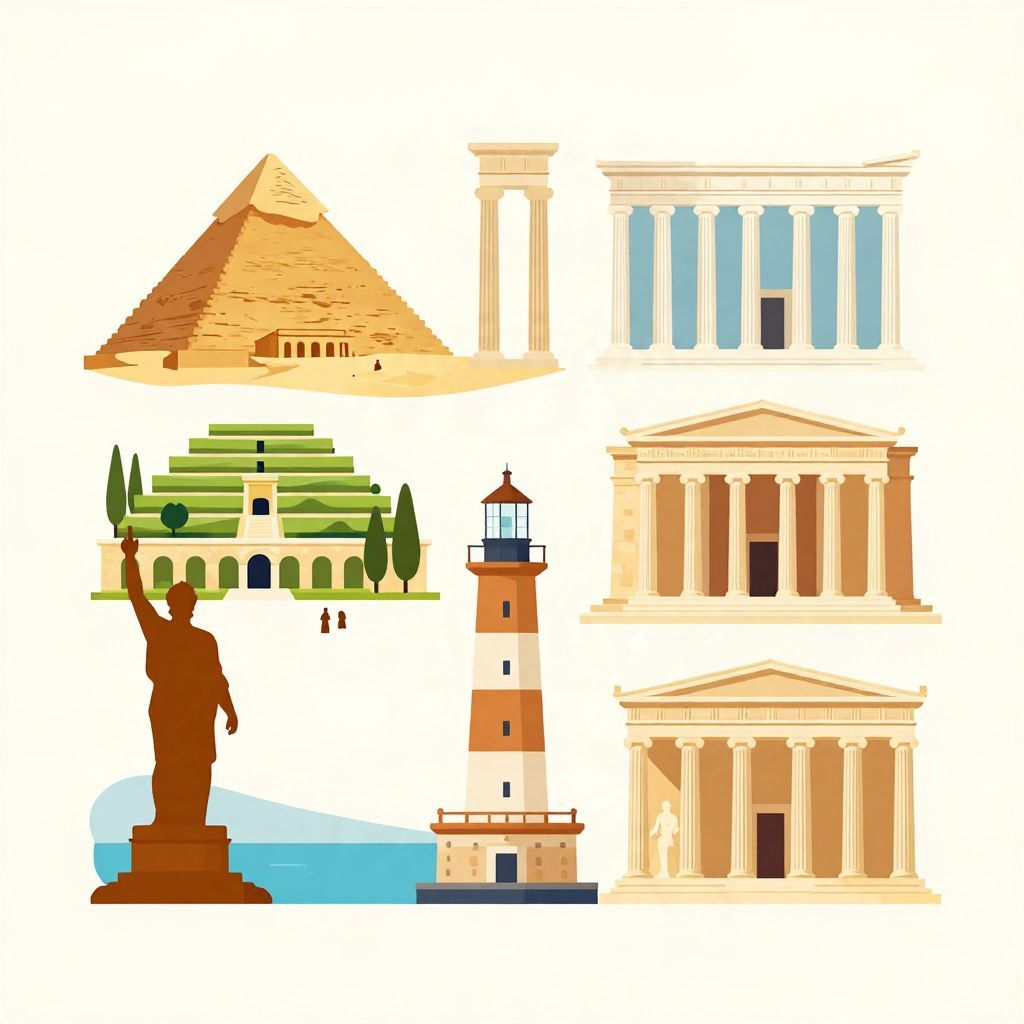
What are the Seven Wonders? The phrase usually refers to the Seven Wonders of the Ancient World, a classical list of extraordinary monuments admired by Greek writers and later tradition. Only one still survives today: the Great Pyramid of Giza. The others were celebrated for their size, artistry, engineering, or sheer fame, not because they were the only remarkable structures of antiquity.
Over time, “the seven wonders” became a way of describing the most astonishing achievements of a civilization. The list changed in meaning across centuries, but its ancient version remains the best known and most historically important.
What Are The Seven Wonders?
The Seven Wonders are the Great Pyramid of Giza, the Hanging Gardens of Babylon, the Statue of Zeus at Olympia, the Temple of Artemis at Ephesus, the Mausoleum at Halicarnassus, the Colossus of Rhodes, and the Lighthouse of Alexandria. They were a Greek-created list of marvels around the Mediterranean and Near East, assembled between the Hellenistic period and later classical tradition.
Where Did the Idea of the Seven Wonders Come From?
The concept grew out of the ancient Greek habit of cataloging remarkable places. Greek travelers, historians, and poets admired impressive works they encountered across the eastern Mediterranean and Near East. By the Hellenistic period, after the conquests of Alexander the Great, educated Greeks had a wider world to compare, and lists of “wonders” helped organize that expanded geography of marvels.
The exact origin of the list is not tied to one author or one date. Different ancient writers named slightly different collections before the standard seven became fixed. The number seven itself mattered in Greek culture because it often symbolized completeness or perfection. The list was therefore as much a cultural idea as a strict inventory.
Why seven?
Seven was a meaningful number in the ancient world, appearing in religion, astronomy, and literature. The choice was not purely practical. There were many impressive monuments, but seven created a neat, memorable canon. In that sense, the list reflects Greek literary taste as much as architectural history.
The Seven Ancient Wonders, Explained
Each wonder had its own historical setting, and each became famous for different reasons. Some were genuine engineering feats; others were celebrated in part because travelers and writers repeated stories about them. In several cases, the surviving evidence is incomplete, so historians distinguish between what is securely known and what comes from later tradition.
1. The Great Pyramid of Giza
Built for the Egyptian pharaoh Khufu around c. 2600 BCE, the Great Pyramid is the oldest and only surviving wonder. It was the tallest human-made structure in the world for many centuries. Its survival is one reason the ancient list still feels tangible today. The pyramid’s precision and scale impressed Greek observers, who saw it as a monument of astonishing antiquity rather than a contemporary marvel.
2. The Hanging Gardens of Babylon
This is the most uncertain of the seven. Ancient writers described a terraced garden in Babylon with trees and waterworks, often linked to King Nebuchadnezzar II in the sixth century BCE. However, no clear archaeological evidence has confirmed its exact location or even its existence as described. Some scholars think the story may have been confused with other royal gardens or with later accounts shaped by imagination and hearsay.
3. The Statue of Zeus at Olympia
Created by the sculptor Phidias around 435 BCE, this massive seated statue stood in the Temple of Zeus in Olympia, Greece. Made of ivory and gold over a wooden core, it represented the king of the gods in a majestic form. Ancient visitors treated it as one of the greatest artistic achievements of the classical world. It was later lost, probably destroyed in late antiquity.
4. The Temple of Artemis at Ephesus
Located in Ephesus, in present-day Turkey, this temple was rebuilt on a grand scale in the 6th century BCE and later again after destruction. It was dedicated to Artemis, a major Greek goddess associated with the city. The temple’s enormous size, ornate decoration, and religious importance made it famous. It was eventually destroyed, and only fragments remain.
5. The Mausoleum at Halicarnassus
This monumental tomb was built for Mausolus, a ruler of Caria, and completed around 350 BCE. His widow and sister Artemisia II commissioned it. The structure combined Greek, Egyptian, and Near Eastern artistic influences, making it one of the most admired tombs in antiquity. Its name became the source of the modern word mausoleum.
6. The Colossus of Rhodes
The Colossus was a giant bronze statue of the sun god Helios, erected around 280 BCE in Rhodes. Ancient sources describe it as standing near the harbor, though the exact pose is debated. It was destroyed by an earthquake only a few decades after completion. Even so, its fame endured because it symbolized civic pride and technical ambition.
7. The Lighthouse of Alexandria
Built on the island of Pharos near Alexandria, Egypt, this lighthouse was completed in the 3rd century BCE, probably under the Ptolemaic rulers. It guided ships into one of the ancient world’s busiest ports. Its height and design made it legendary, and it influenced the later word pharos for lighthouse in several languages. It was damaged by earthquakes over time and eventually disappeared.
How Reliable Is the Ancient List?
The Seven Wonders are historically real as a tradition, but not every item is equally well documented. The Great Pyramid is archaeologically certain. The Temple of Artemis, Mausoleum, Colossus, and Lighthouse are also well attested through ruins, texts, and later scholarship. The Hanging Gardens remain the biggest mystery, because the evidence is literary and indirect rather than physical.
That uncertainty matters. Ancient authors were not writing modern site reports. They relied on travel accounts, inherited reputation, and the desire to record the most astonishing things in the known world. As a result, the list mixes solid history with legend, especially where distant places were concerned.
What the list tells us about the ancient world
- It shows the importance of travel and cultural exchange in the Hellenistic Mediterranean.
- It reflects Greek admiration for scale, craftsmanship, and monumentality.
- It reveals how ancient people remembered places through story, prestige, and wonder, not just through measurements.
- It highlights the fragility of monuments, since only one of the seven survives intact.
Why Did These Wonders Become So Famous?
These structures were famous because they were exceptional in different ways. Some were enormous, some were richly decorated, and some were tied to powerful rulers or gods. They also represented the reach of ancient empires and city-states. For Greek writers, they were not simply buildings; they were proof that human beings could create works that seemed to rival nature itself.
Another reason for their fame is that most of them no longer exist. Loss often increases legend. Once a monument disappears, later generations preserve it through description, imagination, and admiration. That is one reason the Seven Wonders still attract attention: they are partly history, partly memory, and partly myth.
Did the Seven Wonders Change Over Time?
Yes. The ancient list was never completely fixed in the earliest period, and later ages produced new “seven wonders” lists of their own. Medieval and modern writers sometimes replaced the ancient monuments with different marvels, such as the Great Wall of China or the Taj Mahal. These later lists are not the same historical tradition, though they borrow the prestige of the original idea.
In modern usage, “Seven Wonders” can therefore mean different things depending on context. If a historian says “the Seven Wonders,” they usually mean the ancient list unless otherwise specified. If a modern tourism or cultural project uses the phrase, it may refer to a newer selection made for a different audience.
Why the Pyramids Matter So Much in the Seven Wonders Tradition
The Great Pyramid of Giza stands at the center of the Seven Wonders tradition because it is both the oldest and the only surviving ancient wonder. It was already ancient when Greek visitors saw it. That long survival gave it a special authority in later lists, and it continues to anchor popular interest in ancient monumental architecture.
Its inclusion also reminds us that the Seven Wonders were not all built by the same civilization or in the same era. They span centuries and regions, from Egypt to Greece to Asia Minor. The list is therefore a map of the ancient Mediterranean world as imagined by Greek observers.
Key Facts About the Seven Wonders
- They were ancient, not modern. The original list comes from the classical world.
- Only one survives. The Great Pyramid of Giza is still standing.
- Not all are equally certain. The Hanging Gardens remain disputed.
- The list was Greek in origin. It reflects Greek cultural priorities.
- The wonders were diverse. They included temples, statues, tombs, a lighthouse, and a pyramid.
So, What Are The Seven Wonders?
The Seven Wonders are the ancient world’s most celebrated monuments: the Great Pyramid of Giza, the Hanging Gardens of Babylon, the Statue of Zeus at Olympia, the Temple of Artemis at Ephesus, the Mausoleum at Halicarnassus, the Colossus of Rhodes, and the Lighthouse of Alexandria. They survive today mainly as history, legend, and cultural memory, with the Great Pyramid as the one enduring physical witness.
For readers interested in the monuments behind the tradition, it is worth exploring the history of the Great Pyramid itself and the broader story of ancient monumental building. You can also read more about when the Pyramids of Giza were built and, in a different historical context, what was the longest war in history.