
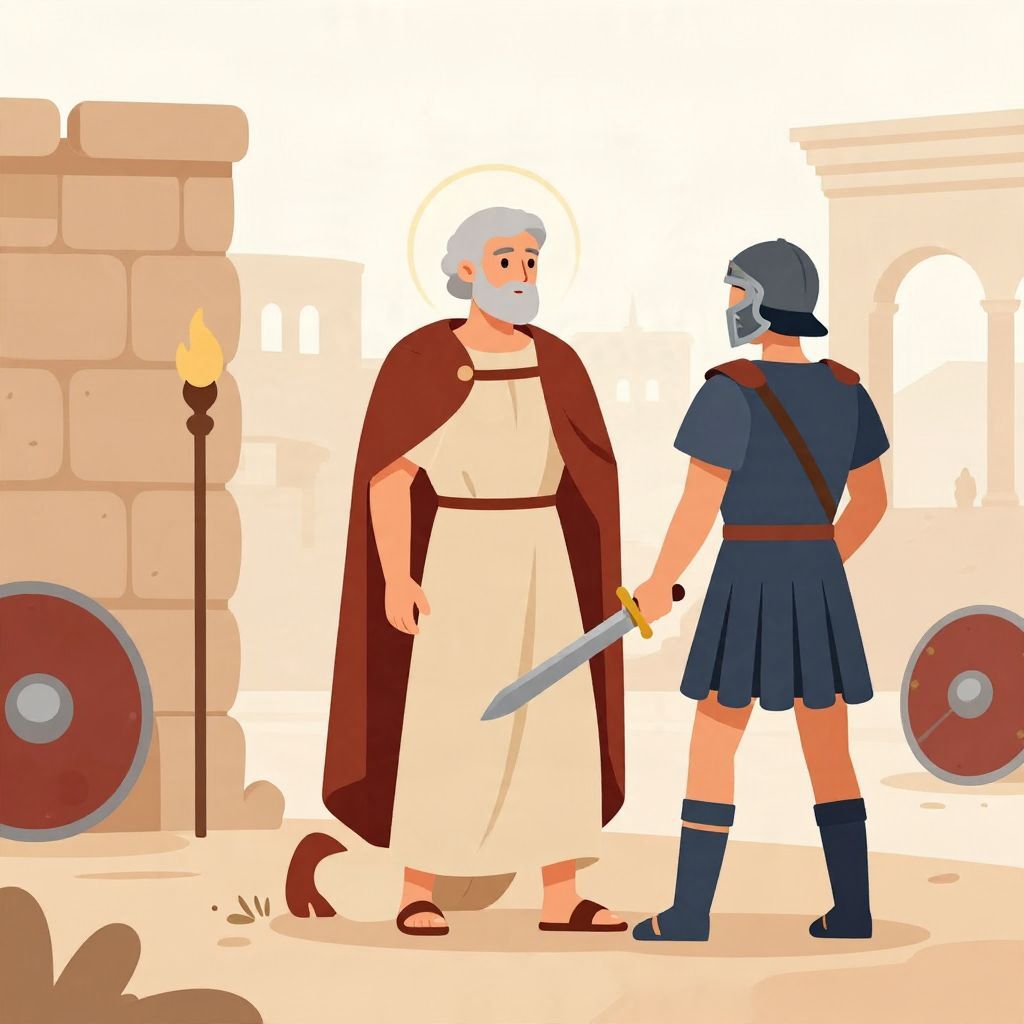
How did Apostle Paul die? The short answer is that Paul was most likely executed in Rome during the persecution of Christians under Emperor Nero, probably sometime in the mid- to late 60s CE. The most common ancient tradition says he was beheaded, which fit the Roman practice for a Roman citizen. But the exact date, place, and circumstances are not recorded in the New Testament and remain partly uncertain.
Paul’s death matters because it marks the end of one of the most influential lives in early Christianity. His letters, missionary journeys, and martyrdom tradition helped shape Christian theology, identity, and memory for centuries afterward.
How Did Apostle Paul Die?
Paul was probably beheaded in Rome during Nero’s reign, likely around 64–68 CE. This conclusion comes from early Christian tradition rather than a surviving eyewitness account. Historians generally regard the execution tradition as credible, but the precise details are not fully verifiable from contemporary sources.
What the historical evidence suggests
The New Testament does not describe Paul’s death. The strongest early traditions come from Christian writers of the late first and second centuries, especially 1 Clement and later accounts that place Paul’s final suffering in Rome. These texts do not give a courtroom record, but they do show that Christians very early believed Paul died as a martyr.
The tradition of beheading is also historically plausible. Paul was a Roman citizen, and Roman citizens were commonly executed by beheading rather than by crucifixion or other harsher public penalties. That detail does not prove the method beyond doubt, but it fits what is known about Roman legal practice.
Why Rome is the most likely place
Most traditions locate Paul’s death in Rome because the city was the center of imperial power and the likely place of his final imprisonment. The New Testament book of Acts ends with Paul under house arrest in Rome, awaiting judgment. Although Acts does not narrate his death, it establishes Rome as the last known setting in his life story.
Later Christian memory strongly tied Paul’s martyrdom to Rome, where he became associated with the city’s early Christian community. The traditional burial place at the site now known as the Basilica of Saint Paul Outside the Walls reflects that long-standing belief, although the archaeological and textual evidence does not allow every detail to be confirmed.
What Happened to Paul Before His Death?
Paul’s final years are reconstructed from his letters, Acts, and later tradition. He spent much of his career traveling through the eastern Roman Empire, founding or strengthening Christian communities in places such as Philippi, Corinth, Thessalonica, and Ephesus. At some point, he was arrested and eventually taken to Rome, where he likely faced imperial justice.
Paul’s missionary career in brief
- Conversion: Paul, originally known as Saul, became a follower of Jesus after a dramatic religious experience, probably in the 30s CE.
- Mission work: He traveled widely through Asia Minor and Greece, preaching to both Jews and Gentiles.
- Imprisonment: He was arrested, likely first in Jerusalem, and later transferred through the Roman legal system.
- Final years: Tradition places his last imprisonment in Rome, where he was executed.
These events unfold against the background of the Roman Empire, where local religious disputes could become political matters if they were seen as threats to public order. Paul’s preaching about Jesus as Lord, his conflict with some local authorities, and the growing visibility of Christian groups all made him vulnerable in that environment.
Was Paul on trial for his faith?
Probably, yes, though not in the modern sense of a formal religious trial. In the Roman world, the issue was less doctrinal disagreement than whether a person’s actions disturbed public peace or challenged imperial authority. Paul’s message could be interpreted as socially disruptive, especially if it drew large crowds or seemed to reject civic religious norms.
Some scholars think Paul may have been executed after a period of detention following the fire of Rome in 64 CE, when Nero blamed Christians for the disaster and launched a brutal persecution. Others are more cautious, noting that direct evidence linking Paul’s death to that specific event is limited. Still, Nero’s reign remains the most likely historical context.
What Sources Tell Us About Paul’s Death?
The evidence for Paul’s death is a mix of early testimony, later tradition, and historical inference. No surviving Roman execution record names him. That means historians must weigh the reliability of Christian sources carefully and distinguish between what is likely and what is certain.
Early Christian testimony
One of the earliest references comes from 1 Clement, a letter from the church in Rome usually dated to the late first century. It praises Paul’s endurance and suffering, implying that he died as a faithful witness. Later writers, including Eusebius, preserve traditions that Paul was martyred in Rome during Nero’s persecution.
These sources are not contemporary legal documents, but they are important because they show that Paul’s martyrdom was an established memory in the early church. The consistency of the tradition across time gives it weight, even if the fine details remain uncertain.
What Acts does and does not say
The book of Acts is valuable for Paul’s career, but it ends before narrating his death. It says Paul preached in Rome under house arrest, but it does not tell readers whether he was released, retried, or executed. That silence is one reason historians must rely on later tradition for the final chapter of his life.
Some readers assume that because Acts ends with Paul alive, he must have been released. That is possible, but not proven. The ending may simply reflect the author’s literary purpose or the limits of available information. In any case, Acts does not settle the question of how Paul died.
Why Was Paul Executed?
Paul was likely executed because his Christian mission placed him in conflict with the Roman order, not because the empire singled him out for his theology alone. In Rome, religion, politics, and public loyalty were closely connected. A movement that proclaimed a crucified and risen Messiah could be viewed as socially and politically suspect.
The Roman context under Nero
Nero’s reign is remembered for instability, court politics, and the persecution of Christians after the Great Fire of Rome in 64 CE. Ancient sources describe Nero as using Christians as scapegoats. If Paul died in this period, his execution may have been part of this broader crackdown or a related legal process against Christian leaders.
Still, historians are careful here. The evidence does not prove that Paul was personally arrested because of the fire. He may have been targeted as a prominent Christian missionary, or he may have been caught in a wider wave of suspicion. The exact legal charge is unknown.
Why martyrdom became central to Paul’s memory
Early Christians remembered Paul not only as a missionary but as a witness who remained faithful under pressure. Martyrdom gave his life a powerful symbolic meaning. It confirmed, in Christian memory, that the message he preached was worth suffering for and that his authority was sealed by sacrifice rather than status.
This is one reason Paul’s death mattered so much to later generations. It linked his letters and teachings to a model of endurance that became central to Christian identity in the Roman world.
How Certain Is the Tradition of Beheading?
The beheading tradition is widely accepted but not absolutely certain. It is supported by longstanding Christian memory and by the fact that Paul was a Roman citizen, which makes that method plausible. However, no surviving first-century source explicitly states, in a contemporary legal sense, “Paul was beheaded on this date in this place.”
What historians can say confidently
- Paul almost certainly died in the mid-first century CE.
- He was probably killed in Rome.
- His death was likely connected to Roman persecution of Christians under Nero.
- The specific method of execution was probably beheading, though not proven beyond doubt.
This is a good example of how ancient history often works. The best answer is not a single dramatic certainty, but a carefully weighed conclusion based on the strongest available evidence.
Why Paul’s Death Matters in History
Paul’s death matters because it helped transform him from a missionary leader into a martyr figure. That shift influenced how Christians read his letters, remembered his travels, and understood the cost of discipleship. His execution also shows how early Christianity developed within the Roman Empire, where belief, identity, and power often collided.
His legacy after death
Paul’s writings became foundational texts for Christian communities. After his death, those letters were copied, circulated, and eventually treated as authoritative scripture. His memory as a martyr added moral force to his teaching and helped establish him as one of the central figures in Christian history alongside Peter.
His death also illustrates a broader pattern in the ancient world: movements often gained strength after the execution of their leaders. Rather than ending Christianity, Paul’s death helped deepen the sense that the faith was rooted in suffering, conviction, and divine purpose.
Paul’s Death in Historical Perspective
When people ask how Apostle Paul died, they are often looking for a simple answer. The best historical answer is that he probably died by beheading in Rome, likely under Nero, sometime around 64–68 CE. That conclusion is strong enough to be useful, but not so strong that the uncertainties should be hidden.
Paul’s final story is important not because every detail is known, but because it shows how early Christians remembered their leaders and how the Roman world shaped the fate of one of Christianity’s most influential voices. For related background, you may also want to read about how Saul died and how Simon Peter died.