
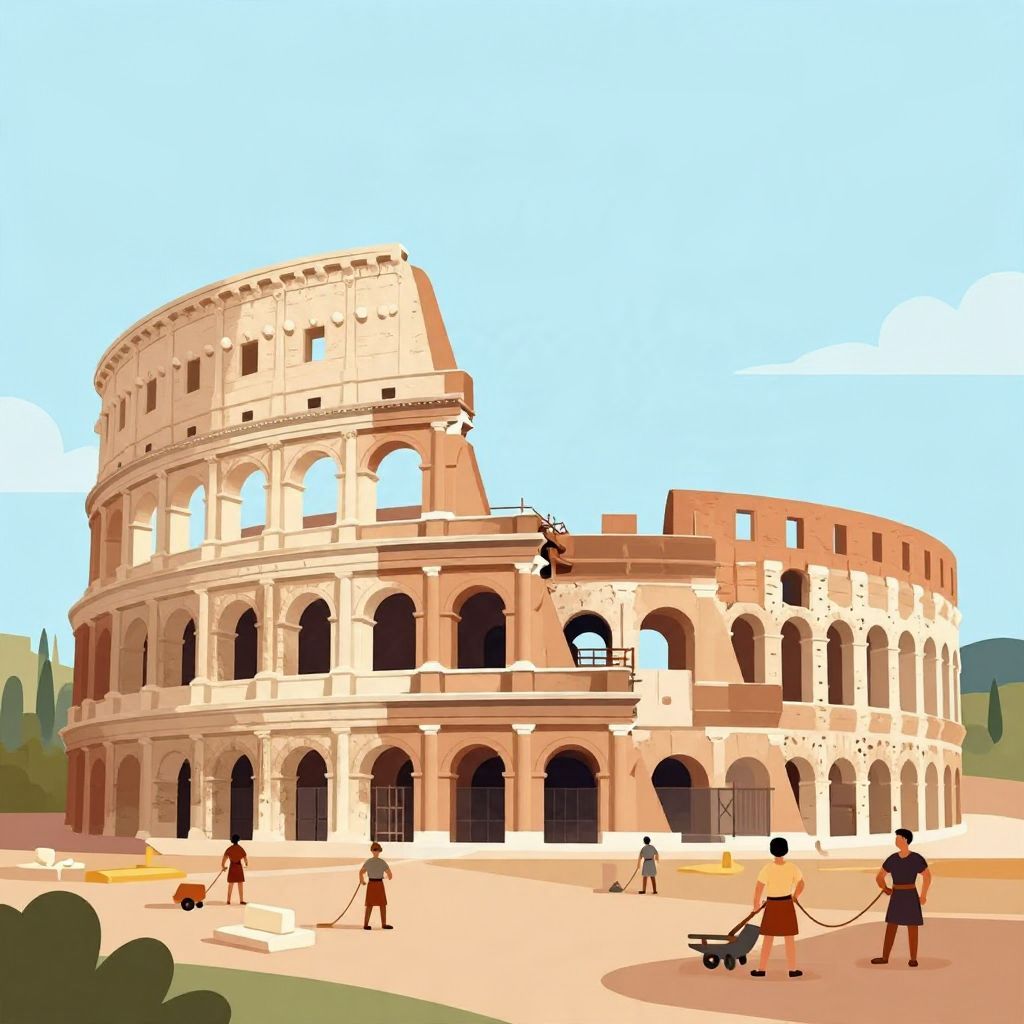
When was the Colosseum in Rome built? The short answer is that construction began under Emperor Vespasian around AD 72 or 73, and the great amphitheater was largely completed by AD 80 under his son Titus. It was then finished with additional work under Domitian in the years that followed.
The Colosseum was not built in a single moment, but in stages, during the early Flavian dynasty. Its construction marked a dramatic shift in Roman politics, urban planning, and public spectacle after the civil wars that followed Nero’s reign.
When Was the Colosseum in Rome Built?
The Colosseum was built in the 1st century AD, with work beginning about AD 72/73 and the main structure completed by AD 80. Ancient sources and modern scholarship generally agree on this broad timeline, though the exact start year is sometimes given as 72 or 73 because Roman dating conventions can be imprecise.
The Date and the Roman Context
The Colosseum was commissioned by Emperor Vespasian, founder of the Flavian dynasty, after the chaos of the civil war that ended Nero’s rule. It was built on land once occupied by Nero’s private palace complex, the Domus Aurea. That choice was politically meaningful: the new emperor returned valuable central Roman land to public use and symbolically distanced his regime from Nero’s extravagance.
Why build it then?
Rome in the late 1st century AD needed both political repair and public reassurance. A massive amphitheater offered entertainment, but it also projected imperial generosity and control. By sponsoring games for the Roman people, the Flavians could present themselves as restorers of order after years of instability.
Who Built the Colosseum?
The building was begun by Vespasian, completed for public use by Titus, and further modified by Domitian. These three emperors are known collectively as the Flavian dynasty. Their involvement matters because the Colosseum was not just an architectural project; it was a dynastic statement.
Vespasian
Vespasian started the project around AD 72/73. His aim was practical and political: to create a vast public venue that would win favor with the Roman population and demonstrate the restoration of imperial stability.
Titus
Titus opened the amphitheater in AD 80, likely with elaborate inaugural games. Ancient writers describe spectacles lasting many days, though the exact details are not always secure. What is clear is that the building was ready for major public use by the end of his reign.
Domitian
Domitian completed and altered parts of the structure after Titus’s death. He added features that improved the functioning of the arena and its underground spaces, helping turn the Colosseum into the highly organized spectacle machine later Romans knew.
How Long Did It Take to Build?
Most historians estimate that the Colosseum took about 8 to 10 years to reach its main completed form, from the start under Vespasian to the opening under Titus. Some finishing work continued afterward. For a monument of its size and complexity, this was an impressive pace, reflecting both imperial resources and Roman engineering skill.
A phased construction
- AD 72/73 – construction begins under Vespasian
- AD 80 – Titus opens the amphitheater
- AD 81–96 – Domitian adds and refines features
This sequence helps explain why the Colosseum can be described as “built” by AD 80, even though work continued beyond that date. In Roman building practice, major monuments often evolved after their formal opening.
Why Was It Called the Colosseum?
The name Colosseum is not the original Roman name for the amphitheater. The ancient building was officially the Amphitheatrum Flavium, the Flavian Amphitheater. The word “Colosseum” became common later, probably because of a colossal statue of Nero that once stood nearby. The popular name stuck, even though it was not the name used when the building was first erected.
What Was Built on the Site Before?
Before the amphitheater rose there, the area formed part of Nero’s lavish palace complex. After the fire of AD 64, Nero had transformed a large central area of Rome into private imperial space. Vespasian’s decision to replace that with a public entertainment venue was a powerful political reversal.
In simple terms, the Colosseum was built where an emperor’s private luxury had stood, and it was turned into a place for public crowds. That change was part architecture, part propaganda, and part urban renewal.
How Was the Colosseum Built?
Roman builders used concrete, stone, brick, and travertine to create an enormous oval amphitheater with tiered seating and a complex underground system. The structure was designed to hold tens of thousands of spectators and to manage movement efficiently through arches, corridors, and numbered entrances.
Roman engineering at work
The Colosseum’s construction shows several hallmarks of Roman engineering:
- Concrete cores for strength and speed of construction
- Arched supports to distribute weight
- Tiered seating to organize the crowd by status
- Subterranean spaces for animals, machinery, and stage effects
These features made it both durable and highly functional. The building was not only large; it was carefully planned for spectacle, discipline, and crowd control.
What Happened at the Opening?
When Titus opened the Colosseum in AD 80, the event likely featured games, animal hunts, executions, and gladiatorial contests. Ancient accounts emphasize the scale of the celebrations, though they do not provide every detail in a way modern historians can verify line by line. Still, the opening clearly served as a grand imperial showcase.
Public spectacle and imperial power
Roman amphitheaters were more than entertainment venues. They were places where the emperor could display generosity, military success, and control over nature and violence. The Colosseum’s opening reinforced the Flavian message: Rome was stable again, and the emperor was providing for the people.
Why the Exact Date Can Be Slightly Uncertain
Ancient chronology is not always exact by modern standards. Roman authors sometimes wrote in ways that leave room for interpretation, and later copies of texts can introduce ambiguity. That is why scholars usually give the Colosseum’s start date as AD 72 or 73 rather than insisting on one absolute day.
Even so, the broader historical picture is secure. The amphitheater belongs to the early Flavian period, was begun by Vespasian, opened by Titus, and completed in its major form by AD 80.
The Colosseum’s Lasting Historical Importance
The Colosseum remains one of the clearest physical symbols of imperial Rome. Its construction tells us about Roman politics, social hierarchy, engineering, and urban identity. It also shows how emperors used architecture to shape public memory. The building was not just a place for games; it was a monument to the restored authority of a new ruling family.
Today, the Colosseum is remembered as one of the most famous ancient structures in the world, but its original meaning was deeply tied to the first decades of Flavian rule. Knowing when it was built helps explain why it mattered so much in Roman history.
So, when was the Colosseum in Rome built? It began in AD 72/73, opened in AD 80, and was completed in stages under the Flavian emperors. If you want to explore more, you may also like how old the Colosseum is and how long it took to build the Colosseum.