
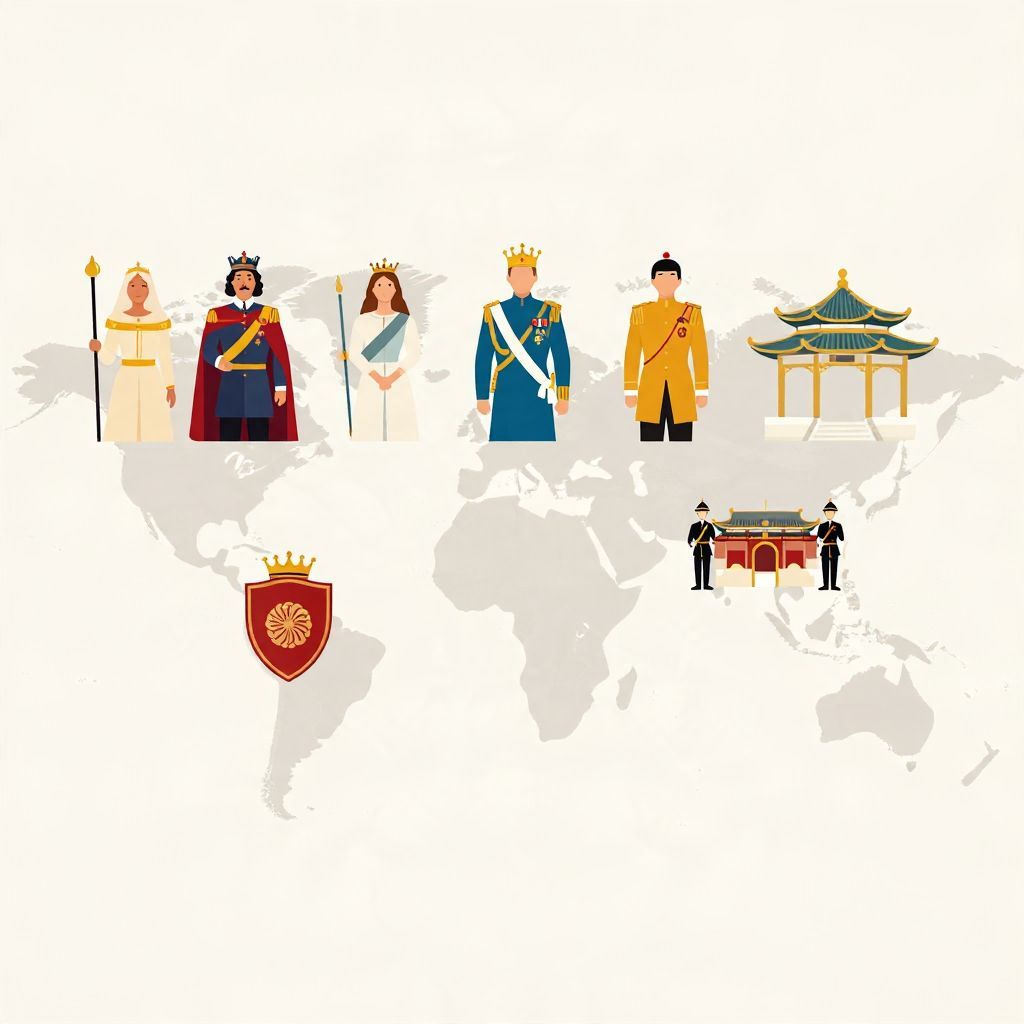
When people ask what countries have a monarchy, they usually mean: which states still recognize a king, queen, emperor, or similar hereditary sovereign today? The answer is more varied than many expect. Monarchies survive in Europe, the Middle East, Asia, and Oceania, but most are now constitutional rather than absolute.
That means monarchs often serve as symbolic heads of state while elected governments run day-to-day politics. A few monarchies still give rulers much broader powers. To understand the modern map, it helps to know how monarchy evolved, why some countries kept it, and why others abolished it.
What Countries Have a Monarchy Today?
As of today, about three dozen countries have monarchies. Most are constitutional monarchies, where a king, queen, or emperor reigns but does not govern alone. A smaller number are absolute or highly centralized monarchies, especially in the Gulf region. The exact count can shift if a country changes its constitution or political status.
The main modern monarchies by region
The countries with monarchies are spread across several regions. Here is a practical overview of the best-known current monarchies:
- Europe: United Kingdom, Spain, Sweden, Norway, Denmark, Netherlands, Belgium, Luxembourg, Monaco, Liechtenstein
- Asia: Japan, Thailand, Bhutan, Cambodia, Malaysia, Brunei, Saudi Arabia, Jordan, Kuwait, Qatar, Bahrain, United Arab Emirates
- Africa: Lesotho, Eswatini, Morocco
- Oceania: Tonga, and several Commonwealth realms in which the British monarch is head of state, such as Australia, Canada, New Zealand, Papua New Guinea, Jamaica, and others
- Americas: There are no sovereign monarchies in the Americas, but several independent countries in the Caribbean and elsewhere still recognize the British monarch as head of state
Because some states share the same monarch, especially the British monarch, the list of monarchies is not the same as the list of monarchs. A single person can serve as head of state for multiple independent countries.
How Many Monarchies Are There?
The number is commonly given as around 43 sovereign states with monarchies, depending on how one counts Commonwealth realms and special constitutional arrangements. Scholars and reference works sometimes differ because they classify shared monarchies, federations, and territories in slightly different ways.
Why the number is not fixed
There is no single perfectly stable count because monarchy is a constitutional category, not just a title. A country may keep a monarch as ceremonial head of state, while another may have a monarch with real governing powers. In addition, some countries periodically debate whether to retain the institution at all.
What Is a Monarchy, Historically?
A monarchy is a form of government in which one person holds the highest office, usually for life, often by hereditary succession. Historically, monarchies were the dominant political system in much of the world. Kingship, queenship, and imperial rule were tied to religion, warfare, inheritance, and ideas of legitimacy.
Ancient and medieval roots
Monarchies are among the oldest political systems in recorded history. Ancient Egypt, Mesopotamia, China, Persia, and many other civilizations were ruled by monarchs or emperor-like figures. In medieval Europe, monarchy became closely linked to feudalism, noble landholding, and the Christian idea of divinely sanctioned rule.
Over time, monarchs were challenged by parliaments, revolutions, republics, and constitutional reforms. The result was not the disappearance of monarchy, but its transformation. In many places, kings and queens survived by accepting limits on their power.
Which Countries Still Have Powerful Monarchs?
Most modern monarchs have limited authority, but a few still retain significant governing power. These are usually absolute or semi-absolute monarchies, where the ruler influences executive, legislative, or judicial decisions much more directly than in a parliamentary monarchy.
Examples of stronger monarchies
- Saudi Arabia: a monarchy with substantial royal authority and a governing role for the king
- Brunei: an absolute monarchy where the sultan holds extensive power
- Qatar, Bahrain, Kuwait, and the United Arab Emirates: monarchies with varying degrees of royal authority and constitutional structure
- Eswatini: an absolute monarchy in southern Africa
- Morocco and Jordan: constitutional monarchies where the king retains notable political influence
These systems differ in detail, but they share one feature: the monarch is more than a ceremonial figurehead. Even so, each country’s legal framework is distinct, and power may be shared with ministers, councils, or elected bodies to varying degrees.
Which Monarchies Are Mostly Ceremonial?
Many monarchies today are constitutional monarchies, meaning the monarch reigns but does not rule in the old absolute sense. The government is generally led by elected officials, while the monarch performs constitutional, diplomatic, and symbolic duties.
Common examples
- United Kingdom: the monarch is head of state, while Parliament and the prime minister govern
- Japan: the emperor is a symbol of the state and the unity of the people
- Sweden, Norway, Denmark, Belgium, the Netherlands, Luxembourg, Spain: parliamentary monarchies with limited royal powers
- Thailand and Cambodia: constitutional monarchies with important cultural and national roles for the crown
- Monaco and Liechtenstein: small European states where the monarch retains a meaningful constitutional role
In these countries, the monarchy often survives because it is seen as a stabilizing institution, a national symbol, or a link to historical continuity. Public support can vary, but many citizens view the monarchy as part of national identity rather than a practical governing necessity.
Why Did Some Countries Keep Monarchy While Others Abolished It?
The survival of monarchy usually depends on political compromise, historical timing, and public support. Countries that experienced violent revolutions or strong republican movements often abolished monarchy altogether. Others reformed the institution, stripping away power but preserving the crown.
Three major historical paths
- Abolition: some states removed monarchy after revolution, war, or regime change
- Constitutionalization: some kept the monarch but limited royal power through constitutions and parliaments
- Restoration: some countries briefly abolished monarchy and later restored it, usually in a reduced form
Europe provides many examples of constitutionalization, especially in the 18th, 19th, and 20th centuries. France, by contrast, moved through repeated revolutions, empires, and republics before settling permanently as a republic. Russia ended its monarchy after the 1917 revolutions. China’s imperial system ended in 1912.
The Role of Monarchy in the Modern World
Today, monarchy is less about ruling territory directly and more about national symbolism, constitutional continuity, and ceremonial representation. Monarchs may open parliaments, appoint prime ministers formally, receive ambassadors, or represent the state abroad.
Modern functions of monarchs
- Serving as head of state
- Performing ceremonial duties
- Representing national unity above party politics
- Supporting charities, diplomacy, and public events
- In some countries, exercising reserve powers under the constitution
Supporters argue that monarchies can provide continuity and political neutrality. Critics argue that hereditary office conflicts with democratic equality. Both views have shaped modern debates, especially in countries where the monarchy’s public funding, influence, or symbolism is controversial.
What About Empires and Emperors?
Some people ask whether an emperor is different from a king. Historically, yes: emperors often ruled over multiple peoples or territories and claimed a rank above kings. In the modern world, however, only Japan continues to use the title of emperor in a sovereign state.
Japan’s unique case
Japan’s imperial institution is especially important because it is the oldest continuous hereditary monarchy in the world, though its role changed dramatically over time. The emperor once held sacred and political authority, but after World War II the office became constitutional and symbolic. For a closer look, see whether Japan still has an emperor.
How Did Monarchy Spread Across the World?
Monarchy spread through conquest, dynastic marriage, religion, colonization, and imitation. European imperial expansion exported monarchical systems to many regions, especially through colonial administration and settler states. In some places, local monarchies predated European rule; in others, colonial powers reshaped or replaced them.
Colonialism and monarchy
In Africa, Asia, and the Pacific, colonial rule often weakened indigenous monarchies or turned them into subordinate institutions. After independence, some states retained traditional kings or sultans as cultural figures, while others rejected monarchy in favor of republican government. The result was a mixed global pattern rather than a single historical trend.
Why Does Monarchy Still Matter Historically?
Monarchy matters because it reveals how political legitimacy changes over time. It shows the shift from inherited rule to constitutional government, from sacred kingship to symbolic headship, and from empire to nation-state. Monarchies are also living institutions, not just relics of the past.
Even when a monarch has little formal power, the office can shape national identity, public ritual, and constitutional tradition. That is why the question “what countries have a monarchy?” is both a modern political question and a long historical one.
In short, countries with monarchies still exist across Europe, Asia, Africa, and Oceania, but most are constitutional rather than absolute. The institution has survived by adapting to democracy, nationalism, and modern statehood. If you want to explore related topics, you may also enjoy learning about what a royal advisor was and the continuing role of the Japanese emperor.