
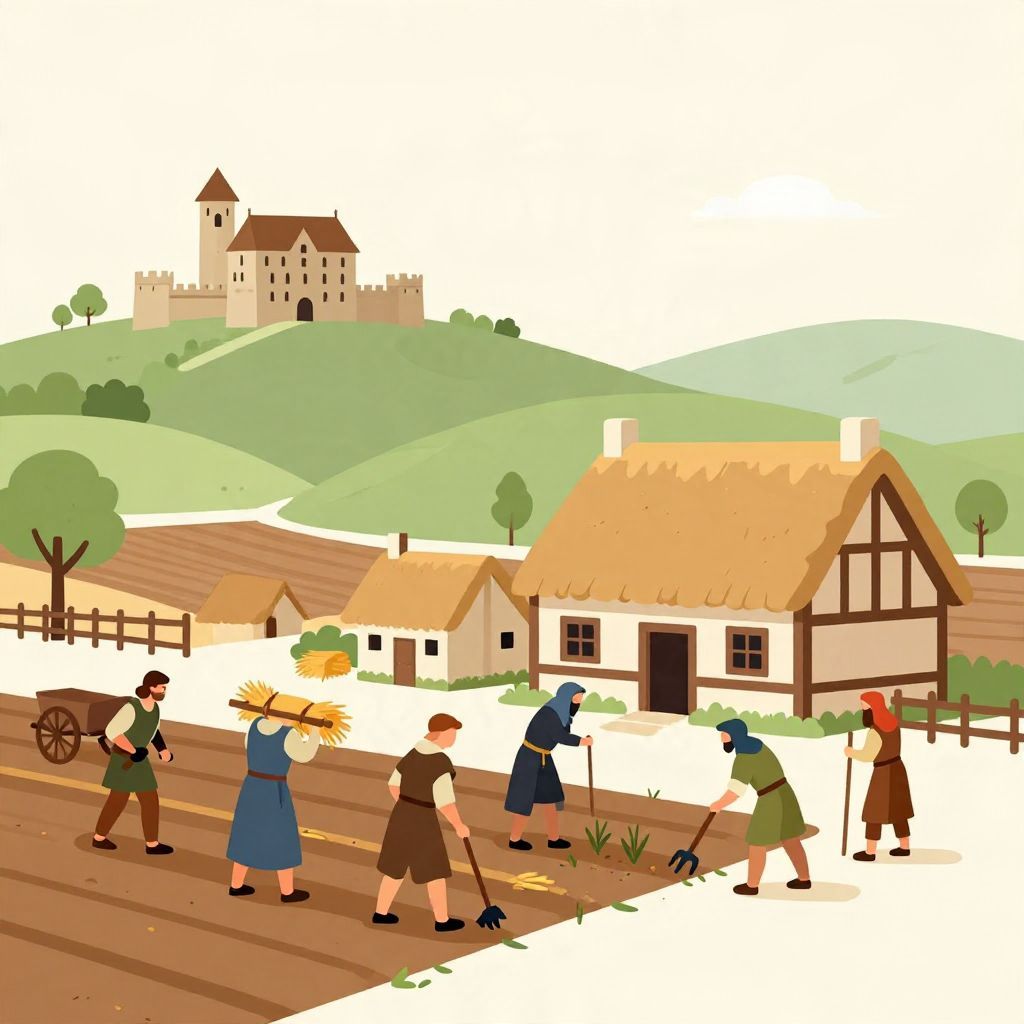
What are serfs? In medieval Europe, serfs were unfree peasants tied to the land they worked. They were not enslaved in the same legal sense as chattel slaves, but they could not freely leave the manor, marry, or inherit property without a lord’s permission. Their labor and obligations helped sustain the feudal economy for centuries.
Understanding serfdom helps explain how medieval rural society functioned, why land mattered so much, and how power was organized between kings, nobles, and peasants. Serfdom was never identical everywhere, and it changed over time, but it remained one of the defining social systems of the Middle Ages.
What are serfs?
Serfs were peasants bound to a lord’s estate who owed labor, rents, and other services in exchange for protection and access to land. They usually could not leave the manor without permission, and their status was inherited. Serfdom was a form of unfreedom rooted in medieval landholding, especially in Europe from roughly the early Middle Ages through the late medieval and early modern periods.
How serfdom worked in everyday life
Most serfs lived in villages attached to a manor, the basic unit of rural life in much of medieval Europe. A manor typically included the lord’s demesne, or home farm, plus peasant holdings. Serfs cultivated strips of land, raised livestock, and paid dues in labor, produce, or money. In return, the lord offered access to land, local order, and some degree of security.
Common obligations
- Labor service: working several days a week on the lord’s demesne.
- Rents and dues: giving grain, eggs, animals, or cash.
- Manorial fees: paying for use of mills, ovens, or wine presses controlled by the lord.
- Restrictions on movement: needing permission to leave or settle elsewhere.
- Marriage and inheritance limits: sometimes requiring approval or payment before marrying outside the manor.
Serfs were not all equally burdened. Some owed heavy labor services, while others paid more in rent than in work. Local custom mattered greatly. A serf’s daily life depended on climate, harvests, local law, and the power of the lord. In bad years, obligations could become crushing; in better years, families might accumulate modest security and tools of their own.
Where did serfs come from?
Serfdom developed gradually out of the collapse of Roman imperial structures in western Europe and the need for local landowners to secure labor in a more fragmented world. It was not created in a single moment. Instead, it emerged between the late Roman period and the early Middle Ages as free and unfree rural populations became tied more closely to estates and local lords.
Roman roots and post-Roman change
Late Roman society already had forms of dependent rural labor, including tenant farmers and coloni, who were increasingly tied to the land in the later empire. After the Western Roman Empire weakened in the 5th century, political authority became more localized. Large estates and rural lordship grew more important, and peasants often sought protection from powerful landholders in exchange for labor and dependence.
By the Carolingian period, especially from the 8th to 10th centuries, many parts of western Europe had systems that historians recognize as precursors to classic serfdom. Over time, local custom, legal status, and economic necessity reinforced the idea that peasants belonged to a manor as much as to a kingdom.
Why lords wanted serfs
Medieval agriculture depended on people, not machines. Land without labor was unproductive. Lords needed a reliable workforce to farm demesne lands and support households, castles, and military obligations. Serfdom gave elites a stable labor supply and helped organize production in a largely rural economy where coin was often scarce and transport was difficult.
Serfs, peasants, and slaves: what is the difference?
These terms are related but not identical. Peasant is a broad social category for rural people who worked the land. A peasant could be free or unfree. Serf refers to a peasant with legally restricted status, tied to a lord’s estate. Slave usually means a person treated as property and lacking personal freedom to a much greater degree.
Key distinctions
- Freedom of movement: free peasants could generally move; serfs usually could not without permission.
- Legal status: slaves were often considered property; serfs were unfree but usually had recognized family and customary rights.
- Land use: serfs often held plots for their own subsistence, though under heavy obligations.
- Inheritance: serf status commonly passed from parent to child.
That said, the line between serfdom and slavery was not always sharp in practice. In some regions and periods, serfs experienced severe coercion, and in others they had meaningful customary protections. Historians therefore prefer careful comparison rather than assuming one universal model.
When was serfdom strongest?
Serfdom was especially prominent in medieval Europe between about the 9th and 14th centuries, though its timing varied by region. In western Europe, it began to weaken in many places after the Black Death in the mid-14th century. In eastern Europe, however, serfdom often intensified later, especially from the 15th to 18th centuries, as landlords expanded control over peasant labor to feed growing export markets.
Regional differences mattered
Western Europe saw a gradual erosion of serfdom as towns grew, cash economies expanded, and labor became more mobile. In parts of France and England, many serfs gained freedom through custom, purchase, or legal change. In contrast, much of eastern Europe experienced what historians call “the second serfdom,” when nobles tightened labor obligations and restricted peasant movement more aggressively.
Outside Europe, similar forms of dependent rural labor existed in many societies, but they were not always called serfdom. The word itself is most closely associated with European medieval history, and it should not be used too loosely for every system of peasant dependence worldwide.
Why did serfdom decline?
Serfdom declined for several interconnected reasons: demographic crisis, economic change, legal shifts, and peasant resistance. The Black Death killed a large share of Europe’s population in the 14th century, making labor scarcer and raising the bargaining power of survivors. Lords often struggled to enforce old obligations when workers could demand better terms elsewhere.
Main causes of decline
- Labor shortages: fewer workers meant peasants could negotiate higher wages or lighter dues.
- Growth of towns: urban centers offered alternatives to manor life.
- Monetization of the economy: cash rents sometimes replaced labor services.
- Peasant revolts and resistance: communities challenged heavy obligations and arbitrary lordly power.
- State centralization: stronger monarchies sometimes limited private lordship, though not always in favor of peasants.
Decline did not mean immediate freedom. In many places, serfdom lingered for centuries, and legal abolition came much later than economic change. In Russia, for example, serfdom remained deeply entrenched until the 19th century, with emancipation in 1861. Elsewhere, forms of dependency survived in altered legal guises.
What rights did serfs have?
Serfs had fewer rights than free peasants, but they were not without protections. Customary law often guaranteed them use of certain lands, access to common resources, and family continuity. Lords could not always act arbitrarily; local courts, village custom, and tradition could limit what a lord could demand. Still, these rights depended on place and time, and they were often unevenly enforced.
Typical protections and limits
- Right to cultivate a hereditary holding in many cases.
- Customary use of woods, pastures, or commons where permitted.
- Access to manorial or village courts for some disputes.
- Restrictions on selling land, marrying freely, or leaving the manor.
Because serfdom was based on custom as much as on written law, disputes were common. A lord might claim new dues; peasants might insist on old privileges. Surviving records from manorial courts show that medieval rural life was often a constant negotiation over obligations, boundaries, and precedent.
Why serfdom matters in history
Serfdom shaped medieval society by linking power, land, and labor. It helped create the feudal world often described in textbooks, though historians now emphasize that “feudalism” is a broad and sometimes imprecise term. Serfdom mattered because it explains how most people lived: not as kings or knights, but as rural families working under obligation and constraint.
It also influenced long-term European development. The decline of serfdom changed labor markets, strengthened towns, encouraged wage work, and altered the balance between nobles and peasants. In places where serfdom lasted longer, it could slow social mobility and deepen rural inequality. Its history is therefore central to understanding both medieval life and the transition to the modern world.
Serfdom in popular memory
Modern depictions sometimes portray serfs as passive and powerless, but that oversimplifies the past. Serfs resisted in many ways: by fleeing, negotiating, withholding labor, appealing to custom, or joining revolts. Their lives were constrained, but not static. Medieval rural society was full of adaptation, conflict, and compromise.
At the same time, it is important not to romanticize serfdom. For most serfs, it meant hard physical labor, limited freedom, and dependence on a local lord’s authority. Even where custom offered some protection, the system rested on inequality and coercion.
Key facts about serfs
- Serfs were unfree peasants tied to a manor or estate.
- They owed labor, rent, and services to a lord.
- Serfdom was most common in medieval Europe, especially from the early Middle Ages onward.
- It developed gradually from late Roman and early medieval rural dependence.
- It declined unevenly across Europe, later in the east than in the west.
- Serfdom was not the same as slavery, though both involved coercion and inequality.
In short, serfs were the dependent rural workers at the heart of medieval manorial society. They were neither fully free nor simply enslaved, but bound by a web of custom, obligation, and local power that defined much of Europe’s social order for centuries. For related background, see what a feudal system was and what a vassal state is.