
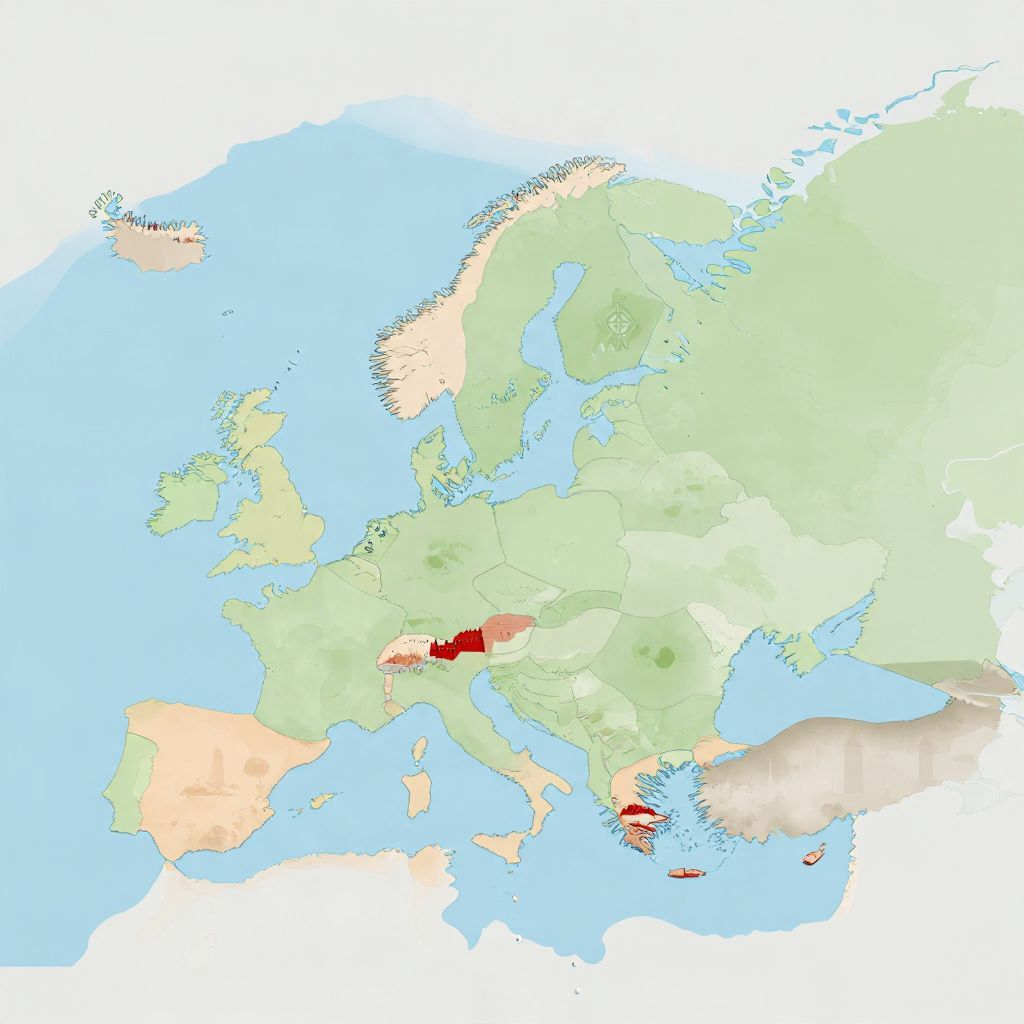
Where was Prussia? The short answer is that Prussia was a historical state in northern and eastern Europe, centered at different times on lands along the southeastern Baltic coast. Its core began in the region that is now northern Poland and the Russian exclave of Kaliningrad, and later the name came to cover much of northern Germany as well.
Because Prussia changed shape over centuries, the answer depends on which period you mean. Medieval Prussia was a Baltic frontier region; later Prussia became a powerful kingdom and then the leading state in the German Empire. By the 20th century, “Prussia” was mostly a historical name rather than a living country.
Where was Prussia?
Prussia was located around the southeastern Baltic Sea, especially in the area of present-day northern Poland, the Kaliningrad region of Russia, and later much of northeastern and central Germany. Its original homeland was the territory of the Old Prussians, a Baltic-speaking people, but the political state called Prussia expanded far beyond that core.
Prussia’s original homeland on the Baltic
The first Prussia was not German
The earliest Prussia was a region inhabited by the Old Prussians, a Baltic people culturally and linguistically related to Lithuanians and Latvians rather than to Germans. This area lay along the southern coast of the Baltic Sea, roughly between the lower Vistula and lower Neman river regions. Today, that means parts of northern Poland and the Kaliningrad area.
In the early Middle Ages, this was a frontier zone of forests, rivers, marshes, and coastal trade routes. It was not a centralized kingdom. Instead, it was made up of local tribal communities with their own customs and religious traditions. The name “Prussia” originally referred to this ethnic and geographic region, not to the later German state.
How the Teutonic Knights changed the map
In the 13th century, the Teutonic Order, a military-religious crusading order, conquered much of the Old Prussian territory. They built castles, founded towns, and brought in settlers from German-speaking lands. Over time, the old Baltic population was reduced, assimilated, or displaced, and the region became increasingly German-speaking.
This conquest is a key reason Prussia became associated with German history. The Teutonic Order’s state was based in the Baltic region, and its administrative structure, castles, and urban foundations shaped the later political geography of the area. Yet the original Prussian people were not the same as the later Prussian ruling elite.
From a Baltic region to a German state
The Duchy of Prussia
After the Teutonic Order secularized part of its territory in 1525, the Duchy of Prussia emerged. It was still located on the Baltic coast, east of the mouth of the Vistula River. At first, it was a Polish fief, meaning it owed allegiance to the Polish crown while retaining its own government.
This duchy is important because it marks the transition from medieval crusader rule to the later Prussian state. The ruling Hohenzollern dynasty linked the duchy with Brandenburg, a separate German territory centered around Berlin. That connection eventually moved the focus of Prussia westward in political terms, even though the name remained tied to the eastern Baltic origin.
Brandenburg-Prussia and the rise of power
By the 17th century, the Hohenzollerns ruled both Brandenburg and Prussia. Brandenburg was part of the Holy Roman Empire and lay in what is now northeastern Germany, including the area around Berlin. Prussia, by contrast, lay outside the empire in the Baltic east. Together, these lands formed Brandenburg-Prussia, the basis of later Prussian power.
When the ruler of Brandenburg-Prussia took the title King in Prussia in 1701, the state gained greater prestige. The title reflected a legal and diplomatic reality: the royal title was tied to Prussia because that territory lay outside the Holy Roman Empire. From then on, “Prussia” increasingly referred to a rising monarchy with its center of gravity in Berlin, even though its name came from the eastern Baltic province.
Where Prussia was on a modern map
On a modern map, Prussia’s historical territories stretched across several present-day countries. Its original core was in northern Poland and the Kaliningrad region of Russia. Later Prussian lands included Brandenburg, much of modern northeastern Germany, parts of western Poland, and, at times, regions farther west such as the Rhineland and Westphalia.
Main areas associated with Prussia
- East Prussia — historically centered on Königsberg, now Kaliningrad and surrounding areas.
- West Prussia — along the lower Vistula, now mostly in northern Poland.
- Brandenburg — around Berlin and the surrounding region in modern Germany.
- Pomerania — coastal territory along the Baltic, now divided between Germany and Poland.
- Rhineland and Westphalia — western territories added later, far from the original Prussian homeland.
Because Prussia expanded so widely, people sometimes imagine it as a single compact place. In reality, it became a patchwork state with separated provinces. Its eastern origins and western expansion made it geographically unusual and politically influential.
Why Prussia mattered in European history
A state built on administration and military power
Prussia became famous for disciplined administration, a strong army, and efficient state organization. These features did not arise from geography alone, but geography mattered. Prussia sat on the northeastern edge of Central Europe, exposed to rivalry between Poland, Sweden, Russia, and the German states. That frontier position encouraged militarization and careful state-building.
Its rulers used bureaucracy, taxation, and military reform to strengthen the state. Under Frederick William I and Frederick II, often called Frederick the Great, Prussia became one of Europe’s major powers. Its location between larger rivals made it both vulnerable and strategically important.
Berlin as the political center
Although the name came from the Baltic east, the political center of Prussia shifted to Berlin in Brandenburg. Berlin became the capital of the Kingdom of Prussia and later the capital of the German Empire after unification in 1871. This is one reason many people associate Prussia with Germany rather than with the Baltic coast.
Still, the original Prussian homeland remained part of the state’s identity. The old eastern provinces were culturally and symbolically important, even after the kingdom’s center of power moved westward.
Prussia and the German Empire
Prussia was not the same as Germany, but it dominated Germany
In 1871, Prussia led the unification of Germany under Prussian leadership. The new German Empire included many states, but Prussia was by far the largest and most powerful. In effect, Prussia became the backbone of the empire, with the king of Prussia also serving as German emperor.
That does not mean Prussia and Germany were identical. Bavaria, Saxony, Württemberg, and other states retained some distinct institutions. But Prussia’s population, territory, army, and bureaucracy made it the dominant force in the new nation.
What happened to Prussia after World War I?
After Germany’s defeat in World War I, Prussia remained the largest state in the Weimar Republic, but its political power was reduced. The old monarchy ended, and Prussia became a republican state within Germany. Then, under Nazi rule, Prussia was gradually stripped of real autonomy and used as a symbolic shell.
After World War II, the Allied powers abolished Prussia in 1947. Its territories were divided among Poland, the Soviet Union, and the two German states. This is why Prussia no longer appears on modern political maps, even though its historical legacy remains strong.
Why the answer is complicated
If someone asks “Where was Prussia?” the most accurate answer is that Prussia was in the Baltic northeast of Europe, but its location changed over time. The original Prussia was in the lands of the Old Prussians, around today’s northern Poland and Kaliningrad. The later kingdom of Prussia also included Berlin, Brandenburg, and large areas of Germany and Poland.
So Prussia was both a place and a political idea. It began as a regional name, became the label for a powerful state, and eventually survived mainly in history books, maps, and cultural memory.
Legacy of Prussia today
Today, the name Prussia survives in museums, historical studies, architecture, and discussions of German and European history. Some place names, monuments, and regional traditions still reflect its past. But there is no modern country called Prussia, and its former lands are now part of several different states.
Understanding where Prussia was means tracing a shift from a Baltic tribal region to a crusader state, then to a German kingdom and finally to a vanished political entity. If you want to compare Prussia’s changing geography with another historical region, you may also find what Prussia is now and where Persia was useful for context.