
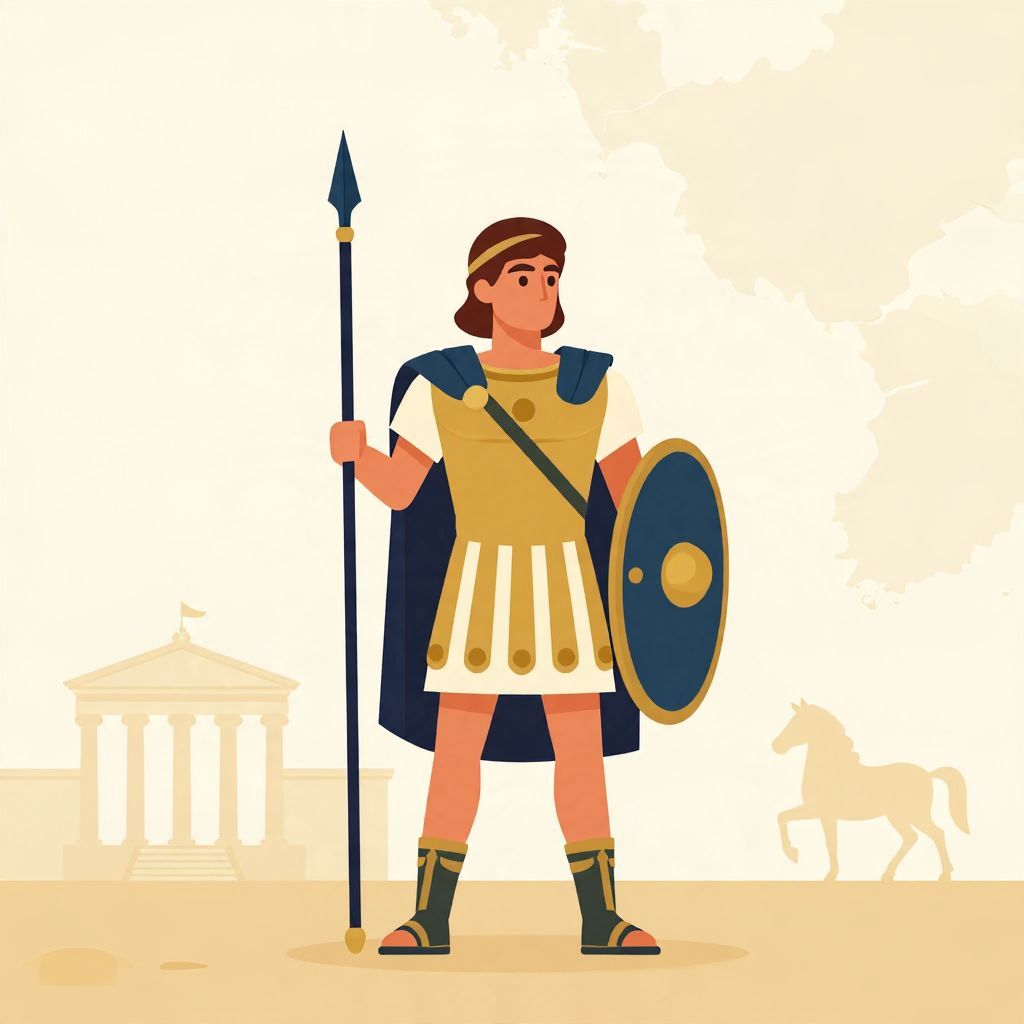
What did Alexander the Great look like? It is a surprisingly difficult question, because no verified portrait from his lifetime survives and ancient artists often idealized rulers. What we can say with confidence comes from coins, sculpture, and ancient descriptions written after his death.
Those sources suggest a young man with a distinctive face: fair or light-brown hair, a clean-shaven look, a strong neck, and an upward gaze that became part of his image as a conqueror and king.
What did Alexander the Great look like?
Alexander the Great was probably a youthful, clean-shaven Macedonian man with a slim but athletic build, a slightly tilted head, and a dramatic upward or sideways gaze. Ancient images suggest soft features rather than a heavily bearded warrior face. However, his exact appearance is uncertain because most surviving portraits were created to glorify him, not to record a photographic likeness.
What the ancient evidence shows
Because Alexander died in 323 BCE, nearly all surviving images of him were made during or after his reign and were shaped by political propaganda. The most useful evidence comes from coins, sculptural copies, and literary descriptions by later ancient writers. Together, they give a general picture, but not a perfectly reliable face.
Coins and official images
Alexander’s image appears on coins minted by his successors after his death. These portraits often show him with the features associated with kingship in the Hellenistic world: smooth cheeks, youthful energy, and a noble expression. Some depictions include the famous anastole, a sweep of hair lifted upward from the forehead, which became one of the best-known visual traits linked to him.
It is important to remember that these coins were not casual sketches. They were political images meant to reinforce Alexander’s prestige and legitimacy. That means they likely captured an idealized version of him, not an exact one.
Sculpture and surviving busts
Ancient sculptural portraits, especially later Roman copies of Greek originals, also help shape modern ideas of Alexander. One famous type shows a youthful face, parted lips, and a head turned slightly upward, as if looking beyond ordinary surroundings. This pose fits the image of a visionary ruler and may reflect how artists wanted him remembered.
These sculptures are valuable, but they come with limits. Many were copied long after Alexander’s death, and Roman artists often adapted Greek models to suit their own tastes. So while they may preserve an early tradition, they cannot be treated as exact likenesses in the modern sense.
The most likely features of Alexander’s face
Based on the best available evidence, historians generally think Alexander had a youthful face with soft, handsome features, light or reddish-brown hair, and an energetic expression. He is usually shown clean-shaven, which matched the Macedonian royal style of his time and set him apart from the bearded philosophers and older generals of later Greek art.
Hair
Ancient depictions often show Alexander with thick hair that rises from the forehead in the famous anastole. Some traditions describe him as fair-haired or light-haired, though the precise shade is uncertain. “Fair” in ancient descriptions could mean anything from blond to light brown, so modern readers should be cautious about imagining a clearly blond Alexander.
Eyes and expression
One of the most striking features in artistic representations is Alexander’s gaze. He is often shown with eyes looking upward, outward, or to the side, rather than directly at the viewer. Ancient writers later connected this with his ambition, charisma, or even a slight physical condition, but the artistic pose itself was also a way to show grandeur and exceptional status.
Face and build
Descriptions suggest a lean, youthful man rather than a bulky warrior. He was likely of average height for his time, though ancient accounts are not precise enough to measure him confidently. His face is commonly portrayed as smooth and almost delicate, which contrasts with the rougher, more mature look often used for generals and kings in later centuries.
What ancient writers said about his appearance
Later authors offered descriptions of Alexander, but they wrote long after his death and often relied on earlier traditions now lost. Their accounts are useful because they preserve how he was remembered in antiquity, yet they should not be treated as direct eyewitness reports unless clearly stated.
Plutarch and the tradition of a distinctive look
Plutarch, writing in the early Roman period, described Alexander as having a head inclined slightly to one side and a gaze that gave him a unique presence. This became one of the most repeated details in later history. Whether it reflects a real physical habit, a medical condition, or simply artistic convention is still debated.
Plutarch also emphasized Alexander’s charisma and energy more than a strict physical inventory. That matters, because ancient biographers often used appearance to express character. A ruler’s body was not just a body; it was a symbol of his mind, fortune, and destiny.
Other ancient traditions
Some sources suggest Alexander had a warm complexion and a strong, attractive face. Others describe him as unusually handsome. These claims fit the ancient tendency to present great leaders as physically exceptional. While Alexander was certainly remembered as striking, the details vary enough that historians avoid treating any single description as definitive.
How reliable are the portraits of Alexander?
The portraits are useful, but they are not neutral evidence. Ancient rulers were commonly idealized, and Alexander was especially vulnerable to mythmaking because his empire stretched across so many cultures. Artists in Greece, Egypt, Asia Minor, and later Rome all had reasons to present him as larger than life.
Why idealization matters
In the ancient world, portraiture often aimed to communicate status, virtue, and authority rather than exact facial measurements. A king could be made to look more youthful, more divine, or more heroic than he really was. Alexander’s images follow this pattern. They tell us how he was meant to be seen, which is historically important, but not always how he literally looked.
Why no perfect likeness survives
Alexander’s lifetime was a transitional period in Greek art, and surviving personal images are limited. Even if a portrait was made from life, later copies may have altered it. Damage, restoration, and artistic reinterpretation all complicate the record. In short, historians can reconstruct a probable appearance, but not a guaranteed one.
Did Alexander look like the ideal Greek hero?
In many ways, yes. His public image was built to resemble the ideal young conqueror: handsome, energetic, and almost superhuman in confidence. This was not accidental. Alexander understood the power of image and likely encouraged representations that linked him to heroic and even divine models such as Achilles and Heracles.
The role of royal image-making
Alexander’s court used visual culture to strengthen his authority. Portraits, coins, and ceremonial imagery helped create a ruler who seemed destined for greatness. This was especially important as he expanded his empire beyond Macedonia into Egypt, Persia, and Central Asia. A memorable face helped create a memorable legend.
That legend grew quickly after his death. Successor kings, Roman collectors, and later historians all helped preserve a stylized Alexander: youthful, noble, and almost timeless. The historical man and the symbolic figure became increasingly hard to separate.
What modern historians think
Most modern historians agree on a cautious reconstruction. Alexander was likely a young, clean-shaven Macedonian man with a distinctive hairstyle, a strong but not heavy build, and a memorable, slightly upward-looking expression. Beyond that, certainty drops away. Claims about exact hair color, eye color, or facial proportions are speculative unless supported by a specific ancient source.
Some modern reconstructions try to combine numismatic evidence, sculpture, and literary testimony to produce a realistic face. These can be helpful, but they are still educated interpretations. They should be read as historical visualizations, not as final proof.
What we can say with confidence
- Alexander was usually shown as youthful and clean-shaven.
- His hair was often depicted in a raised, tousled style called the anastole.
- Ancient art often gave him an upward or sideways gaze.
- He was probably portrayed as handsome and energetic.
- Exact details such as eye color, height, and precise facial structure remain uncertain.
Why his appearance still matters
Alexander’s look matters because it reveals how ancient societies understood power. His portraits were not just about one man’s face; they were about kingship, ambition, and the image of empire. The fact that his likeness was so carefully shaped tells us how important visual authority was in the ancient Mediterranean world.
It also explains why Alexander remains so recognizable today. Even without a certain photograph-like portrait, his image has endured through a combination of art, legend, and political symbolism. He became not just a historical conqueror, but a visual archetype of youthful rule.
So, what did Alexander the Great look like? Most likely a handsome, clean-shaven young king with light or light-brown hair, a distinctive swept-up hairstyle, and a famous upward gaze. The exact face is lost to history, but the image that survived was powerful enough to shape his legend for more than two thousand years. For more context, see where Alexander the Great was born and where Alexander the Great was buried.