
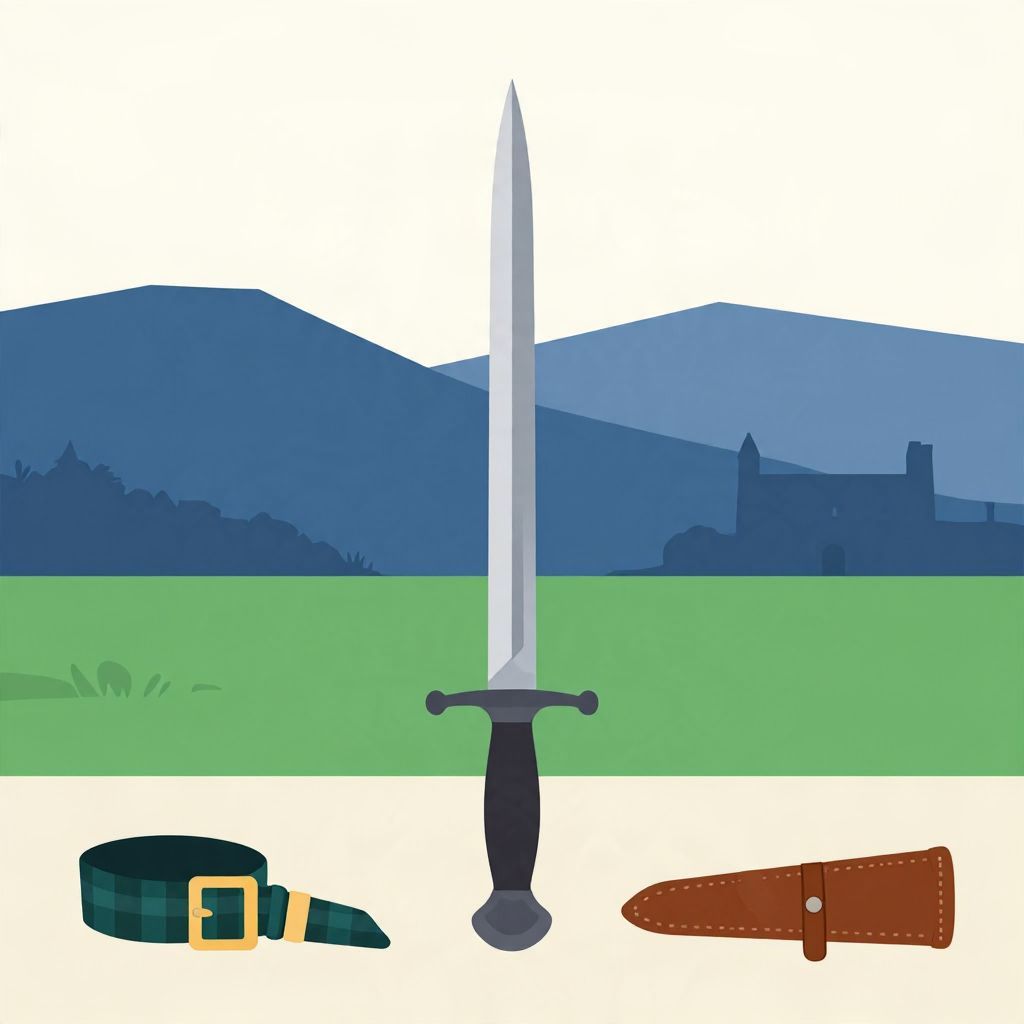
A dirk is a long, narrow dagger most closely associated with Scotland, especially Highland culture. It was both a practical sidearm and a symbol of status, worn for defense, ceremony, and identity. Over time, the word has also been used more broadly for similar daggers in other contexts, which can make its history a little confusing.
To answer “what is a dirk” clearly, it helps to look at the weapon’s form, its Scottish origins, and the ways its meaning changed from the early modern period into the modern age. The dirk is not just a knife by another name; it sits at the intersection of warfare, dress, and cultural memory.
What is a dirk?
A dirk is a dagger with a long blade, usually straight or only slightly curved, designed for thrusting rather than cutting. In Scottish history, it became a distinctive sidearm of Highland men, especially from the 17th to 19th centuries. It was carried as a weapon, but also as an emblem of rank, tradition, and masculine identity.
Origins of the dirk in Scottish history
The dirk did not appear out of nowhere. It grew out of the broader European tradition of long daggers used from the late medieval and early modern periods. In Scotland, the weapon evolved alongside Highland society, where personal arms were common and a man’s weapon could signal both readiness and social standing.
From medieval dagger to Highland sidearm
By the 16th and 17th centuries, Scottish Highlanders were using a variety of blades for everyday life, self-defense, and combat. The dirk likely developed from earlier hand weapons and utility knives, becoming a longer, more formalized dagger. Its design reflected the needs of a society where travel could be dangerous and where clan conflict, raiding, and local violence were real possibilities.
Unlike a sword, which required more space and training, a dirk was compact enough to wear constantly. That made it useful in close quarters and practical as a backup weapon. In a world of swords, targes, and pistols, the dirk occupied an important middle ground between tool and weapon.
How a dirk was used
The dirk was primarily a thrusting weapon. Its long blade made it effective for stabbing in close combat, while the hilt and balance allowed it to be drawn quickly. In addition to fighting, it could serve everyday purposes such as cutting food, preparing materials, or handling camp tasks, though its ceremonial role eventually became more prominent than its practical one.
Weapon, utility item, and symbol
- As a weapon: used in close combat or as a secondary sidearm.
- As a tool: useful for ordinary cutting tasks in daily life.
- As a symbol: worn to show Highland identity, honor, or military affiliation.
The dirk’s symbolic value became especially strong when Highland dress was regulated and later romanticized. Even when it was no longer essential in battle, it remained important in ceremonial wear and military tradition.
What did a dirk look like?
Although styles varied, a traditional Scottish dirk usually had a long, narrow blade and a hilt made of wood, horn, or metal. Some examples were plain and functional; others were highly decorated with silver fittings, carved grips, and ornamented scabbards. The most famous form is the Scottish Highland dirk, often associated with dress and regimental display.
Common features
- A straight or slightly tapered blade
- A single-edged or double-edged form, depending on period and maker
- A grip often made from dark wood or horn
- A scabbard that could include a small knife and fork in later ceremonial versions
- Decorative metal mounts, especially on higher-status examples
These details mattered. A finely made dirk could communicate wealth and rank just as clearly as a sword or brooch. In Highland material culture, weapons were rarely just weapons.
The dirk and Highland culture
The dirk became closely tied to the image of the Highlander. That association was strengthened in the 18th and 19th centuries, when Scottish identity was increasingly shaped by both political conflict and romantic revival. The weapon came to represent bravery, loyalty, and a stylized version of Highland life.
After Culloden and the changing role of Highland dress
After the Jacobite Rising and the Battle of Culloden in 1746, the British state moved to suppress aspects of Highland culture, including the wearing of Highland dress by many civilians. Over time, however, Highland symbols returned in altered form, especially through military regiments and elite fashion. The dirk survived this transition because it could be adapted from battlefield use to ceremonial display.
By the 19th century, the dirk was often worn with tartan dress in formal settings, especially by soldiers, pipers, and men participating in Highland ceremonies. It became part of an idealized visual language of Scotland that was popular at home and abroad.
Historical development of the dirk
The dirk’s history is best understood as a long evolution rather than a single invention. Its form and meaning changed over several centuries, shaped by warfare, law, fashion, and national identity.
- Late medieval roots: long daggers and utility blades were common across Europe.
- 16th–17th centuries: the Scottish dirk emerges as a recognizable Highland sidearm.
- 18th century: the weapon remains practical but becomes increasingly tied to Highland identity and military use.
- 19th century: the dirk becomes more ceremonial, especially in regimental and dress contexts.
- Modern era: it survives mainly as a historical, ceremonial, and collector’s item.
This shift from utility to symbolism is common in the history of weapons. As firearms became more dominant and state control increased, knives and daggers often lost their battlefield importance but gained cultural meaning.
Was the dirk only Scottish?
No. The word “dirk” has been used in broader English for certain daggers and thrusting blades beyond Scotland, especially in older or literary usage. But the term is most strongly linked with the Scottish Highland dirk, which is the form most people mean today. In historical writing, context is important because the word can refer either to a specific Highland weapon or more generally to a dagger-like blade.
Why the term can be confusing
English speakers sometimes used “dirk” loosely for any dagger, particularly in older texts. That means a historical reference to a dirk does not always describe the same object. When reading sources, it is best to ask whether the writer means a specifically Scottish Highland weapon or a dagger in a more general sense.
Dirks in military and ceremonial life
In later centuries, the dirk became especially important in military and ceremonial settings. Scottish regiments, cadet organizations, and cultural groups preserved the weapon as part of dress uniform traditions. In that setting, the dirk functioned less as a combat tool and more as a marker of heritage, discipline, and continuity.
Regimental traditions
Military dirks often featured polished blades, ornate mounts, and symbolic decoration. They were worn with formal uniforms and could indicate service, rank, or ceremonial role. This helped keep the dirk alive long after its practical battlefield use had faded.
The survival of the dirk in these contexts shows how material culture can outlast the conditions that created it. A weapon may cease to be useful in war yet remain powerful as a cultural sign.
How the dirk differs from similar blades
People often confuse a dirk with a dagger, knife, or short sword. The distinctions are not always rigid, but there are useful differences. A dirk is generally longer than an ordinary knife and more specialized for thrusting than cutting. It is usually smaller and less complex than a sword, but more formalized than a utility blade.
- Knife: usually shorter, more everyday, and primarily a tool.
- Dagger: a general term for a thrusting blade, often with two edges.
- Dirk: a long dagger, especially associated with Scottish Highland tradition.
- Short sword: generally larger and more clearly a battlefield weapon.
These categories overlap, which is why historians pay close attention to period, region, and context rather than relying on modern labels alone.
Why the dirk matters historically
The dirk matters because it reveals how weapons can carry social meaning well beyond their battlefield function. It tells us about Highland society, personal defense, status, and the later romantic image of Scotland. It also shows how objects can move from everyday use into ceremonial tradition and national symbolism.
In that sense, the dirk is not only a blade. It is a historical artifact that reflects changing ideas about violence, identity, and heritage. Its story connects material culture with politics and memory.
Key facts about the dirk
- What it is: a long dagger, especially associated with Scotland.
- Primary use: close-combat sidearm and utility blade.
- Historical peak: especially prominent from the 17th to 19th centuries.
- Cultural role: symbol of Highland identity and ceremonial dress.
- Modern status: largely ceremonial, historical, or collectible.
So, what is a dirk? It is a Scottish-associated dagger with a long history, shaped by practical needs and cultural meaning. From Highland sidearm to ceremonial emblem, the dirk shows how a weapon can become part of a people’s historical identity. For more on related cultural objects, see what a samovar is and what a dashiki is.