
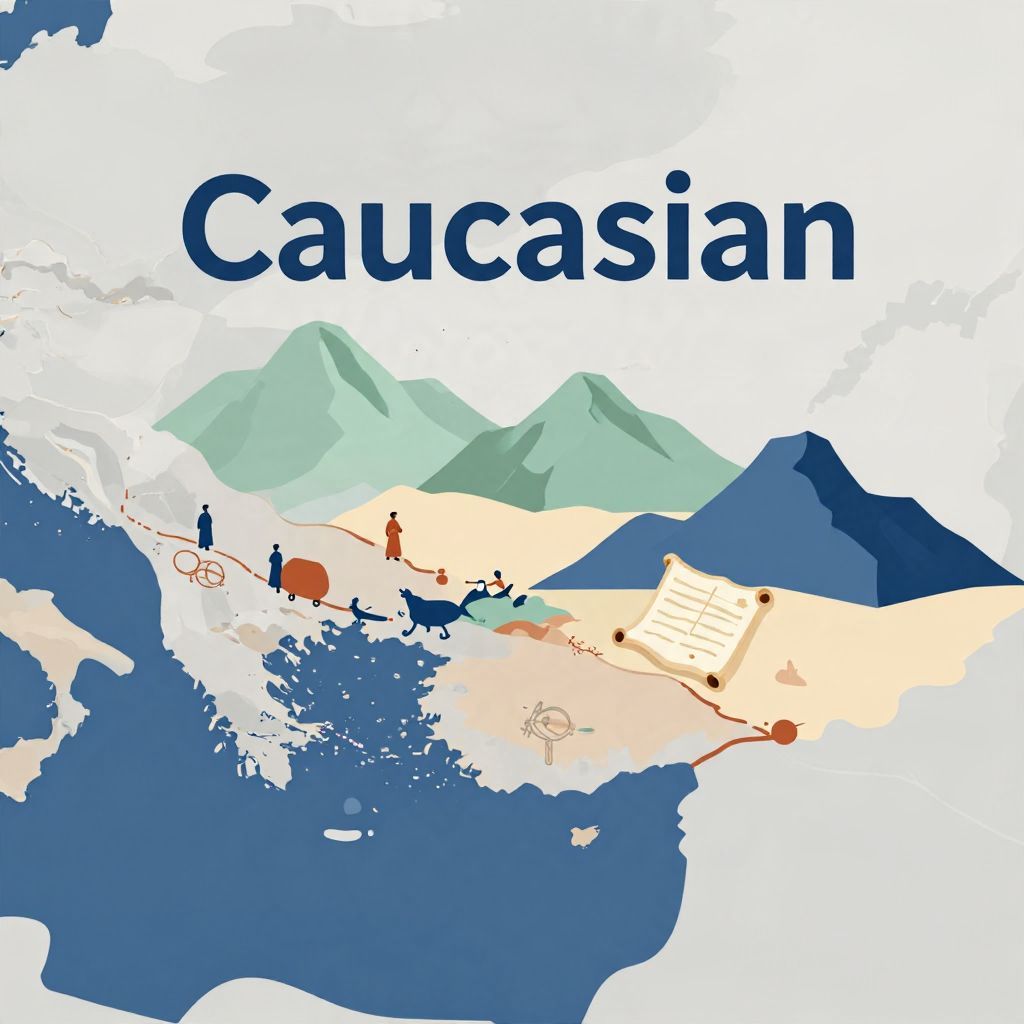
Is “Caucasian” the same as “white”? In modern English, the two words are often used as if they mean the same thing, especially in the United States. But historically, “Caucasian” began as a scholarly label for a much broader and more ambiguous idea than a simple synonym for white people.
The answer depends on context: biology, history, law, and everyday language have all used the term differently. To understand why “Caucasian” became associated with whiteness, it helps to trace the word from 18th-century racial classification to its later life in government forms, popular speech, and modern identity debates.
Is Caucasian White?
In common modern usage, especially in the United States, “Caucasian” usually means “white.” Historically, though, the term was never a precise biological category. It began as a racial classification tied to old European theories, and over time it narrowed in popular use to refer mainly to people of European ancestry.
Where Did the Word “Caucasian” Come From?
The term “Caucasian” entered racial vocabulary in the late 18th century through the work of the German anatomist Johann Friedrich Blumenbach. He used it in a theory that divided humanity into several racial groups. Blumenbach chose the name “Caucasian” because he believed the peoples of the Caucasus region represented an especially “beautiful” or “original” human type. That idea was a scholarly guess, not a scientific fact.
Blumenbach’s classification system
Blumenbach’s system reflected the intellectual world of its time, when many European thinkers tried to sort human diversity into fixed categories. His model was influential, but it was also shaped by bias. Later writers borrowed his term and turned it into a broader racial label, often stripping away its original context.
Why the Caucasus?
The Caucasus is a mountainous region between the Black Sea and the Caspian Sea, including areas of present-day Georgia, Armenia, Azerbaijan, and neighboring lands. Blumenbach did not mean that all people from the region were “white” in a modern sense. He used the name because he thought the area was associated with an idealized origin point for humanity. That assumption is now rejected by historians and scientists alike.
How Did “Caucasian” Become Linked to Whiteness?
The link between “Caucasian” and “white” developed in the 19th and early 20th centuries, when racial theories became common in European and American writing. In those systems, “Caucasian” was often used as a high-status category that included Europeans and sometimes other populations considered “white” by the classifier. Over time, the term became a more polite or technical-sounding substitute for “white.”
Race science and social hierarchy
Modern historians emphasize that these racial categories were not neutral descriptions. They were part of a broader attempt to rank human groups. In many societies, especially in the Atlantic world, “white” was tied to legal privilege, citizenship, land ownership, and social power. “Caucasian” gained traction because it sounded more learned and less openly political than “white,” even though it carried the same assumptions in many settings.
American usage in law and bureaucracy
In the United States, “Caucasian” appeared in court cases, census language, immigration debates, and everyday bureaucratic forms. Legal systems often used racial labels to decide who could naturalize, vote, marry, or own property. Because the legal meaning of race was unstable and often inconsistent, “Caucasian” sometimes functioned as a catchall term for people legally treated as white, even when the boundaries were contested.
Is “Caucasian” a Scientific Term Today?
No. In modern anthropology, genetics, and history, “Caucasian” is not considered a reliable scientific racial category. Human variation does not divide neatly into a few fixed biological races. The term survives mainly as a historical label and as a social descriptor in some countries, especially the United States.
Why scholars moved away from it
Researchers now understand that physical traits such as skin color, hair texture, and facial features vary gradually across populations and do not map cleanly onto old racial boxes. The word “Caucasian” is therefore seen as a product of a specific historical moment, not a timeless truth about human groups.
Confusion in everyday language
Despite this, many people still use “Caucasian” to mean “white,” often without knowing the term’s history. In casual speech, it can sound more formal or less blunt than “white,” but its meaning is usually the same in practice. In some contexts, however, it may be used more broadly or imprecisely, which can create confusion.
How Did the Meaning Change Over Time?
The history of the term shows a gradual narrowing. What began as one scholar’s racial label for a supposed human type became a general category for many people of European descent. This shift was driven by colonialism, immigration debates, legal classification, and the spread of racial thinking in modern institutions.
- Late 1700s: Blumenbach introduces “Caucasian” as part of a racial classification scheme.
- 1800s: The term spreads through European and American racial theory.
- Early 1900s: “Caucasian” becomes common in legal, academic, and bureaucratic use as a synonym for “white.”
- Late 1900s to present: The term remains in use in some settings, but scholars increasingly criticize it as outdated and scientifically weak.
Why Does the Question Matter Historically?
Asking whether Caucasian is white is not just a vocabulary question. It opens a window onto how societies invented racial categories, assigned status, and justified inequality. The term reveals how language can make social hierarchies seem natural or objective when they are historically produced.
Race as a social category
Historians generally treat race as a social and political construct with real consequences, rather than as a fixed biological truth. That does not mean race has no historical power. On the contrary, labels like “Caucasian” shaped laws, identities, and opportunities for generations. Understanding that history helps explain why the word still appears in documents and conversations today.
Shifts in identity and self-description
Over time, many immigrant groups in the United States were gradually absorbed into the category of “white,” even if they were once viewed as outside it. The term “Caucasian” sometimes helped smooth that process by offering a seemingly neutral umbrella. But that neutrality was misleading: it masked the political work the category was doing.
Caucasian, White, and the Limits of Old Racial Labels
It is accurate to say that “Caucasian” is often used today as a synonym for white, but it is not accurate to treat the two words as identical in all historical or scholarly contexts. “White” is a social category with a long history of changing boundaries. “Caucasian” is a specific term from an older racial theory that later became attached to that category.
What the distinction tells us
The distinction matters because it shows how racial language evolves. Terms that seem natural today may have originated in speculation, prejudice, or administrative convenience. Once adopted widely, they can outlive the ideas that created them.
Conclusion: The Historical Answer
So, is Caucasian white? In modern everyday usage, usually yes. Historically, however, the word began as a flawed racial classification and only later became widely used as a synonym for white people. The story of the term is a reminder that racial labels are made by history, not discovered in nature. For more on the language behind the term, see why white people are called Caucasian and the related question of what Jesus really looked like historically.