
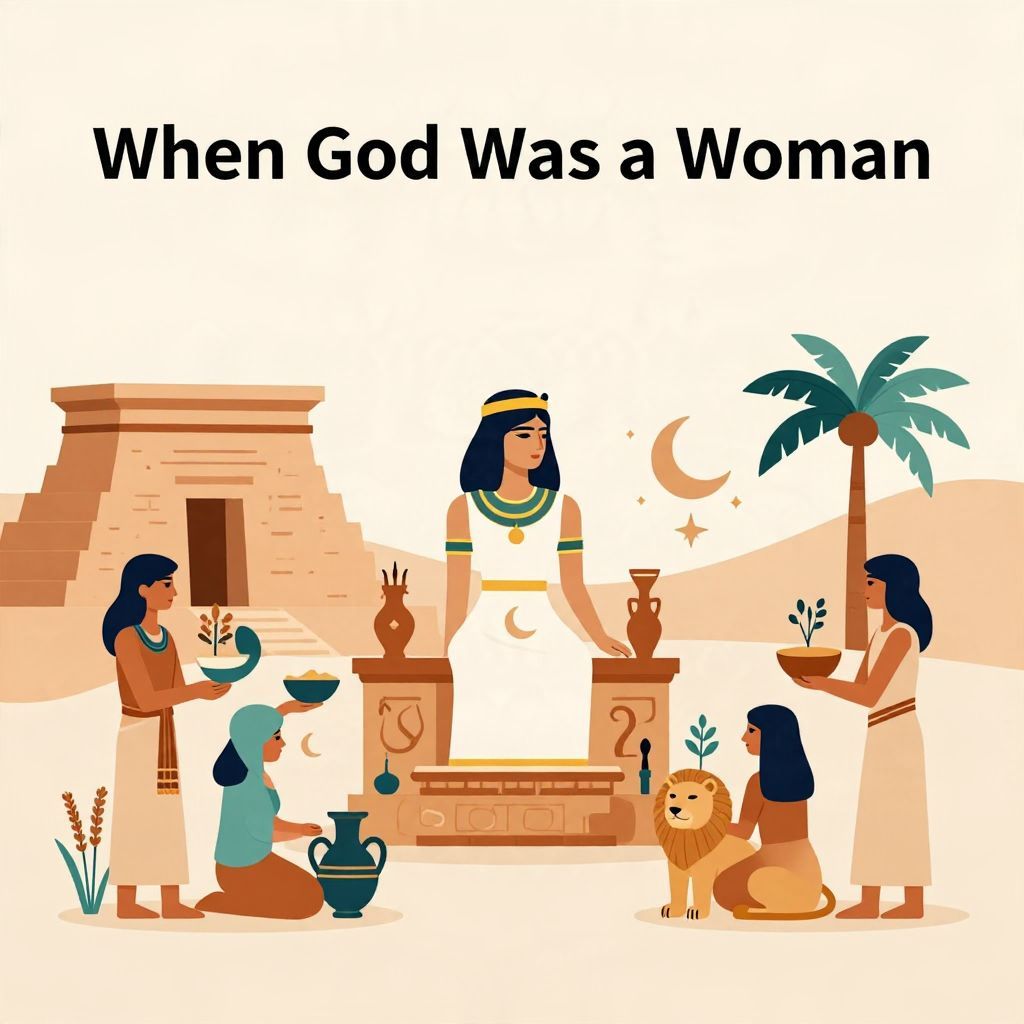
“When God was a woman” is a provocative phrase, but it is not the name of a single historical era. It usually refers to the idea that some ancient societies worshipped powerful goddesses, or even imagined the divine in feminine form, before later religions became more strongly male-centered.
The historical reality is more complex: women were not universally in charge, and male gods existed alongside goddesses in many cultures. Still, archaeology and texts show that female divinities played major roles in religion from prehistoric times through the ancient world.
When God Was a Woman: what does the phrase really mean?
The phrase refers to ancient and early historic religions in which goddesses were central, sometimes dominant, in myth, ritual, and royal ideology. It does not mean there was a single global time when all people worshipped only a female deity. The evidence instead points to many different societies, each with its own mix of gods, goddesses, and beliefs.
The ancient evidence for female divinity
Archaeology and early texts show that female deities were deeply important in many early civilizations. In some places they were associated with fertility, childbirth, agriculture, war, wisdom, love, or sovereignty. These roles mattered because religion was tied to daily life: food production, family continuity, political power, and the natural world.
Prehistoric figurines and the limits of interpretation
Small figurines of women from the Upper Paleolithic and Neolithic periods, sometimes called “Venus figurines,” are often cited in popular discussions of a prehistoric mother goddess. These objects, which appear across parts of Europe and western Eurasia, may have had ritual meaning, but scholars disagree about their exact purpose. They could represent fertility, beauty, status, ancestral figures, or something else entirely. The evidence does not prove a universal goddess religion, but it does show that female imagery was important very early on.
Mesopotamia: Inanna and Ishtar
In ancient Mesopotamia, goddesses were among the most powerful figures in religion. Inanna in Sumer and Ishtar in later Mesopotamian traditions were associated with love, sexuality, war, and political authority. Their myths and temple cults show that female divinity could be both creative and dangerous, nurturing and forceful. Kings often sought divine approval from these goddesses, which shows how religious authority and state power were connected.
Egypt: Isis and divine motherhood
Ancient Egypt also gave major prominence to female deities. Isis became one of the most influential goddesses in the ancient Mediterranean world. She was linked to magic, healing, motherhood, and kingship. Her story with Osiris and Horus helped shape ideas about divine family, resurrection, and legitimate rule. Egyptian religion did not replace male gods with a goddess, but it clearly gave women’s divine forms a central place.
Greece, Rome, and the wider Mediterranean
Greek and Roman religions included powerful goddesses such as Athena, Artemis, Aphrodite, Demeter, and Juno. These figures were not marginal. Athena represented wisdom and civic identity; Artemis guarded wilderness and childbirth; Demeter was tied to agriculture and seasonal renewal. In Rome, Juno was linked to marriage and the state. The presence of major goddesses in these cultures shows that female divinity remained important even in societies that were socially patriarchal.
Did ancient societies worship a mother goddess?
Some scholars and popular writers have argued that early societies were centered on a single Great Goddess or Mother Goddess. This idea became especially influential in the 19th and 20th centuries, when researchers tried to connect prehistoric figurines, fertility cults, and later goddess traditions into one long story. Today, most historians and archaeologists treat that sweeping theory cautiously. There is no solid evidence for one universal goddess religion spanning all ancient cultures.
What scholars agree on
- Many ancient societies honored female deities.
- Some goddesses had very high status in myth and ritual.
- Female imagery appears in prehistoric and early historic art.
- Religious systems often changed over time, sometimes becoming more male-centered.
What remains disputed
- Whether prehistoric figurines represent goddesses at all.
- Whether any ancient society was truly matriarchal.
- Whether goddess worship was ever dominant enough to justify the phrase “when God was a woman” as a historical description.
In other words, the phrase works better as a cultural idea than as a precise historical claim.
Was there ever a matriarchal age?
The notion that early human societies were ruled by women or centered on female religion has a long history in modern thought, especially in 19th-century anthropology and later feminist spirituality. However, historians have found little evidence for a universal prehistoric matriarchy. Most known ancient societies were patriarchal in law, inheritance, and public office, even when they honored goddesses.
Why the idea became popular
The idea of a lost age of goddess worship appealed to people searching for alternatives to male-dominated religion and politics. It also fit broader 19th-century theories about social evolution, which often imagined a progression from primitive to civilized stages. But these theories frequently relied on speculation rather than firm evidence. Modern scholarship is more careful: it recognizes female sacred power without turning it into a simple story of women’s rule.
How did male-centered religions become more dominant?
In many regions, male gods and male priestly authority became more prominent over time, but this did not happen in one single way or at one single date. The shift was shaped by state formation, warfare, inheritance systems, priesthoods, and changing social hierarchies. As centralized kingdoms and empires grew, religious systems often reflected male political authority more strongly.
State power and divine kingship
When rulers claimed divine favor, they often preferred gods who mirrored kingship, warfare, and sovereignty. Male deities could be linked more directly to royal ideology, though goddesses still remained important. In some traditions, female divinities were not eliminated; instead, their roles were narrowed, reinterpreted, or placed alongside stronger male counterparts.
Religious reform and exclusivity
Later monotheistic traditions, especially in the ancient Near East, increasingly emphasized one supreme male God. Judaism, Christianity, and Islam all developed within worlds where older polytheistic systems still existed, but over time they reduced the public authority of goddesses and female divine figures. This was not simply a theological change. It also affected ritual leadership, sacred imagery, and ideas about gender and authority.
What about Hinduism and the divine feminine?
Hindu traditions preserve one of the richest and most enduring forms of goddess devotion in world history. The divine feminine appears in many forms, including Durga, Parvati, Lakshmi, and Saraswati. In some traditions, the goddess is not secondary to male gods but is understood as their power, energy, or source. This makes Hinduism especially important in discussions of female divinity, though it is not accurate to say Hinduism has always been “goddess-centered” in a single uniform way.
The history of Hindu goddess worship is long and varied, shaped by regional practices, devotional movements, temple culture, and philosophical interpretation. It shows that the divine feminine did not disappear from major world religions, even when many societies remained socially unequal. If you want to explore that wider context, see how Hinduism spread.
Why the phrase still matters today
“When God was a woman” remains powerful because it challenges assumptions that the sacred has always been imagined as male. It reminds us that religious history is not fixed. Beliefs about divinity changed as societies changed, and women’s sacred roles were sometimes central, sometimes restricted, and sometimes transformed rather than erased.
The phrase also has modern political meaning. For feminists, spiritual seekers, and historians of religion, it raises questions about power: who gets to represent the divine, who leads rituals, and how gender shapes authority. But historically, the best answer is nuanced. Ancient people did not live in a simple golden age of female rule. They lived in diverse societies where goddesses could be immensely important even when women lacked equal social power.
The historical takeaway
The most accurate answer to “When God Was A Woman” is that there was never one single time when all humanity worshipped a woman as God. Instead, from prehistoric imagery to Mesopotamian, Egyptian, Greek, Roman, and Hindu traditions, female divinity has been a major and recurring part of religious history. The enduring lesson is not that the past was uniformly matriarchal, but that the sacred has long been imagined in both feminine and masculine forms. For related reading, you may also be interested in Frailty, Thy Name Is Woman.