
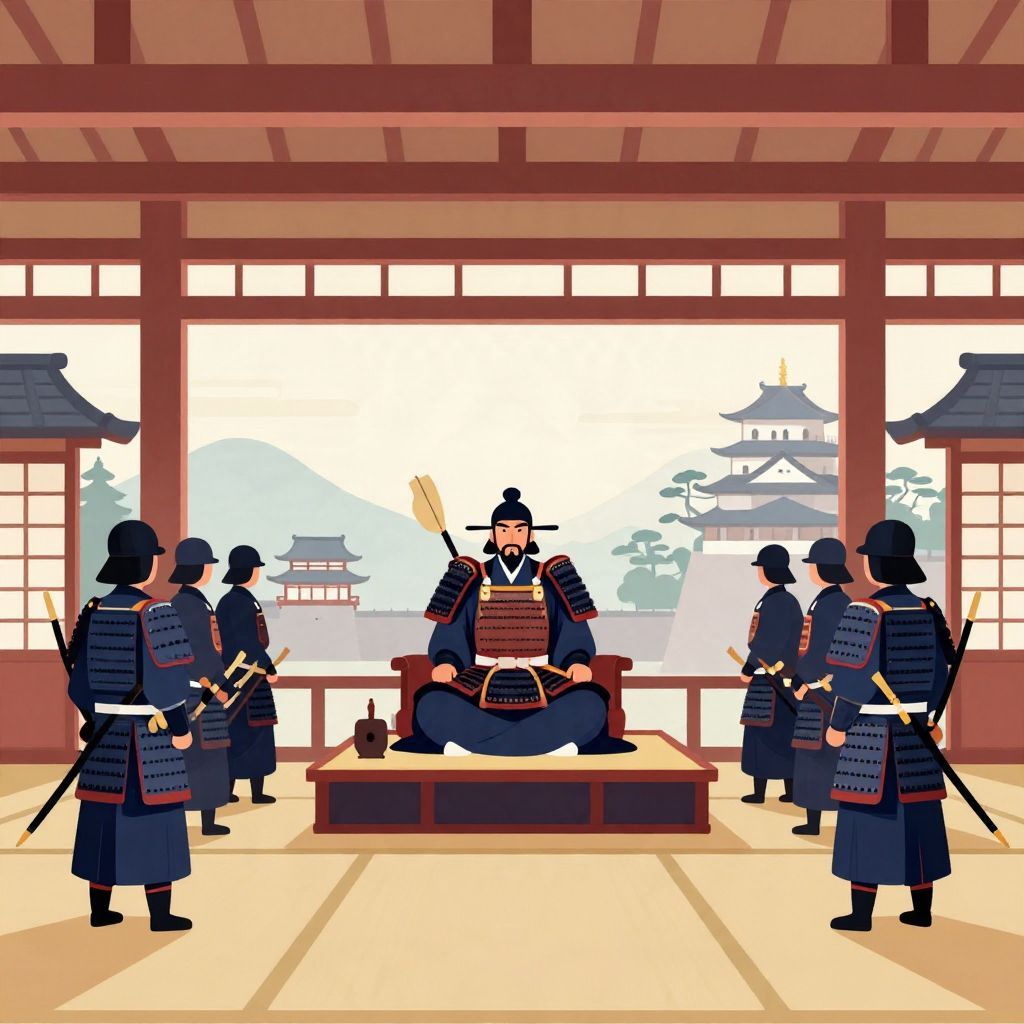
What is a shogun? In Japanese history, a shogun was the country’s top military commander and, for long periods, the real center of political power. The title is most closely associated with feudal Japan, when military governments ruled alongside, and often above, the emperor.
Understanding the shogun helps explain how Japan was governed for centuries, why samurai became so influential, and how authority could be divided between a ceremonial court and a military regime.
What Is a Shogun?
A shogun was a military ruler appointed to lead armed forces and govern on behalf of the emperor. In practice, especially from the late 12th century onward, shoguns often exercised far more power than the imperial court, controlling land, war, and political order through a military government called the bakufu.
Where Did the Title Shogun Come From?
The word shogun is a shortened form of Sei-i Taishōgun, usually translated as “Great General for Subduing the Barbarians.” The title existed before it became the name of Japan’s military rulers. It was originally a temporary battlefield appointment given to commanders leading campaigns against groups the central court considered outside its authority.
Early use before the shogunate
Before the title became a permanent political office, it was granted for specific military expeditions. That means “shogun” did not begin as a hereditary ruler or a king-like office. Its later meaning developed gradually as military leaders gained more influence during periods of political instability and weak central control.
How Did the Shogunate Begin?
The shogunate emerged in the late 12th century, after decades of conflict among aristocratic and warrior families. The decisive figure was Minamoto no Yoritomo, who established his military government in Kamakura in 1192 after defeating rivals in the Genpei War. This is the traditional date used for the start of the first shogunate, though historians sometimes note that his power had already been growing before then.
The rise of the samurai class
The shogunate was possible because the samurai had become a powerful warrior elite. As provincial fighting increased, local military families gained land, armed retainers, and political leverage. The imperial court in Kyoto remained culturally important, but it increasingly depended on these warrior leaders to maintain order.
Why the emperor did not simply rule directly
The emperor remained the symbolic sovereign of Japan, but direct rule was difficult in a fragmented political landscape. Court institutions had limited reach outside the capital, while military leaders controlled the provinces. The shogun’s authority therefore filled a practical need: enforcing stability, settling disputes, and organizing defense.
What Did a Shogun Actually Do?
A shogun governed through military and administrative power rather than through the emperor’s ritual authority. Shoguns appointed regional governors, supervised major landholders, managed military obligations, and maintained public order. They also shaped law, taxation, and succession politics, though the exact balance of power changed from one shogunate to another.
Key functions of a shogun
- Commanded military forces and organized defense
- Appointed or supervised regional officials
- Controlled land rights and rewarded loyal retainers
- Settled conflicts among warrior families
- Maintained the political structure of the shogunate
In many periods, the shogun did not personally manage every aspect of government. Instead, authority was delegated to deputies, councils, and powerful domain lords. Even so, the shogun stood at the top of the military hierarchy.
The Major Shogunates in Japanese History
Japan had three major shogunates, each shaped by different political conditions. Together they define the main eras when shoguns ruled Japan. These governments were not identical, but each linked military authority with national governance.
1. The Kamakura shogunate (1185/1192–1333)
The Kamakura shogunate was the first lasting military government. Founded by Minamoto no Yoritomo, it established the precedent that a warrior leader could govern Japan while the emperor remained in place. After Yoritomo’s death, the shogunate weakened internally, and real power often shifted to the Hōjō regents who ruled in the shogun’s name.
2. The Ashikaga or Muromachi shogunate (1336–1573)
The Ashikaga shogunate began after civil war and political breakdown in the 14th century. Based in Kyoto, it had closer ties to the imperial court than the Kamakura government, but it was often weaker and less centralized. Over time, regional warlords grew more independent, contributing to the long era of conflict known as the Sengoku period.
3. The Tokugawa shogunate (1603–1868)
The Tokugawa shogunate, founded by Tokugawa Ieyasu in 1603, was the most stable and long-lasting of the three. It created a highly organized political system that limited warfare, controlled the daimyo, and brought relative peace for more than 250 years. This was the shogunate most people think of when they hear the word “shogun.”
Was the Shogun More Powerful Than the Emperor?
Usually, yes in practical terms. The emperor was the legitimate sovereign in theory and ritual, but the shogun often held the actual governing power. This division of authority is one of the most distinctive features of Japanese history. The emperor represented continuity and sacred legitimacy, while the shogun represented military control and administration.
A dual structure of power
This arrangement was not always simple or peaceful. At times, emperors tried to reassert direct rule, and at other times shoguns ruled through the emperor’s formal approval. The relationship varied by era, but the broader pattern remained: symbolic authority and political power were often separated.
How Did the Tokugawa Shoguns Govern Japan?
The Tokugawa shogunate created a centralized feudal order that balanced control with local autonomy. Daimyo, or regional lords, governed their own domains but were required to obey the shogun. One of the most important controls was sankin-kōtai, the system that required daimyo to spend time in Edo and leave their families there as a form of political leverage.
Peace, hierarchy, and social order
Tokugawa rule reduced large-scale warfare and promoted a rigid social hierarchy. Samurai became administrators as much as fighters, while merchants, peasants, artisans, and nobles occupied defined social roles. The peace of the Tokugawa era helped urban culture, literacy, and commerce expand, even though political mobility remained limited.
Foreign contact and isolation
Tokugawa policy also restricted foreign relations. Japan was not completely isolated, but the shogunate tightly controlled trade and contact with outside powers. This policy is often simplified as “sakoku,” or closed country, though historians note that Japan still maintained selected links with China, Korea, the Netherlands, and the Ryukyu Kingdom.
Why Did the Shogunate End?
The shogunate ended in 1868 during the Meiji Restoration, when political reformers overthrew Tokugawa rule and restored direct imperial government. The change was driven by internal pressures, economic strain, social unrest, and the shock of Western military and diplomatic power after the arrival of American ships in the 1850s.
From military rule to modern state
The Meiji leaders believed Japan needed a more centralized, modern government to survive in a changing world. They abolished the shogunate, ended the old feudal order, and built new institutions modeled partly on Western states. The title of shogun did not return as a governing office after that.
Common Misconceptions About Shoguns
Because the word appears often in popular culture, it is easy to misunderstand what a shogun was. Historical reality was more complex than the image of a single warrior-king.
Shogun was not always a permanent title
Originally, it was a temporary military appointment. It only later became associated with a lasting office and a ruling government.
The emperor was not abolished
Even under shogunal rule, the emperor continued to exist and remained central to Japan’s legitimacy and ritual life. The shogun governed, but did not replace the emperor as sovereign symbol.
Not all samurai were shoguns
Samurai were the warrior class that supported and served military governments. Very few ever became shogun. The title belonged to the supreme military leader, not to all warriors.
Why Does the Shogun Matter in History?
The shogun matters because the office shaped Japan for centuries. It explains how military elites transformed the political system, how regional power could coexist with imperial legitimacy, and how Japan developed a distinctive form of feudal rule. The shogunate also influenced law, class structure, diplomacy, and cultural life.
In short, a shogun was Japan’s top military ruler, especially from the late 1100s to the 1800s. The office began as a battlefield command and evolved into a powerful political institution that governed Japan for long stretches of its history. If you want to explore the world that surrounded the shogun, you may also find it useful to read about whether samurai still exist and whether Japan still has an emperor.