
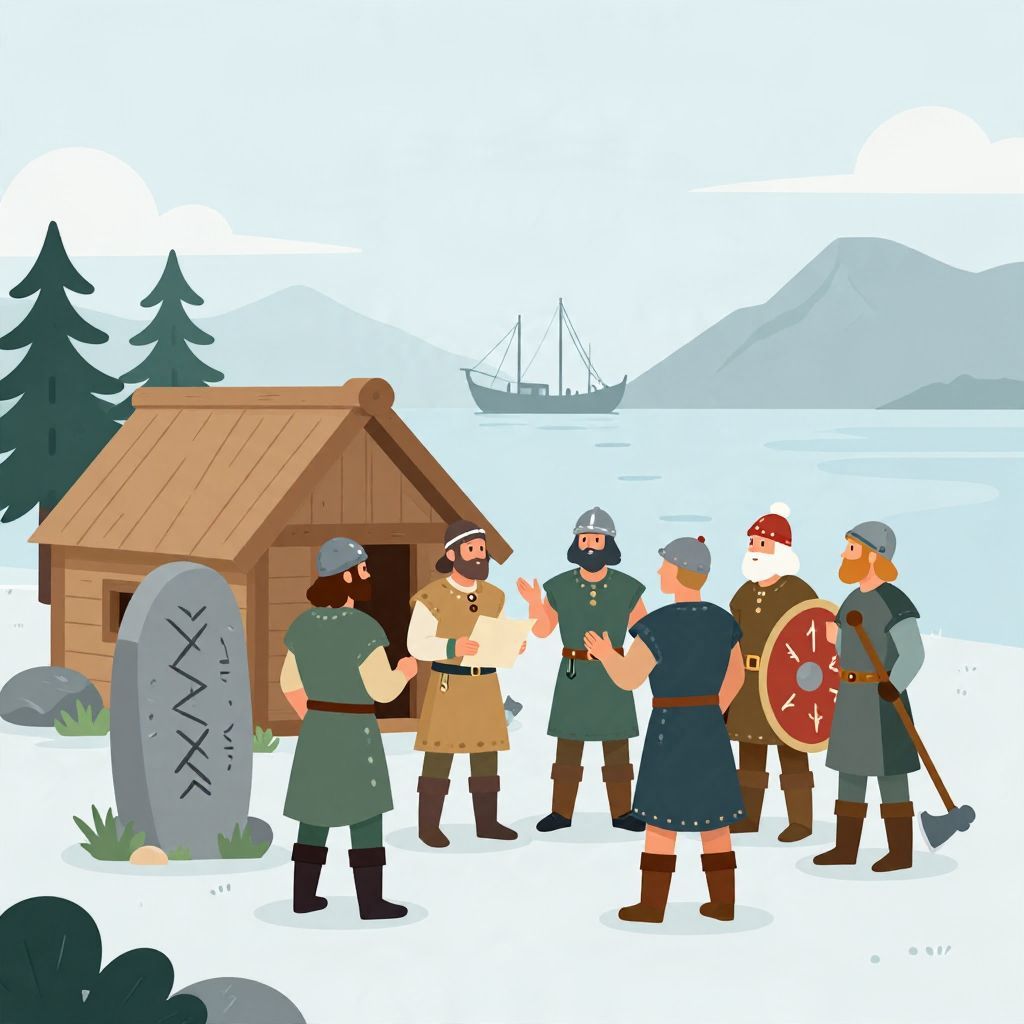
What language did Vikings speak? The short answer is that most Vikings spoke Old Norse, a North Germanic language spoken in Scandinavia during the Viking Age, roughly from the late 8th to the 11th century. It was not one single uniform speech, but a family of closely related dialects that varied by region and changed over time.
Because Vikings traveled widely as traders, settlers, raiders, and explorers, their language spread far beyond Scandinavia. It influenced place names, personal names, and later languages in the British Isles, Iceland, and parts of northern Europe.
What Language Did Vikings Speak?
Vikings primarily spoke Old Norse, especially the early medieval forms used in Norway, Denmark, and Sweden. This language belonged to the Germanic branch of Indo-European languages and was the ancestor of modern Icelandic, Norwegian, Danish, Swedish, and Faroese. In practice, “Viking language” is a modern label for several related dialects rather than one perfectly standardized tongue.
Old Norse was the common language of the Viking Age
Old Norse developed from earlier Proto-Norse and was spoken across Scandinavia by about the 8th century. During the Viking Age, speakers could usually understand one another across large parts of the region, though pronunciation and vocabulary differed. The language was used in everyday life, trade, law, poetry, and storytelling.
It was not called “Viking” language by the people who spoke it
The word Viking referred to a person engaged in raiding or seafaring activity, not to an ethnic group or language. Most people in Scandinavia were farmers, craftsmen, traders, or local elites, and they all spoke forms of Old Norse whether or not they ever went “viking.”
How Old Norse Developed
Old Norse emerged from the earlier Germanic speech of northern Europe. By the early Middle Ages, Scandinavian communities had developed a distinct linguistic identity. The language changed gradually, shaped by migration, trade, political fragmentation, and contact with neighboring peoples. Its history is best understood as a long transformation rather than a sudden linguistic break.
From Proto-Norse to Old Norse
Before the Viking Age, Scandinavians spoke Proto-Norse, known mainly from runic inscriptions. Over several centuries, sound changes and grammatical shifts produced Old Norse. This transition is difficult to date precisely because written evidence is limited, but by around the 8th century the language had clearly taken on the form associated with the Viking Age.
Regional varieties mattered
Scholars often distinguish between West Norse and East Norse. West Norse was spoken mainly in Norway and later in Iceland, while East Norse was associated more with Denmark and Sweden. These were not separate languages in the modern sense, but they did differ enough to matter. Over time, they contributed to the later development of distinct Scandinavian languages.
How We Know What Vikings Spoke
Historians and linguists reconstruct Viking speech from runestones, inscriptions on everyday objects, later manuscripts, poetry, and comparative language study. The evidence is fragmentary, but it is strong enough to show that Old Norse was the main language of Viking-age Scandinavia and that it had a rich written and oral tradition.
Runes were the main writing system
Vikings wrote with runes, especially the Younger Futhark alphabet, which was used in the Viking Age. Runic inscriptions appear on stones, tools, memorials, and personal items. These texts are often brief, but they preserve names, formulas, and grammar that help scholars identify how the language sounded and changed.
Most literature was written later
The famous Icelandic sagas, mythological poems, and legal texts were written down in the 12th and 13th centuries, after the Viking Age ended. They preserve older language and traditions, but they are not direct Viking-era transcripts. That means they are invaluable sources, yet historians must read them carefully and distinguish between earlier oral material and later literary shaping.
Did All Vikings Speak the Same Language?
Not exactly. Old Norse was the dominant language, but Viking-age Scandinavia was not linguistically identical everywhere. Local speech varied by region, and people who traveled widely often encountered other languages. A Viking merchant in Dublin, for example, might use Old Norse at home, some form of contact language in trade, and local languages in daily dealings.
Dialect differences existed within Scandinavia
Variation in vocabulary, pronunciation, and grammar likely existed between regions such as Norway, Denmark, and Sweden. Because surviving evidence is limited, scholars cannot map every dialect with modern precision. Still, the broad picture is clear: there was a shared Scandinavian language continuum rather than a single rigid standard.
Contact with other peoples shaped speech
Vikings interacted with the Irish, Anglo-Saxons, Franks, Slavs, Finnic peoples, and others. These contacts introduced loanwords and bilingual settings, especially in trading centers and settlements. In some places, Norse speakers adapted to local languages; in others, their own language left a lasting imprint.
What Languages Did Vikings Encounter?
As Vikings expanded through raiding, trading, and settlement, they met speakers of many languages. These contacts mattered because language was one of the main tools of diplomacy, commerce, and cultural exchange. The Viking world was multilingual, even if Old Norse remained the core language of Scandinavian identity.
In the British Isles
Vikings encountered Old English in England, Old Irish in Ireland, and Brittonic languages in parts of Britain. Norse settlement in areas such as the Danelaw led to long-term language contact. Many English words of Norse origin survive today, especially everyday terms such as sky, egg, knife, they, them, and their.
In continental Europe and beyond
Vikings trading or raiding along the rivers of eastern Europe met Slavic and Finnic speakers, while those in the Frankish world encountered early Romance and Germanic languages. In the east, Scandinavian groups known as Varangians interacted with peoples around the Baltic and farther south, eventually reaching Byzantine and Islamic markets. Language exchange was part of that broader movement of goods and people.
How Old Norse Influenced Later Languages
Old Norse left a deep mark on the languages of northern Europe. Its influence is especially visible in English, but it also shaped the development of Scandinavian languages themselves. The Viking Age was therefore not only a period of movement and conflict; it was also a major chapter in linguistic history.
Influence on English
Norse settlement in England during the 9th and 10th centuries brought prolonged contact between Old Norse and Old English. Because the two languages were related, speakers could often communicate with some effort, and over time many Norse forms entered English. This contact helped shape Middle English and contributed to the loss or simplification of some older grammatical endings.
Influence on place names
Many English place names preserve Norse roots, especially in northern and eastern England. Endings such as -by meaning settlement, -thorpe meaning outlying farm or village, and -thwaite meaning clearing are reminders of Viking settlement patterns. These names are among the clearest everyday traces of Viking speech.
Influence on Scandinavian languages
Modern Danish, Norwegian, Swedish, Icelandic, and Faroese all descend from Old Norse, but they evolved differently after the Viking Age. Icelandic is often considered the most conservative, preserving many older grammatical features. Danish and Swedish changed more substantially over time, especially under later political and cultural influences from continental Europe.
What Did Viking Speech Sound Like?
We can only reconstruct Viking pronunciation approximately, but Old Norse likely had sounds that would seem familiar to speakers of modern Scandinavian languages while also including features now lost or changed. Its grammar was more complex than modern English, with case endings and verb forms that marked relationships between words.
Grammar was highly inflected
Old Norse nouns, adjectives, and pronouns changed form depending on case, number, and gender. This made word order somewhat more flexible than in modern English. For example, a sentence could often be understood even if the parts were arranged differently, because the endings showed who was doing what to whom.
The language had a strong poetic tradition
Viking-age poets used Old Norse in highly structured verse, especially skaldic poetry. These poems were dense with metaphor, alliteration, and complex word order. They show that Old Norse was not only practical but also a language of prestige and artistic skill.
Was Latin Used by Vikings?
Not as their native language. Latin was the language of the Christian Church and of learned writing in much of medieval Europe, but it was not the everyday speech of Vikings in Scandinavia. After conversion to Christianity, some Scandinavians learned Latin for religious and administrative purposes, especially in clerical settings, yet Old Norse remained the main spoken language of the population.
Christianization changed literacy, not the core spoken language
As Scandinavian kingdoms became Christian from the late 10th through the 12th centuries, Latin literacy expanded. Monasteries and church institutions used Latin for texts and ritual, while vernacular Old Norse continued in daily life. Over time, written culture shifted, but spoken language changed more gradually.
Why the Question Matters
Asking what language Vikings spoke helps correct a common misconception: that “Viking” was a single people with a single culture. In reality, Viking-age Scandinavia was diverse, regionally varied, and deeply connected to the wider medieval world. Language reveals those connections better than almost anything else.
Language shows movement, not isolation
The spread of Old Norse across the North Atlantic and into the British Isles shows how mobile Viking societies were. It also shows that conquest and settlement were not only military events. They were cultural encounters that left traces in names, speech, law, and literature.
It helps explain modern Europe
Many features of modern English and Scandinavian languages make more sense once Old Norse is placed in the story. The Viking Age was one of the major periods when northern Europe’s linguistic map was reshaped. That legacy survives in words, place names, and the modern descendants of Old Norse.
In summary: Vikings spoke Old Norse, a North Germanic language with regional dialects, rich oral traditions, and a lasting influence on English and the modern Scandinavian languages. Their speech was one of the clearest markers of Viking-age identity, and it remains visible today in words, names, and literary heritage. For related historical context, see what language the Romans spoke and, for a different kind of cultural history, what a didgeridoo is.