
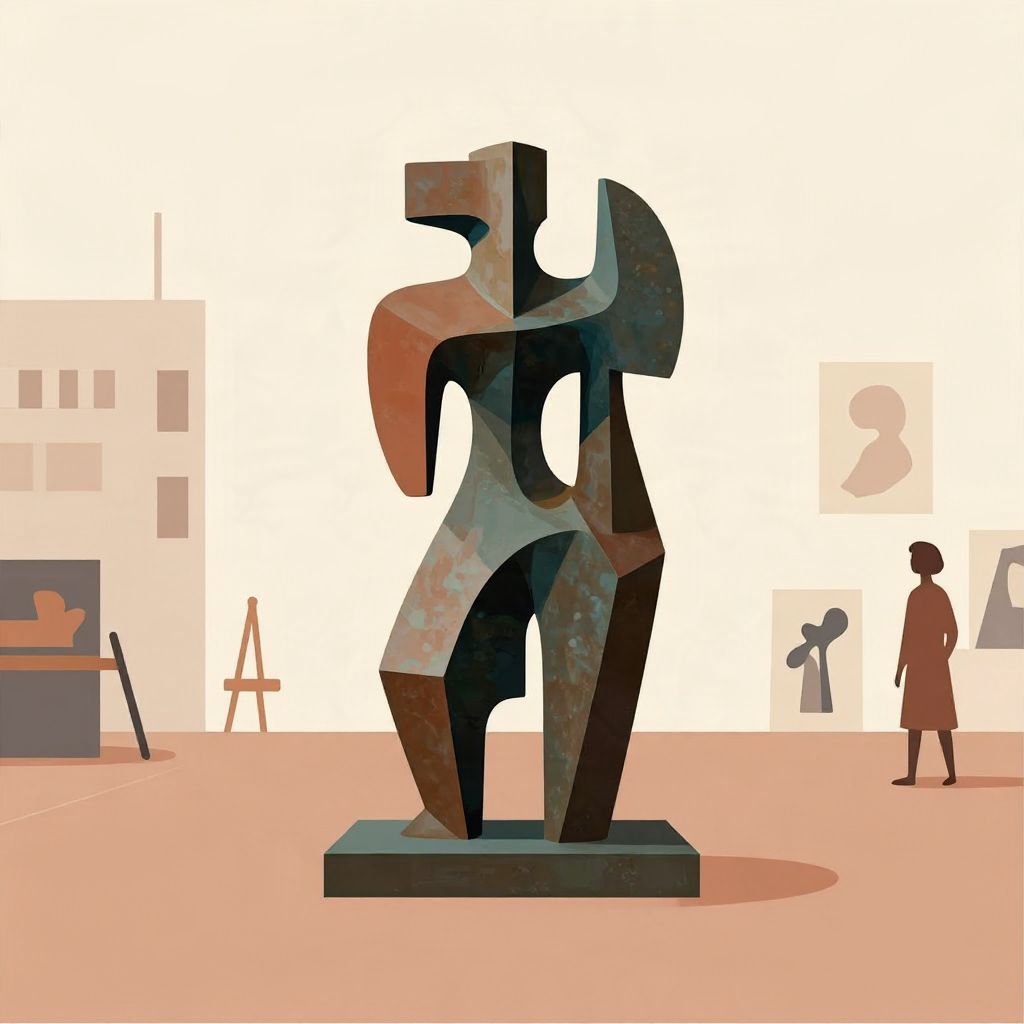
What is a modernist sculpture? In simple terms, it is a sculpture made within the broad modernist movement of the late 19th and 20th centuries, when artists broke away from academic realism and experimented with abstraction, simplified forms, new materials, and fresh ways of representing the human figure and space.
Modernist sculpture did not follow one single style. Instead, it reflected a shared desire to rethink what sculpture could be in an age shaped by industrialization, world wars, mass culture, and changing ideas about art, identity, and perception.
What Is a Modernist Sculpture?
A modernist sculpture is a work of sculpture associated with modernism, the artistic movement that challenged traditional rules from the late 1800s through much of the 1900s. Rather than copying nature exactly, modernist sculptors often simplified forms, emphasized structure and material, or moved toward abstraction. The result could be figurative, semi-abstract, or fully nonrepresentational.
Background: How Modernist Sculpture Emerged
Modernist sculpture developed in response to major changes in European and global society. By the late 19th century, academic art institutions still favored polished, idealized figures based on classical models. But many artists felt those conventions no longer fit modern life. New cities, factories, photography, archaeology, and global travel exposed artists to unfamiliar visual forms and challenged older artistic assumptions.
Painting often led the way in modernism, but sculpture changed too. Sculptors began to reject the idea that a statue had to imitate the body as faithfully as possible. Instead, they explored mass, void, movement, fragmentation, and the relationship between a sculpture and the space around it.
The shift away from academic sculpture
In the 19th century, official sculpture in Europe often served monuments, public commemorations, and decorative programs. It valued smooth surfaces, balanced poses, and recognizable subjects. Modernist sculptors did not necessarily reject the figure itself, but they treated it differently. They might distort anatomy, reduce detail, or leave marks visible so that the making of the work remained part of its meaning.
Influences from outside the classical tradition
Modernist artists were influenced by many sources, including African, Oceanic, and ancient non-European art, though these borrowings were often filtered through colonial-era collections and unequal power relations. They were also influenced by prehistoric carvings, medieval art, industrial materials, and the visual language of machinery. These influences helped expand what sculpture could look like and what it could express.
Key Origins and Early Modernist Sculptors
The origins of modernist sculpture are usually traced to the late 19th and early 20th centuries, especially in France, where artists such as Auguste Rodin played a major transitional role. Rodin is not always labeled a modernist in the strictest sense, but his expressive surfaces, unfinished-looking forms, and emotional intensity helped break with academic polish and opened the door to modern sculpture.
Auguste Rodin and the transition to modern sculpture
Rodin’s work showed that sculpture could feel alive, unstable, and psychologically complex. Pieces such as The Thinker and The Gates of Hell emphasized gesture, texture, and emotional force rather than idealized perfection. His influence was enormous because he made it possible for later sculptors to treat form itself as a subject.
Brancusi and the move toward abstraction
One of the most important modernist sculptors was Constantin Brancusi, who simplified forms to their essential shapes. Works such as Bird in Space and Sleeping Muse reduced the figure to elegant, distilled lines and volumes. Brancusi’s art became a landmark in modern sculpture because it showed that sculpture could suggest reality without copying it literally.
Other major early figures
Several other artists helped define the movement:
- Umberto Boccioni, associated with Futurism, explored motion and speed.
- Alexander Archipenko experimented with hollow spaces and fragmented bodies.
- Jacques Lipchitz developed Cubist sculpture, breaking forms into angular planes.
- Naum Gabo and Antoine Pevsner introduced Constructivist ideas, using industrial materials and transparent structures.
What Makes a Sculpture Modernist?
Not every sculpture made in the modern era is modernist. The term refers to a set of artistic attitudes and methods, not simply a date. A modernist sculpture usually shows one or more of the following features: simplification, abstraction, experimentation with materials, emphasis on structure, or a refusal to imitate classical naturalism.
Common characteristics
- Abstraction: the figure may be reduced to basic shapes or removed entirely.
- Distortion: proportions may be altered to create emotional or formal effects.
- Visible material: artists often let stone, bronze, wood, steel, or plaster remain expressive rather than hidden.
- Open space: voids and gaps can be as important as solid mass.
- Experimentation: sculptors use welding, assemblage, casting, carving, and found objects.
Modernist sculpture versus traditional sculpture
Traditional sculpture often aims for clarity of subject, balance, and finish. Modernist sculpture may instead emphasize ambiguity, fragmentation, or process. A classical statue typically presents a stable, idealized body. A modernist sculpture may show movement, tension, inner feeling, or the tension between object and environment.
Major Styles Within Modernist Sculpture
Modernist sculpture was not a single school. It developed through several overlapping movements, each with its own priorities. These styles often influenced one another, and many artists moved between them over time.
Cubist sculpture
Inspired by Cubist painting, Cubist sculpture broke bodies and objects into geometric planes. Rather than presenting one fixed viewpoint, it suggested multiple angles at once. This approach changed how viewers understood volume and perspective in three dimensions.
Futurist sculpture
Futurist sculptors celebrated speed, technology, and modern energy. Their works often tried to capture motion rather than stillness. The emphasis on dynamism reflected the movement’s fascination with machines, cities, and the rapid pace of the modern world.
Constructivist sculpture
Emerging in the aftermath of the Russian Revolution, Constructivism treated sculpture as an art of construction rather than carving or modeling alone. Artists used industrial materials such as metal, glass, and wire, and they often favored functional, spatial, or architectural forms. This style linked art to modern engineering and social change.
Surrealist sculpture
Surrealist sculptors explored dreams, the unconscious, and strange juxtapositions. Their works could combine recognizable objects in unsettling ways or create forms that seem organic, erotic, or dreamlike. Surrealist sculpture broadened modernism by showing that abstraction was not the only path away from realism.
Materials and Techniques in Modernist Sculpture
One of the most important changes in modernist sculpture was the use of new materials and methods. Traditional sculpture relied heavily on marble, bronze, and carved stone. Modernist artists continued to use those materials, but they also embraced iron, steel, plaster, wood, wire, glass, and assembled found objects.
Why materials mattered
Materials were not neutral. Industrial metals suggested modern life, machinery, and urban construction. Rough wood or visible welds could make the making process part of the artwork. By contrast, smooth bronze or carved stone could still be modernist if used in a simplified or abstract way. The material itself became part of the sculpture’s meaning.
From carving to assembling
Modernist sculpture expanded beyond carving and casting. Artists welded, bent, bolted, and assembled pieces. Some built sculptures from prefabricated parts, while others used plaster maquettes to test spatial ideas before making larger works. This shift reflected the broader modernist interest in process, experimentation, and the artist’s hand.
Historical Context: Why Modernism Mattered
Modernist sculpture was shaped by the upheavals of the 20th century. World War I shattered faith in old European certainties. World War II, exile, migration, and political violence further transformed artistic life. Many sculptors worked across borders, and modernism became an international language rather than a purely French or European one.
Art after war and revolution
After the First World War, many artists felt that old representational forms had lost authority. Some turned toward abstraction as a way to rebuild art from basic elements. Others used disjointed bodies or broken forms to reflect trauma and instability. In this sense, modernist sculpture was not only about style; it was also a response to modern history.
The museum and the public
As museums, galleries, and public collections expanded in the 20th century, sculpture moved from civic monuments into modern art institutions. This changed how people encountered it. Instead of only commemorating heroes or events, sculpture could now be seen as an experimental art form in its own right.
How to Identify a Modernist Sculpture
If you are looking at a sculpture and wondering whether it is modernist, ask a few simple questions. Does it simplify or distort the subject? Does it use abstraction or unusual materials? Does it seem more interested in form, space, or process than in realistic likeness? If so, it may belong to modernism.
A simple checklist
- Is the work from roughly the late 19th century through the mid-20th century, or clearly influenced by that period?
- Does it reject strict academic realism?
- Does it experiment with shape, space, or material?
- Does it reflect modernist ideas such as abstraction, fragmentation, or simplification?
That said, dating alone is not enough. Some 20th-century sculptures are traditional in style, while some contemporary works continue modernist methods. Modernism is best understood as an artistic approach, not a fixed calendar label.
Lasting Influence of Modernist Sculpture
Modernist sculpture changed the history of art permanently. It expanded the definition of sculpture from a carved or modeled object into a field of spatial, material, and conceptual experimentation. Later artists in abstract, minimalist, assemblage, and installation art all inherited something from modernism, even when they rejected it.
Its influence also remains visible in public art, museum collections, and architectural sculpture. Modernist sculptors showed that a work could be powerful without being literal, and that form itself could carry meaning. That idea continues to shape how sculpture is made and understood today.
In historical terms, a modernist sculpture is best understood as part of a wider artistic revolution: one that replaced certainty with experiment, imitation with interpretation, and fixed tradition with new ways of seeing. If you want to explore the broader artistic context, you may also find what abstract sculpture is and the difference between modern and contemporary art useful next steps.