
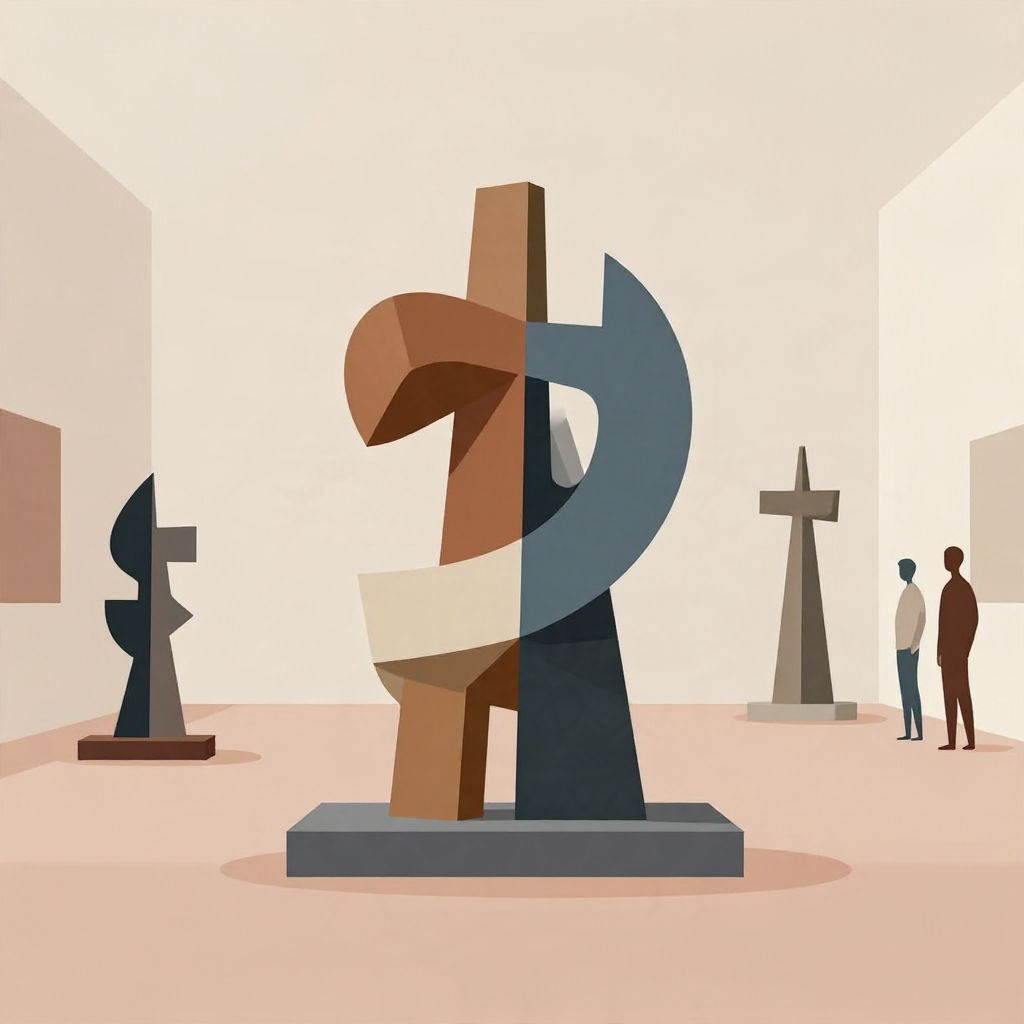
What is abstract sculpture? In simple terms, it is sculpture that does not try to copy the visible world exactly. Instead of making a lifelike portrait, animal, or scene, the artist may use shape, line, mass, texture, and space to create an expressive form of its own.
Abstract sculpture became one of the defining developments of modern art in the 20th century, but its roots reach back to earlier experiments with simplified form. Understanding it means looking at both what it rejects and what it reveals: a shift from imitation toward idea, structure, and feeling.
What Is Abstract Sculpture?
Abstract sculpture is three-dimensional art that does not aim for realistic representation. It may simplify, distort, fragment, or entirely abandon recognizable subjects. Some abstract sculptures still hint at figures or objects, while others are fully non-representational, focusing on form, balance, movement, and material.
How it differs from realistic sculpture
Traditional sculpture often sought to portray gods, rulers, heroes, or ordinary people as convincingly as possible. Abstract sculpture takes a different path. Rather than asking, “What does this look like?” it asks, “What can shape, volume, and material communicate on their own?”
This does not mean abstract sculpture has no meaning. Its meaning may be emotional, symbolic, spiritual, or purely formal. A curved steel form can suggest motion; rough stone can suggest weight or endurance; a suspended composition can create tension or balance without depicting anything specific.
Where Did Abstract Sculpture Come From?
Abstract sculpture emerged in the late 19th and early 20th centuries, especially in Europe, as artists began challenging academic realism. It did not appear out of nowhere. Earlier modern movements in painting and sculpture had already questioned whether art needed to imitate nature closely.
Important influences before abstraction
- Symbolist and post-impressionist art encouraged artists to express inner states rather than only external appearance.
- Non-Western and ancient art, including African, Oceanic, and pre-Columbian sculpture, showed that powerful art did not have to be naturalistic.
- Modern industry and new materials such as steel, wire, and welded metal expanded what sculpture could be.
- New ideas in philosophy and psychology encouraged artists to explore perception, emotion, and abstraction.
By the early 1900s, many artists were moving away from traditional representation. Cubism, for example, broke objects into geometric facets. Futurism emphasized speed and movement. These movements helped prepare the ground for sculpture that could be abstract in either form or intention.
When Did Abstract Sculpture Become a Major Art Form?
Abstract sculpture became a major force in the early 20th century, especially from the 1910s through the 1930s. Exact “firsts” are hard to define because abstraction developed gradually and in several places at once. Still, the period between the two world wars is central to its history.
Key early figures
Several artists are closely associated with the rise of abstract sculpture. Constantin Brâncuși simplified natural forms into elegant, distilled shapes, as in works such as Bird in Space. His sculptures are not literal birds; they capture the essence of flight through polished surfaces and streamlined form.
Naum Gabo and Antoine Pevsner explored construction, transparency, and space, helping define a more experimental, engineered approach. Barbara Hepworth and Henry Moore later developed abstract and semi-abstract forms that often retained a human or organic presence without strict realism.
Why the 20th century mattered
The modern era encouraged abstraction for several reasons. Industrial materials made new forms possible. Cities and machines changed how people experienced space. At the same time, the trauma of war made many artists skeptical of old cultural certainties. Abstract sculpture offered a language that could feel modern, universal, or meditative without relying on traditional narrative.
What Makes a Sculpture Abstract?
A sculpture becomes abstract when its form is not primarily intended to represent a specific visible subject. The degree of abstraction can vary widely. Some works are only slightly simplified, while others are completely non-objective.
Main features of abstract sculpture
- Reduction: simplifying a subject to essential lines or masses.
- Distortion: altering proportions or structure for expressive effect.
- Fragmentation: breaking forms into parts or planes.
- Non-representation: creating shapes with no direct subject at all.
- Emphasis on materials: using stone, bronze, wood, steel, glass, or mixed media as active parts of the meaning.
Because sculpture occupies real space, abstraction in sculpture often feels especially physical. Viewers do not just look at it from one angle; they walk around it. Light, shadow, and perspective become part of the work. In this sense, abstract sculpture is not only about form but also about experience.
How Abstract Sculpture Developed Across the 20th Century
Abstract sculpture did not develop in a straight line. It grew through overlapping movements, each with different goals. Some artists wanted purity of form, others wanted to express technology, and others aimed to explore the relationship between object and space.
Constructivism and the machine age
In the years after the Russian Revolution, Constructivist artists treated sculpture as something that could reflect modern materials, engineering, and social change. They often used geometric structures and industrial methods rather than traditional carving alone. Their work helped make abstraction seem connected to the modern world rather than detached from it.
Surrealism and organic abstraction
Some sculptors moved toward softer, more organic abstraction. Their works could evoke bones, shells, landscapes, or the human body without directly depicting them. This gave abstract sculpture a more poetic and sometimes unsettling quality. The form might feel alive, eroded, or dreamlike.
Mid-century expansion
After World War II, abstract sculpture became even more visible internationally. Large outdoor works, welded metal sculptures, and monumental public commissions became common. Artists experimented with scale, emptiness, and environmental interaction. Sculpture was no longer confined to pedestals and museum interiors.
What Materials and Techniques Are Used?
Abstract sculpture can be made from almost any material, but some materials became especially important in modern art because they supported new ideas about form and construction.
Common materials
- Stone for carving and simplified mass.
- Wood for direct carving and warm surface texture.
- Bronze for casting detailed or fluid forms.
- Steel and iron for welded, industrial-looking structures.
- Wire, glass, plastic, and mixed media for lighter or more experimental compositions.
Common techniques
Traditional carving remained important, but modern abstract sculptors also used welding, assembling, bending, casting, and construction. Instead of starting with a block and removing material only, many artists built works from separate parts. This shift made sculpture feel closer to architecture, engineering, and design.
Why Did Abstract Sculpture Matter Historically?
Abstract sculpture mattered because it changed what sculpture could be. For centuries, sculpture in Europe had been closely tied to religion, commemoration, and realism. Abstract sculpture expanded the field into new territory: pure form, spatial experimentation, and non-narrative expression.
Its cultural significance
Abstract sculpture helped redefine modern art as something that did not need to imitate the visible world to be meaningful. It also challenged viewers to engage differently. Instead of recognizing a subject immediately, they had to consider proportion, rhythm, texture, and the relationship between object and space.
In public settings, abstract sculpture became part of modern urban life. Parks, plazas, and civic buildings increasingly featured works that were not memorial statues in the old sense. These pieces often invited open interpretation, which made them suitable for diverse audiences and changing cultural contexts.
Is Abstract Sculpture the Same as Non-Objective Sculpture?
Not exactly. The terms overlap, but they are not identical. Abstract sculpture may begin with a recognizable subject and simplify or transform it. Non-objective sculpture usually avoids any direct reference to recognizable objects altogether. In practice, many works fall somewhere between the two.
This distinction matters because some sculptors wanted to strip away realism while still keeping a trace of the human body, animal life, or natural growth. Others wanted complete independence from representation. Historians and critics may describe the same work differently depending on how much subject matter they think remains visible.
How Should We Understand Abstract Sculpture Today?
Today, abstract sculpture is recognized as a broad and influential part of modern and contemporary art. It includes minimalist works, organic forms, monumental public art, kinetic sculpture, and mixed-media installations. The category is flexible because abstraction itself is flexible.
Lasting legacy
Its legacy lies in the way it changed artistic expectations. Abstract sculpture showed that art could be about presence rather than portraiture, structure rather than storytelling, and experience rather than imitation. It also opened sculpture to new materials and new audiences, influencing everything from museum collections to public monuments and design.
In historical terms, abstract sculpture is best understood as a modern answer to an old question: what should art do if it no longer has to copy the world exactly? The answer, across the 20th century and beyond, was to explore form itself. For related reading, see the role of sculpture in history and what pointillism in art means.