
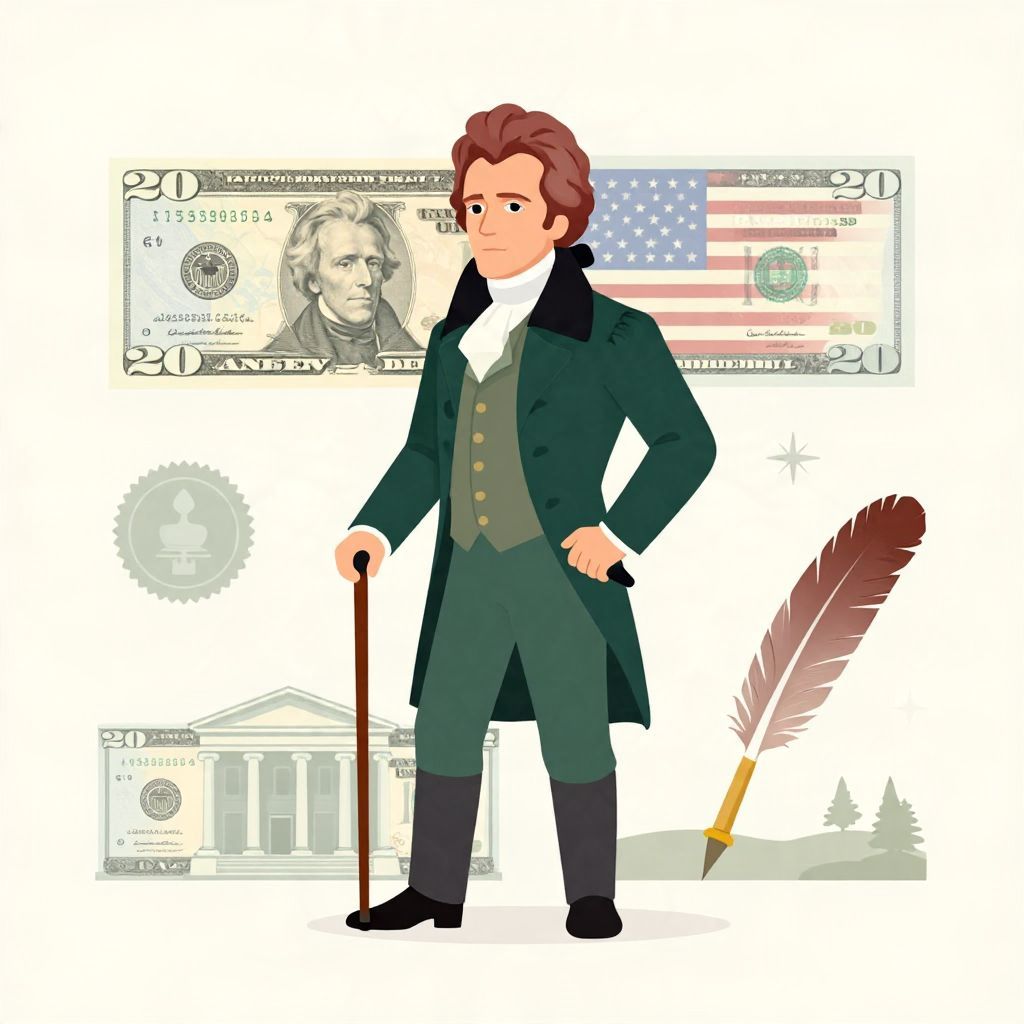
Andrew Jackson is on the $20 bill because 19th-century and early 20th-century Americans saw him as a powerful symbol of the “common man,” military victory, and democratic politics. His face was placed on the note in 1928, when the federal government standardized modern currency designs and chose well-known national figures for major denominations.
That choice has remained controversial. Jackson was one of the most influential presidents in U.S. history, but he was also deeply associated with slavery, the forced removal of Native peoples, and a harsh style of politics. So the $20 bill is not just a piece of money; it is a reminder of how Americans have chosen to remember their past.
Why Is Andrew Jackson On The $20 Bill?
Andrew Jackson is on the $20 bill because the U.S. government selected him as a nationally recognizable presidential figure when the modern $20 note was redesigned in 1928. He was celebrated for his military leadership, his populist image, and his appeal to white male voters in the early republic. The decision reflected his popularity at the time, not a neutral judgment about his legacy.
The Historical Reasons Behind Jackson’s Place on U.S. Money
He became a national hero after the War of 1812
Jackson’s rise to fame began long before he became president. During the War of 1812, he won major military victories, especially at the Battle of New Orleans in January 1815. That battle made him a national celebrity, even though the war had technically ended before the fighting occurred. In the public imagination, Jackson became a defender of the republic and a tough frontier leader.
In the 19th century, military success often translated into political prestige. Jackson’s reputation as a fighter helped make him one of the best-known men in the country. By the time he ran for president, many Americans already saw him as a symbol of strength and determination.
He was viewed as the “people’s president”
Jackson’s supporters portrayed him as a champion of ordinary white voters against elites in government and finance. His election in 1828 marked a major shift in American politics, often described as the rise of Jacksonian democracy. That era saw broader participation by white men in elections, though this expansion did not include women, Native Americans, or most Black Americans.
Because of this image, Jackson became associated with democracy in a broad cultural sense. His face on currency fit the idea that U.S. money should honor presidents who represented national ideals. To many Americans in the early 20th century, Jackson seemed like a fitting figure for a widely used banknote.
His image fit the politics of the 1920s and 1930s
The redesign of U.S. currency in 1928 was part of a practical effort to make notes smaller and more standardized. During that redesign, the Treasury Department chose familiar historical figures for the bills. Jackson was already a well-established national icon, and his portrait had appeared on earlier currency as well.
By then, the $20 bill had become one of the most common notes in circulation. Putting Jackson on it gave the bill a recognizable face tied to American identity and presidential history. The choice was not made because he was the most admired president by every group, but because he was one of the most famous.
How Andrew Jackson Got on the $20 Bill
Currency design changed over time
Before the modern Federal Reserve Note system, U.S. paper money came in many forms, including national bank notes, treasury notes, and other issues. Portraits on currency were not always consistent. In the 19th century, different bills sometimes featured different historical figures, allegorical images, or even living people.
Jackson’s appearance on the $20 bill became more fixed as the federal government standardized currency. The modern design introduced in 1928 placed Jackson on the front of the note, where he has remained ever since, even as the reverse side changed in later redesigns.
He replaced other figures on earlier versions of the bill
Jackson was not the first person to appear on a $20 note. Earlier versions of U.S. currency featured other designs and portraits, depending on the issuing authority and period. The 1928 redesign was part of a broader effort to simplify and unify the nation’s paper money, and Jackson’s portrait was selected for the new standard $20 bill.
This means his position on the bill is historically contingent. It reflects a particular moment in U.S. memory and state design, not an eternal or inevitable choice.
Why Jackson Was Popular Enough to Be Chosen
His presidency changed the political culture
Jackson served as president from 1829 to 1837. He helped shape the modern presidency by using the office aggressively and by appealing directly to voters. He also built a powerful Democratic political movement. Supporters admired him for resisting what they saw as special privilege, especially in his conflict with the Second Bank of the United States.
His veto of the bank’s recharter in 1832 became one of the most famous acts of his presidency. To many supporters, it proved that he stood up to concentrated financial power. That image helped keep his name prominent in American political memory for generations.
He was a symbol, not a neutral historical choice
When governments choose people for currency, they are usually choosing symbols. Jackson represented a certain version of American identity: white male democracy, military victory, frontier toughness, and distrust of elites. Those qualities made him appealing to designers and officials who wanted a recognizable national figure on the $20 bill.
But symbols can outlast the values that created them. As historical scholarship and public memory changed, more Americans began to question whether Jackson’s legacy deserved such honor.
The Controversy Over Andrew Jackson on the $20 Bill
His record on Native American removal is central to the debate
The strongest reason many people object to Jackson’s place on the $20 bill is his role in Indian removal. As president, he supported policies that led to the forced relocation of Native nations from their homelands in the Southeast. The Indian Removal Act of 1830 authorized the federal government to negotiate or compel removals, and the consequences were devastating.
The Trail of Tears, especially the Cherokee removal of the late 1830s, became one of the most tragic results of this policy. Thousands died during forced marches and displacement. For many historians and Native communities, this legacy makes Jackson a deeply troubling figure to celebrate on national currency.
He was also a slaveholder
Jackson enslaved Black people and participated in the slaveholding economy of the antebellum South. That fact is another reason his presence on money has been criticized. Modern debates over currency often ask whether national symbols should honor leaders whose power depended on slavery and racial exclusion.
These criticisms do not erase Jackson’s historical importance, but they do change how people evaluate his legacy. A figure can be historically significant and still be controversial as a public symbol.
Public memory has changed
In recent years, there have been proposals to replace Jackson on the $20 bill with Harriet Tubman, the abolitionist and Underground Railroad conductor. That debate reflects a larger shift in how Americans think about representation, memory, and national honor. The discussion is not only about who was important, but about whose importance should be celebrated on money used by everyone.
As of today, Jackson remains on the bill, but the controversy itself shows that historical reputation is never fixed. It changes as societies rethink what they value.
What the $20 Bill Says About American History
Money is a public history lesson
Currency is one of the most widely circulated forms of historical symbolism. The face on a bill can tell citizens whom a nation has chosen to remember. In Jackson’s case, the choice reveals how strongly 19th- and early 20th-century America valued military heroism, presidential power, and white male democratic politics.
It also reveals how later generations can inherit symbols without fully agreeing with them. The $20 bill preserves a version of the past that was once widely accepted, even as that version has become harder to defend uncritically.
The bill reflects both admiration and amnesia
Jackson’s presence on the $20 bill shows how national memory often works: it emphasizes some achievements while minimizing or ignoring harm. For many decades, his military fame and political strength overshadowed the suffering caused by his policies. Today, more people are asking whether that balance should remain the same.
That tension is why the question “Why is Andrew Jackson on the $20 bill?” leads to more than a simple answer. It opens a window into how the United States has remembered its presidents, its ideals, and its injustices.
Conclusion
Andrew Jackson is on the $20 bill because he was once celebrated as a national hero, a democratic symbol, and a powerful president whose image fit the way the United States wanted to present itself on currency in 1928. But his place there is also a reminder that historical symbols can carry uncomfortable legacies. If you want to explore more about American money and the figures chosen for it, see which president is on the nickel and why there is a pyramid on the dollar bill.