
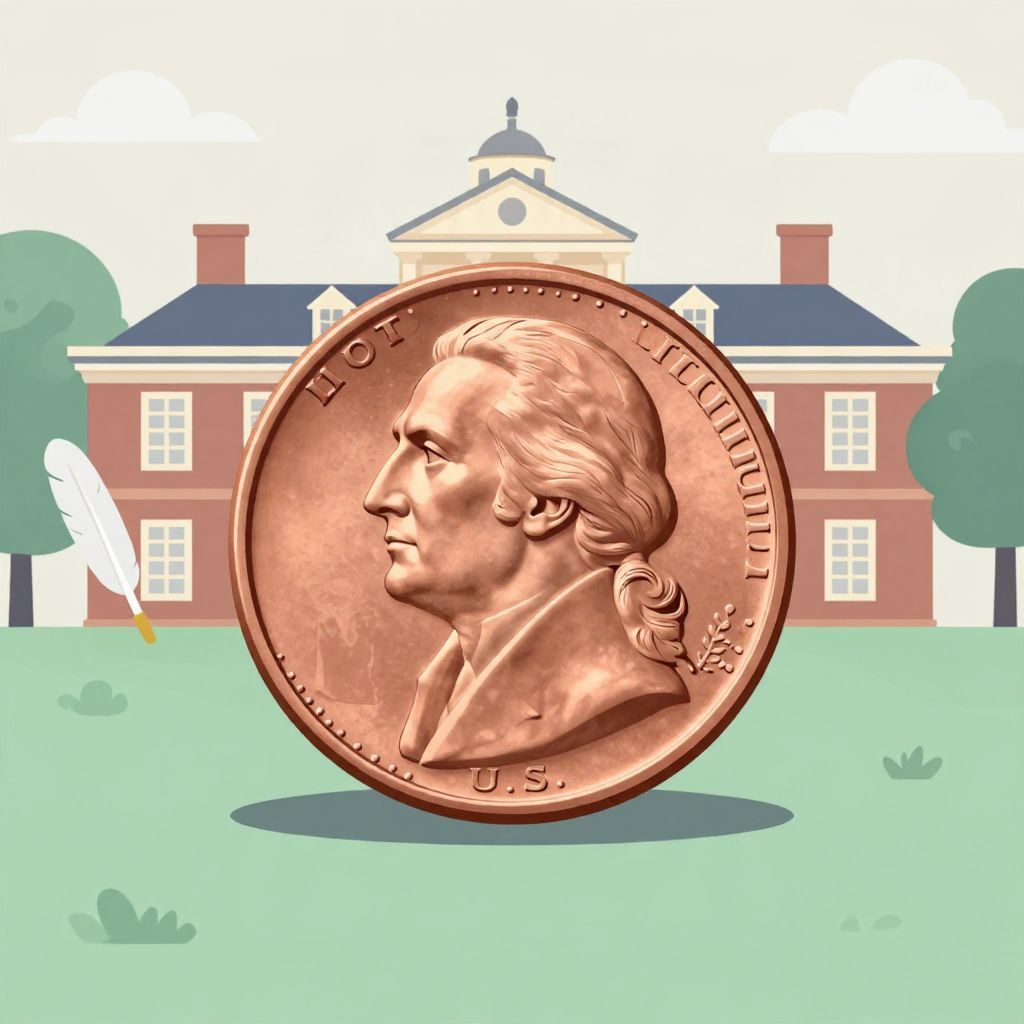
Which president is on the nickel? The answer is Thomas Jefferson, the third president of the United States. His portrait has appeared on the five-cent coin for more than a century, making the nickel one of the most familiar pieces of American currency.
Jefferson’s presence on the coin is not just a matter of design; it reflects how the United States has chosen to remember his role as a founding statesman, author of the Declaration of Independence, and president during a period of major territorial expansion.
Which President Is On The Nickel?
Thomas Jefferson is on the nickel. His portrait appears on the obverse, or front, of the U.S. five-cent coin. The nickel has carried Jefferson’s image since 1938, replacing earlier designs that featured Liberty. The coin also traditionally shows Jefferson’s home, Monticello, on the reverse side, tying the currency to one of the nation’s best-known Founding Fathers.
Who Was Thomas Jefferson?
Thomas Jefferson (1743–1826) was a Virginia planter, lawyer, political thinker, diplomat, architect, and statesman. He is best known as the principal author of the Declaration of Independence in 1776 and as the third president of the United States, serving from 1801 to 1809. Jefferson was one of the most influential figures in the early republic, though his legacy is also complicated by his lifelong enslavement of other people and the gap between his ideals and his personal practice.
Early life and education
Jefferson was born in 1743 in colonial Virginia, into a wealthy slaveholding family. He studied at the College of William & Mary and trained as a lawyer. Like many elite colonial Virginians, he moved easily between intellectual life and plantation society. His education shaped his interest in philosophy, law, science, and architecture, all of which later influenced his public career.
Role in the American Revolution
During the Revolutionary era, Jefferson became one of the most important voices for independence. In 1776, the Continental Congress asked him to draft a statement explaining why the colonies were breaking from Britain. The resulting Declaration of Independence articulated ideas about natural rights, equality, and government by consent that would become central to American political identity.
Why Is Jefferson on the Nickel?
Jefferson was placed on the nickel in 1938, after the U.S. Mint decided to redesign the coin. The new design honored Jefferson’s stature as a Founding Father and replaced the earlier “Buffalo nickel,” which had been in circulation since 1913. The choice linked the coin to a major national figure while also giving the denomination a more traditional and enduring look.
The decision was part of a broader pattern in U.S. coinage. American coins often feature presidents or other nationally significant leaders, and the nickel became one way to commemorate Jefferson’s role in the country’s founding and expansion. His association with Monticello also made the coin visually distinctive and historically grounded.
The 1938 redesign
The Jefferson nickel was introduced after the government sought a new five-cent design. The portrait was based on a bust of Jefferson by sculptor Jean-Antoine Houdon, one of the most respected likenesses of him. The reverse showed Monticello, Jefferson’s Virginia home and a symbol of his architectural interests and elite status.
Over time, the nickel’s design changed in small ways, but Jefferson remained the central figure. In 2006, the coin’s reverse was updated as part of the Westward Journey series, and later designs continued to feature Jefferson on the front. The image has become so familiar that many Americans recognize it before they know the history behind it.
Jefferson’s Historical Influence
Jefferson’s influence extends far beyond the coin that bears his image. He helped shape the political language of the United States, especially ideas about liberty, republican government, and the rights of citizens. At the same time, his life reveals the contradictions of the early republic: a nation founded on freedom while many of its leaders, including Jefferson, were deeply involved in slavery.
Author of the Declaration of Independence
Jefferson’s most famous contribution was his drafting of the Declaration of Independence. The document did more than announce separation from Britain. It offered a powerful argument that governments exist to protect rights and derive their legitimacy from the consent of the governed. Those ideas influenced later democratic movements in the United States and abroad.
President during expansion
As president, Jefferson oversaw one of the most important territorial changes in U.S. history: the Louisiana Purchase in 1803. This acquisition from France nearly doubled the size of the United States and opened the way for westward expansion. Jefferson also supported the Lewis and Clark expedition, which helped map the new territory and gather information about the continent.
Limits and contradictions
Jefferson’s legacy is not simple. He wrote eloquently about equality, yet he enslaved hundreds of people over the course of his life. He also had a long relationship with Sally Hemings, an enslaved woman at Monticello, a subject that historians have studied extensively and that remains central to understanding his life and household. These facts do not erase his political importance, but they do shape how historians assess him today.
The Nickel as a Piece of Historical Memory
Coins are small objects, but they carry public messages. By placing Jefferson on the nickel, the United States turned everyday money into a tool of remembrance. Millions of people have handled the coin without thinking about its symbolism, yet the design reflects choices about who is honored in public life and which historical figures are presented as national exemplars.
Why Jefferson specifically?
Jefferson was a logical choice for a widely used coin because of his central place in the founding era. He represented intellectual leadership, republican ideals, and the expansion of the young nation. His image on the nickel also complemented other U.S. coin portraits, which often feature presidents and statesmen from different eras.
Public memory and changing interpretations
The fact that Jefferson remains on the nickel does not mean his reputation has remained unchanged. Over time, Americans have debated how to remember founders whose achievements were intertwined with slavery and inequality. Jefferson’s place on the coin shows how public memory can preserve honor while historical scholarship continues to complicate the story.
How the Nickel Changed Over Time
The Jefferson nickel has not always looked exactly the same, but its core identity has stayed consistent. The coin’s history reflects both artistic changes and shifts in national priorities.
- 1913–1938: The five-cent coin featured the Buffalo nickel design, with Native American and bison imagery.
- 1938: Jefferson replaced the Buffalo design as the nickel’s central figure.
- 2004–2005: Special reverse designs marked the Lewis and Clark bicentennial and westward expansion themes.
- 2006 onward: The coin returned to a version of Monticello on the reverse, with updated artistic details.
These changes show that coinage is not fixed forever. It evolves as governments decide which symbols best represent the nation at a given moment. Jefferson’s continued presence suggests that, despite controversy, he remains one of the most durable figures in American civic memory.
Thomas Jefferson’s Lasting Place in U.S. History
Jefferson’s importance comes from more than one achievement. He was a revolutionary thinker, a political leader, a diplomat, and a president during a formative period. He helped define the language of American independence and contributed to the nation’s territorial growth. At the same time, his life exposes the contradictions at the heart of the early republic, especially the tension between liberty and slavery.
That combination of achievement and contradiction is part of why Jefferson remains so prominent in public history. His face on the nickel is a reminder that national symbols often carry layered meanings: they celebrate, simplify, and sometimes obscure. Understanding who is on the nickel means understanding both the man himself and the historical choices that placed him there.
So, the answer to the question is simple: Thomas Jefferson is on the nickel. But the history behind that answer is richer than a coin portrait. If you want to keep exploring American history, related topics such as the Declaration of Independence and the Louisiana Purchase help explain why Jefferson remains such an enduring figure in the nation’s story.