
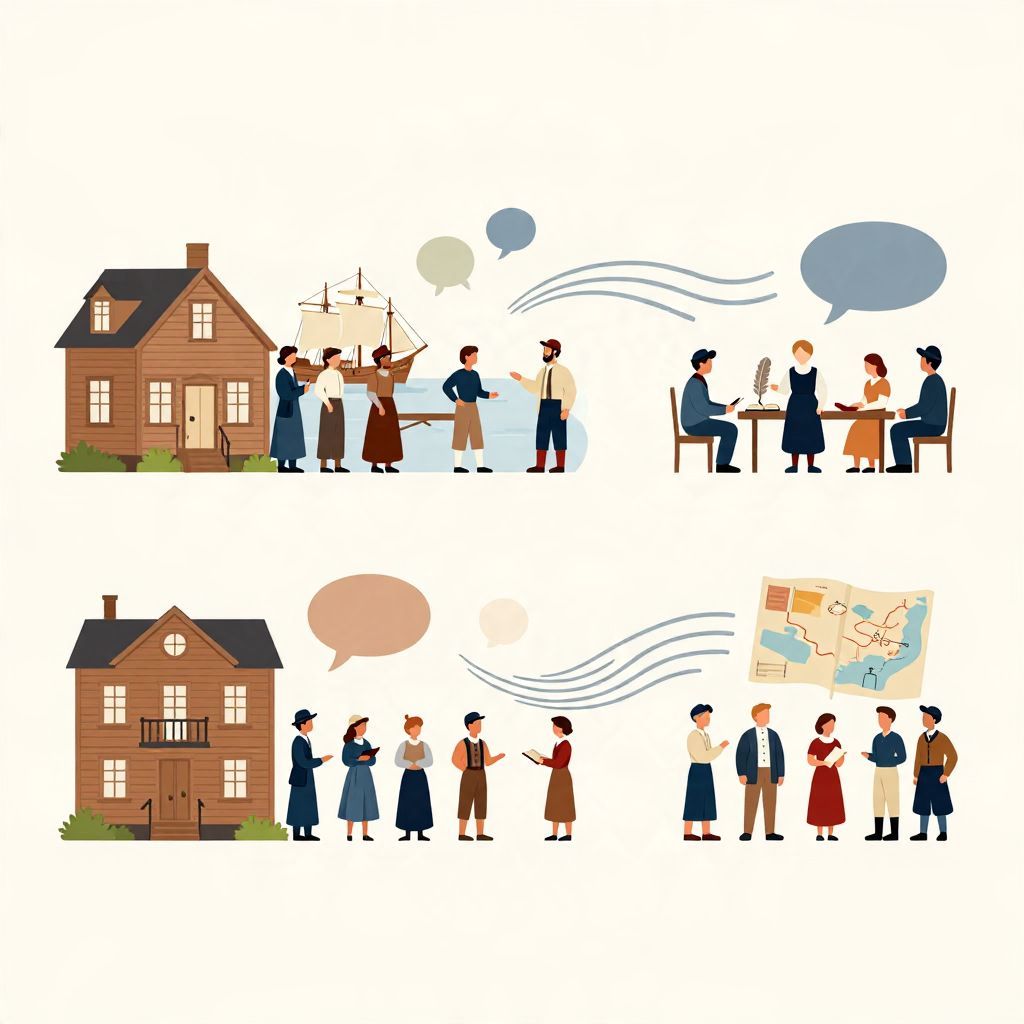
How did the American accent develop? The short answer is that it did not begin as one single accent. It emerged over centuries from English brought by settlers, shaped by regional migration, contact with other languages, and the social changes of colonial and early national life.
What people call “the American accent” today is really a family of accents. Some features came from 17th-century English speech, others from later immigration and internal movement across North America, and still others from local innovation. The result was a distinctly American way of speaking that gradually diverged from British and other Englishes.
How did the American accent develop?
The American accent developed through a long process of linguistic change after English speakers arrived in North America in the early 1600s. Because communities were separated by distance, mixed with speakers of other languages, and adapted speech to new social conditions, American English evolved in different regional directions rather than staying close to one “original” accent.
English arrived in North America, but it did not stay the same
When English colonists settled in places such as Virginia and Massachusetts in the 1600s, they brought a range of regional English accents from England, not one uniform standard. Those settlers spoke in ways that already differed by class, region, and occupation. Once in North America, their speech began changing under new conditions.
Colonial isolation encouraged change
Early settlements were often separated by long distances, poor roads, and limited communication. That isolation mattered because accents change most quickly when communities develop apart from one another. Over time, local speech patterns became more distinct, especially in port cities, plantation regions, frontier settlements, and religious communities.
There was no single “original American accent”
It is a mistake to imagine that Americans simply preserved a 1600s English accent and then drifted away from it. The speech of early colonists was already diverse. Different colonies also developed differently. New England, the Mid-Atlantic, the South, and later the interior all followed separate linguistic paths, which is why American English has many accents rather than one national sound.
Why American English diverged from British English
American English changed because languages naturally evolve, but several historical forces accelerated the process. Colonial settlement, immigration, political independence, and social mobility all helped create speech patterns that sounded increasingly different from those in Britain by the 18th and 19th centuries.
Political independence encouraged a separate identity
After the American Revolution, many educated Americans became more interested in defining a national culture, including language. Writers and teachers promoted spelling reforms, dictionaries, and pronunciation guides. Noah Webster, in particular, helped standardize American spelling, though he did not invent the accent. Still, the new republic’s cultural independence reinforced the idea that American speech could be distinct.
Social networks changed with westward expansion
As the United States expanded westward, people from different regions mixed in new towns and frontier communities. This mixing sometimes leveled older local differences, but it also produced new regional speech patterns. In some places, migrants from several areas influenced one another; in others, communities remained relatively isolated and preserved distinctive accents.
Which English sounds stayed older, and which changed?
Some features of American English sound “older” because they preserve pronunciations that later changed in much of England. Other features are innovations that developed in North America. The accent heard in the United States today is therefore not simply old English, nor is it purely modern invention.
Rhotic speech became a major American feature
One of the best-known differences is that most American accents pronounce the r sound in words like car and hard. Many British accents, especially in southern England, became non-rhotic over time, meaning the r was reduced or dropped after vowels. American English remained more rhotic in many regions, partly because early settlers came from areas where rhotic pronunciation was common and partly because American speech did not follow the same later British change.
Vowel shifts created regional variety
Vowels changed significantly in different parts of the United States. The Northern Cities Vowel Shift, the Southern Vowel Shift, and other regional patterns developed over time, giving local speech its distinct sound. These changes were gradual and often unconscious, spreading through communities as people learned speech patterns from those around them.
Some colonial pronunciations survived in surprising ways
Words such as schedule, tomato, or dance can sound different in American and British English because pronunciation standards diverged. In some cases, American forms preserve older British pronunciations; in others, the United States adopted different habits. There is no single rule that explains every difference.
Immigration and language contact shaped American speech
English was always only part of the story. Native languages, African languages, Dutch, German, French, Spanish, and many others influenced American English through contact, borrowing, and community speech patterns. These influences did not create one accent all by themselves, but they helped shape the sound and vocabulary of American English.
Native peoples and multilingual contact
In colonial and early national America, English speakers interacted with Native nations in trade, diplomacy, warfare, and everyday life. While Native languages did not transform the mainstream American accent in a simple direct way, multilingual contact affected local place names, vocabulary, and some regional speech habits.
Enslaved Africans and African American speech traditions
The forced migration of Africans to North America brought many languages into contact with English. Over generations, African American communities developed rich and varied speech traditions, including dialects with their own histories and rules. Scholars continue to study how African language structures, plantation conditions, and later segregation shaped African American English, which is not a broken form of English but a legitimate linguistic system.
Later immigration added new layers
In the 19th and 20th centuries, large numbers of immigrants from Ireland, Germany, Italy, Eastern Europe, Scandinavia, and elsewhere added new speech influences. In some cities, immigrant neighborhoods affected local pronunciation and rhythm. In others, children of immigrants adopted local American speech while retaining traces of family language patterns.
Regional accents developed because America was large and mobile
The United States is geographically enormous, and that mattered for language. Accents spread, mixed, and changed as people moved between farms, ports, cities, and new states. Over time, broad regional accents emerged, though none of them is the only “true” American accent.
New England, the South, and the Midland developed differently
New England speech developed under strong early English influence and later local change. Southern speech was shaped by plantation society, migration from the British Isles, and contact among diverse populations. The Midland region, stretching through parts of the Mid-Atlantic and interior, often became the basis for what many people now hear as “general American” pronunciation, though that label is itself broad and imperfect.
Urban centers helped spread new norms
Cities such as New York, Philadelphia, Boston, Charleston, and later Chicago, St. Louis, and Los Angeles became centers where accents mixed and evolved. Urban speech often reflected class distinctions, neighborhood identity, and contact among many communities. Radio, film, and television later spread some pronunciation patterns nationwide, but they did not erase regional accents.
How did “standard” American speech emerge?
What many people call a neutral or standard American accent is not ancient and not universal. It developed mainly in the 19th and 20th centuries through education, broadcasting, and social prestige. It reflects a set of pronunciations that became widely accepted in public life, especially in national media and professional settings.
Schools and dictionaries promoted uniformity
As public education expanded, teachers often encouraged standardized speech and discouraged local forms they considered unrefined. Pronunciation manuals and dictionaries helped define “correct” usage, even though language is always changing. These efforts did not eliminate regional accents, but they did shape how many Americans learned to speak in formal settings.
Broadcast media amplified certain accents
In the 20th century, radio and television made some accents more familiar than others. Broadcasters often used a carefully trained pronunciation that was meant to sound clear and regionally neutral. This helped create the impression of one standard American accent, even though everyday speech across the country remained diverse.
Why the American accent matters historically
The development of the American accent reveals how culture changes through migration, separation, and contact. Accents are not trivial details; they are evidence of historical movement, identity, power, and belonging. They show how people adapted inherited traditions to new environments and new social realities.
Accents preserve historical memory
Speech can retain traces of older eras long after political borders and institutions have changed. American English still carries echoes of early modern English, colonial settlement, African diaspora history, and immigrant communities. In that sense, accents are living records of the past.
Accents also reveal social inequality
Not all accents have been treated equally. Some have been linked to education, class, race, or region in ways that shaped opportunity and prejudice. Studying the American accent therefore means studying power as well as language. Who is heard as “educated,” “local,” “foreign,” or “authentic” has often depended on historical attitudes, not linguistic facts.
The American accent was never one thing
The American accent developed gradually from English brought by settlers, then changed through isolation, migration, contact with other languages, and the rise of national institutions. It is best understood not as a single accent invented at one moment, but as a broad set of regional and social speech patterns that evolved over centuries.
That history helps explain why Americans sound different from Britons, why Americans sound different from one another, and why accents remain such a powerful marker of identity. For related background on how cultures and languages diverge over time, see what cultural divergence means and why Mexicans speak Spanish.